The Algorithmic Bestiary (a living archive of the psyche)
-
![]()
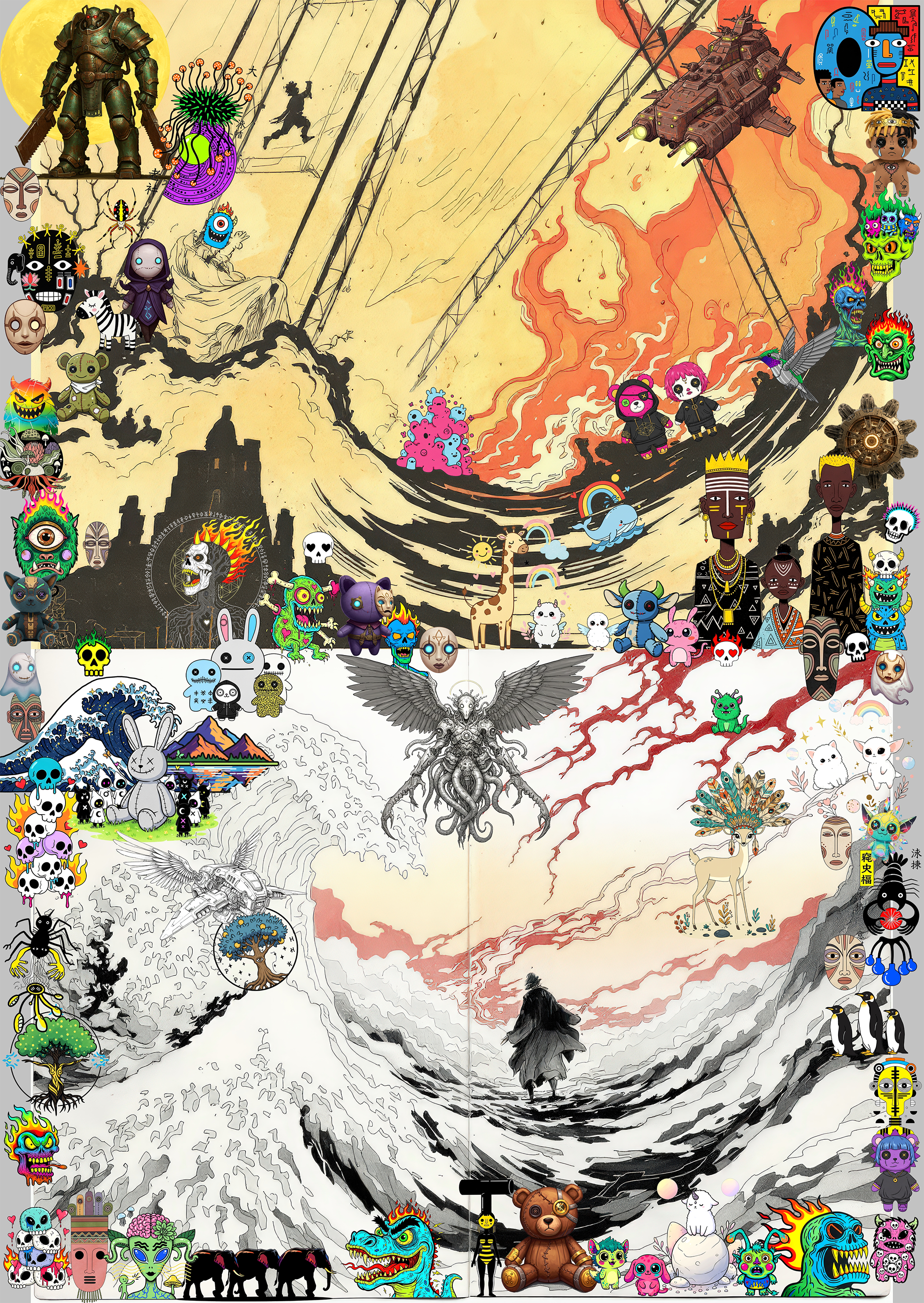
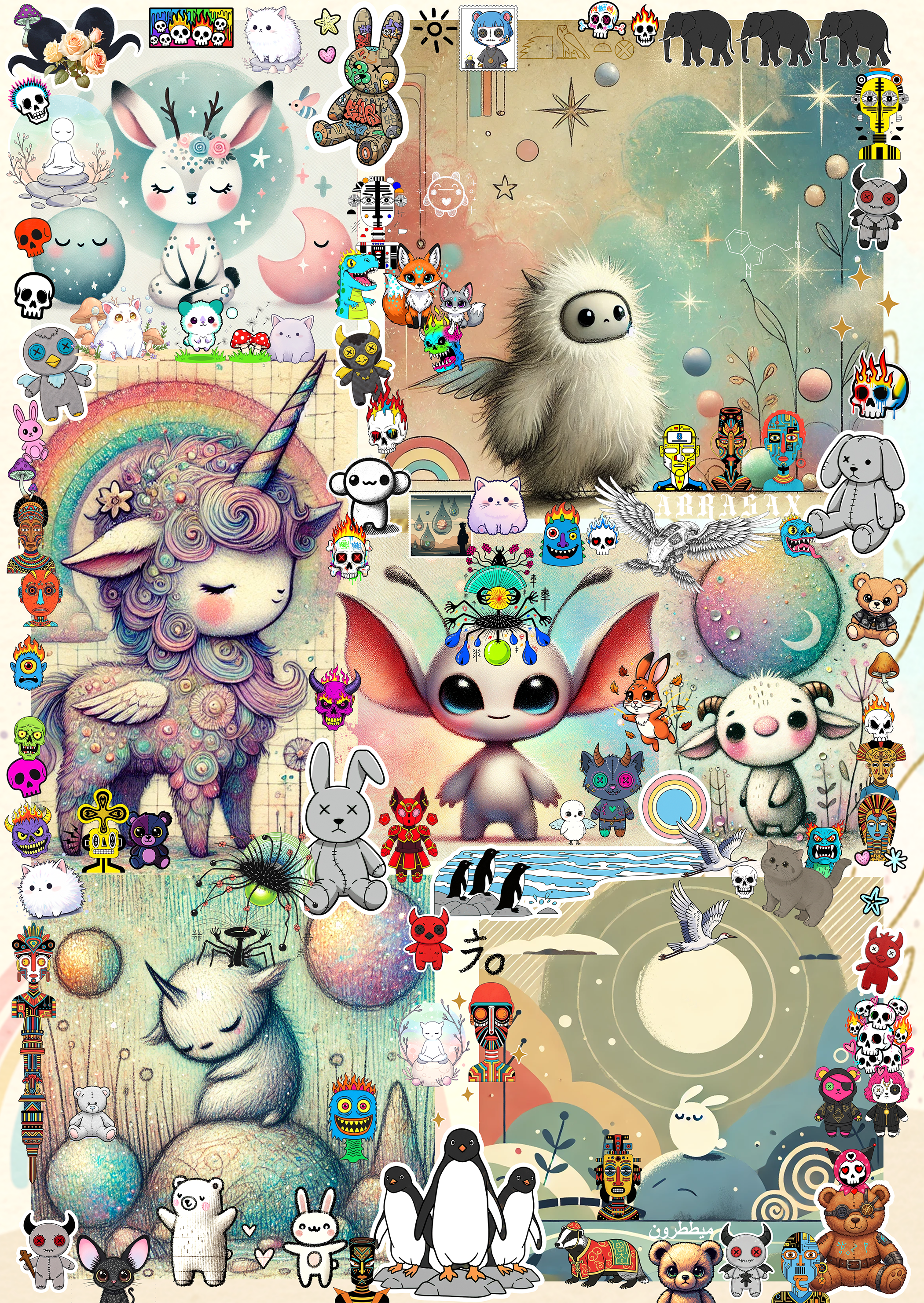
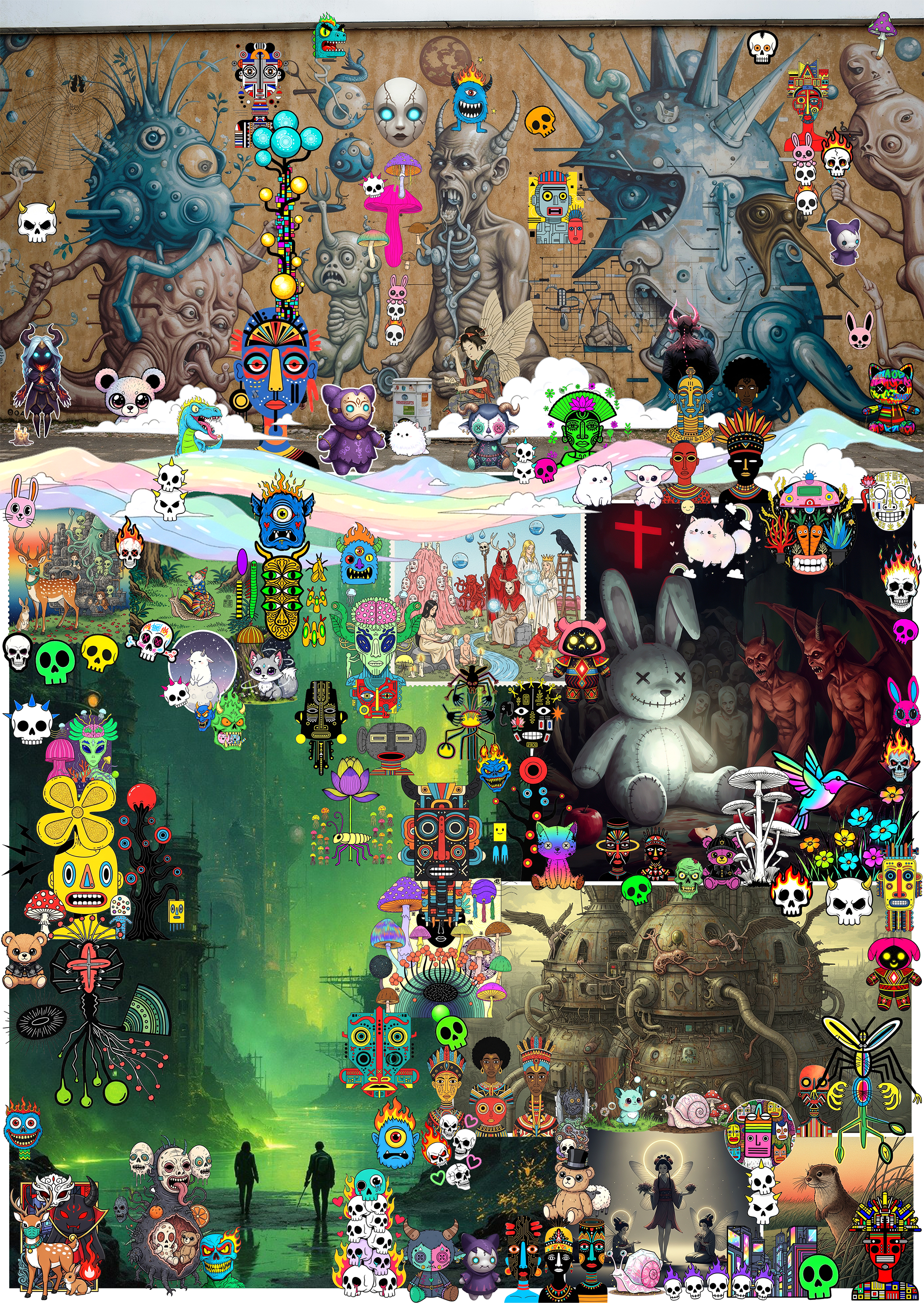
The Algorithmic Bestiary: A Totem Atlas is a sequence of AI-assisted digital collages that treats the internet’s visual culture as a living myth-space. Each work functions like a “field plate” from an imagined anthropology: a crowded ecology of totems, cute, grotesque, sacred, commercial, ancestral, coexisting inside the same frame. The compositions stage a recurring journey through thresholds (fire/ice), guardians (moon-turtle oracle), angels and demons of attention (skull-rose swarms), ruins of public space (graffiti temple), and the archive itself (a stratified wall of scenes). What looks like chaos is structured as a system: repetition, motif migration, and visual contagion. The series asks how algorithmic image systems reshape memory, innocence, violence, and spiritual symbolism, especially within a South African/postcolonial context where images carry both enchantment and injury.
DXARTS relevance: This project treats AI image systems as cultural infrastructure, using collage, worldbuilding, and visual taxonomy to study how algorithmic media reshapes perception, memory, and symbolic life. It can expand into interactive archives, installation, and participatory storytelling.
-
![]()
Method: AI-assisted collage, selection-as-authorship, narrative compositing
Source-generation: diffusion-based image generation + artist-directed prompt cycles to produce “specimens” (characters, masks, icons, landscapes).
Curation as authorship: I treat selection, omission, and grouping as the primary creative act—like editing a documentary from an overwhelming archive.
Compositing & continuity: Photoshop cut-outs, masking, scale logic, lighting harmonization, color grading, and spatial layering to create a coherent “world” inside each plate.
Motif system: recurring symbols (skulls, roses, moon, waves, ancestral faces, toy-like beings) act as narrative anchors that migrate across images.
Iterative critique loop: each plate is revised through multiple passes to strengthen legibility, rhythm, and emotional tone (comic → sacred → ominous → tender).
Output: print-ready digital works + a developing “story bible” that can expand into interactive/installation formats.
-
![]()
Motifs (recurring symbols)
Skulls: memento mori + “data death” (what the internet keeps and what it erases)
Roses/flowers: beauty under pressure; grief with decoration
Moon/water/waves: memory, dream logic, emotional time
Ancestral faces/masks: lineage, cultural memory, the ethics of representation
Cute creatures/toys: innocence as a technology of survival; soft resistance
Urban ruins/graffiti: South African public space as archive and battleground
-
![]()
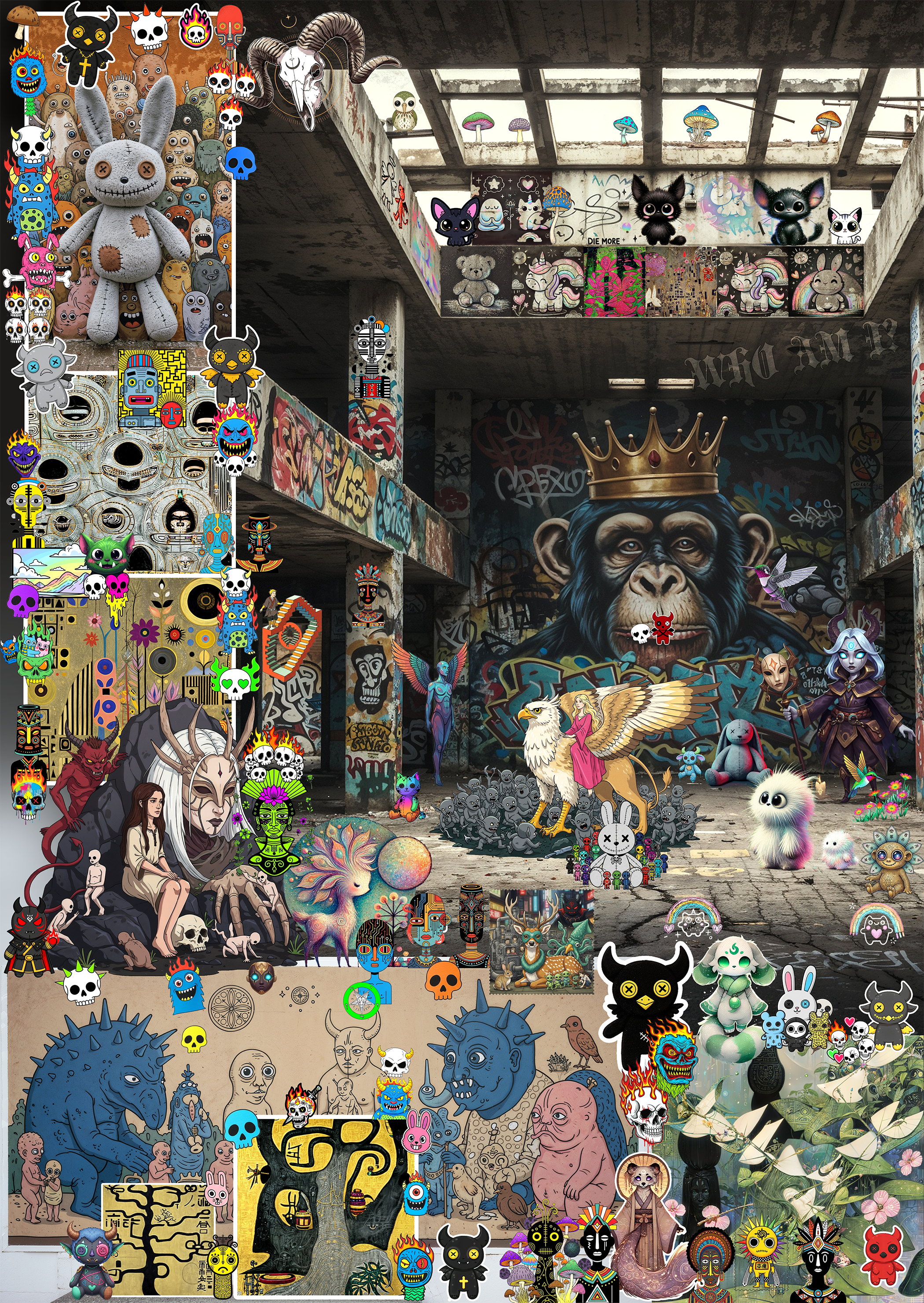
The Graffiti Temple
A ruined urban interior becomes a shrine: a crowned figure, scattered relics, and small beings colonizing abandoned architecture. Public space is shown as both threat and playground—an ecosystem where power, innocence, and surveillance overlap. The collage reads like a documentary still from a city that has turned into myth.
-
![]()
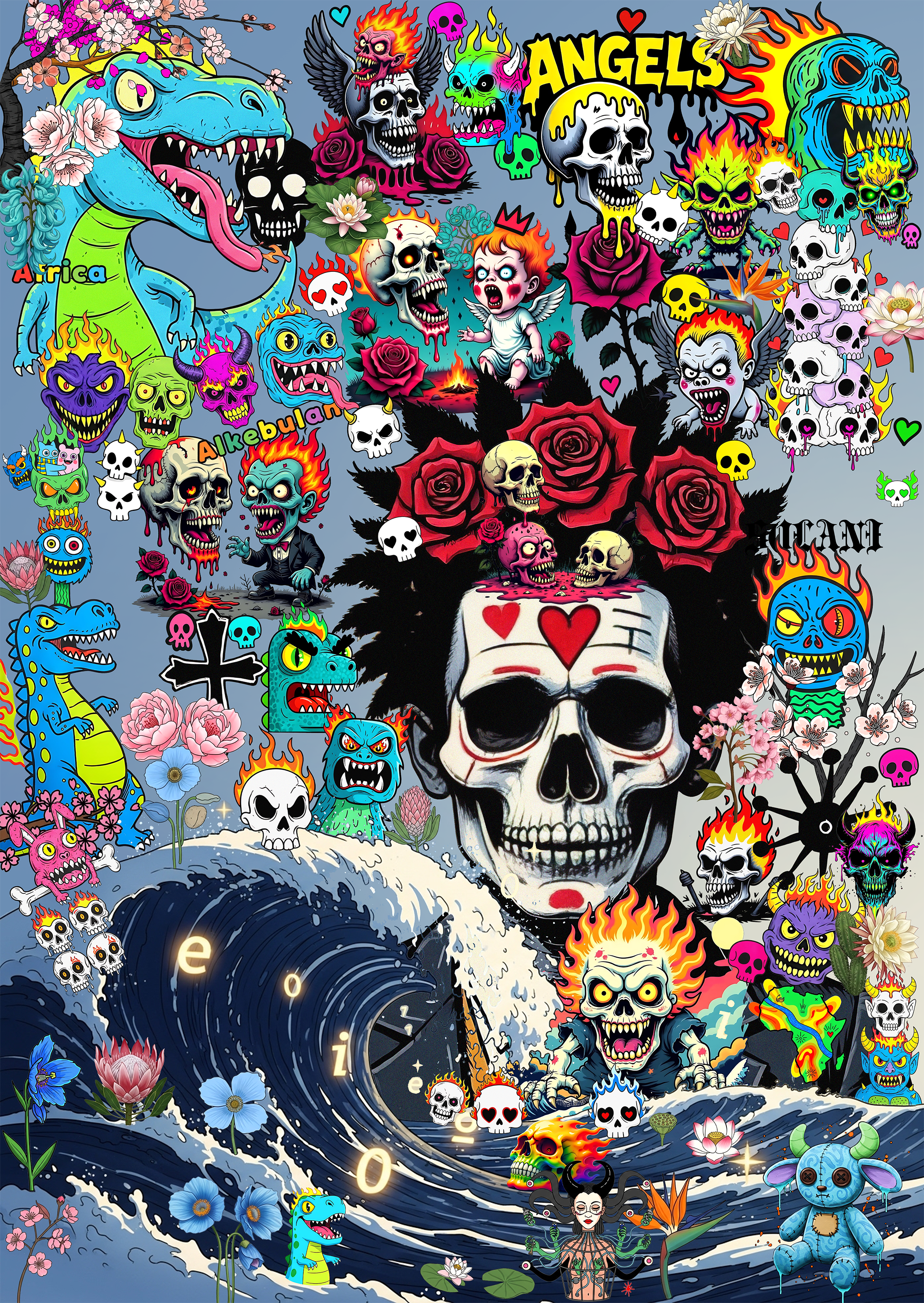
Angels of Noise
A delirious congregation of skulls, roses, flames, and cartoon faces. This is the attention economy rendered as religious iconography—devotion, hysteria, comedy, and terror braided together. The work asks: what do we worship when images never stop arriving? What becomes “holy” inside a feed?
-
![]()
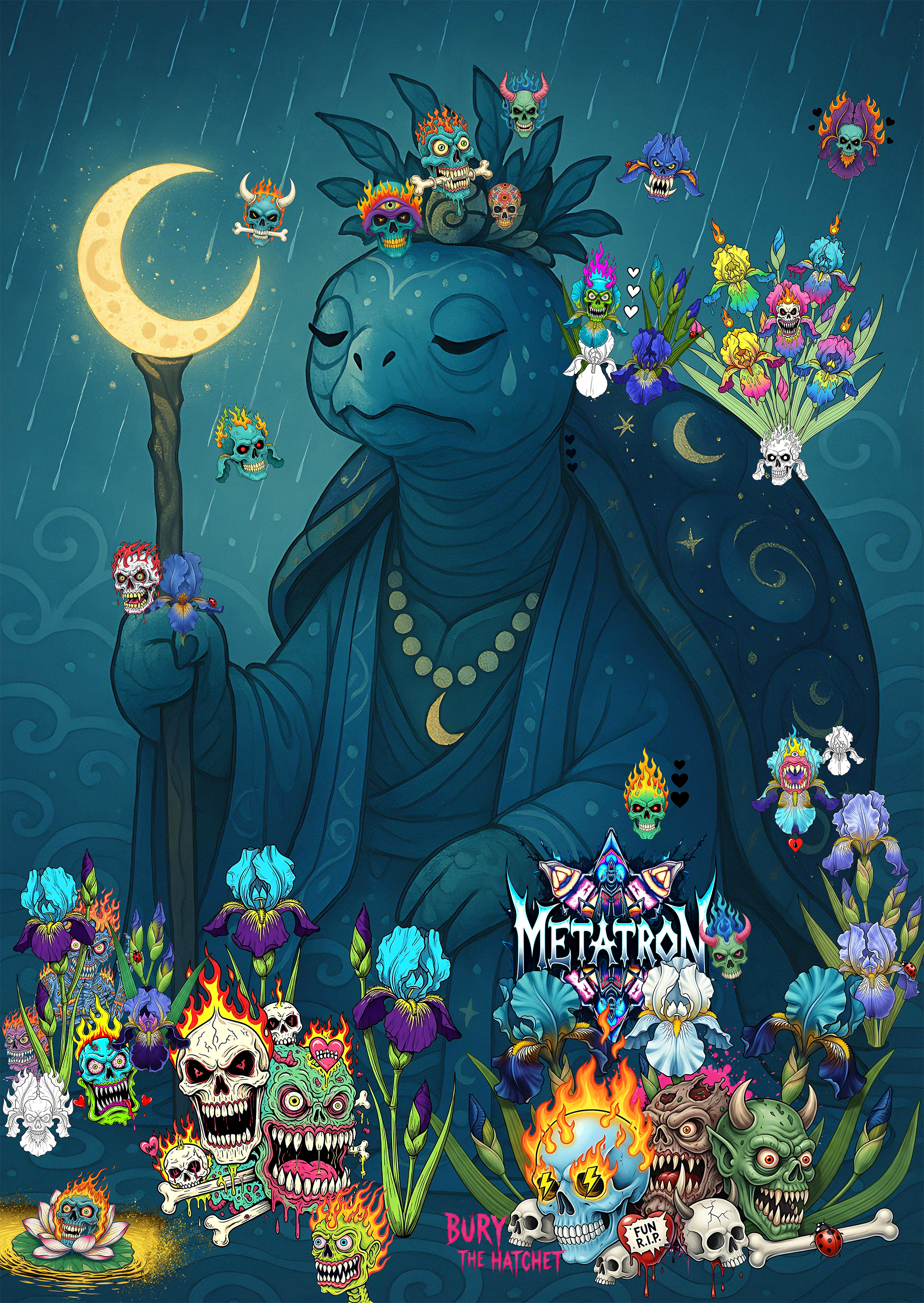
The Moon Oracle
A quiet guardian holds a crescent staff while a swarm of small spirits gathers like thoughts around a single body. The work frames the “bestiary” not as horror, but as a tenderness: grief, protection, and weird beauty occupying the same space. The moon becomes a navigation device—a soft technology for crossing the night.
The Liturgy of the Machine
-
![]()
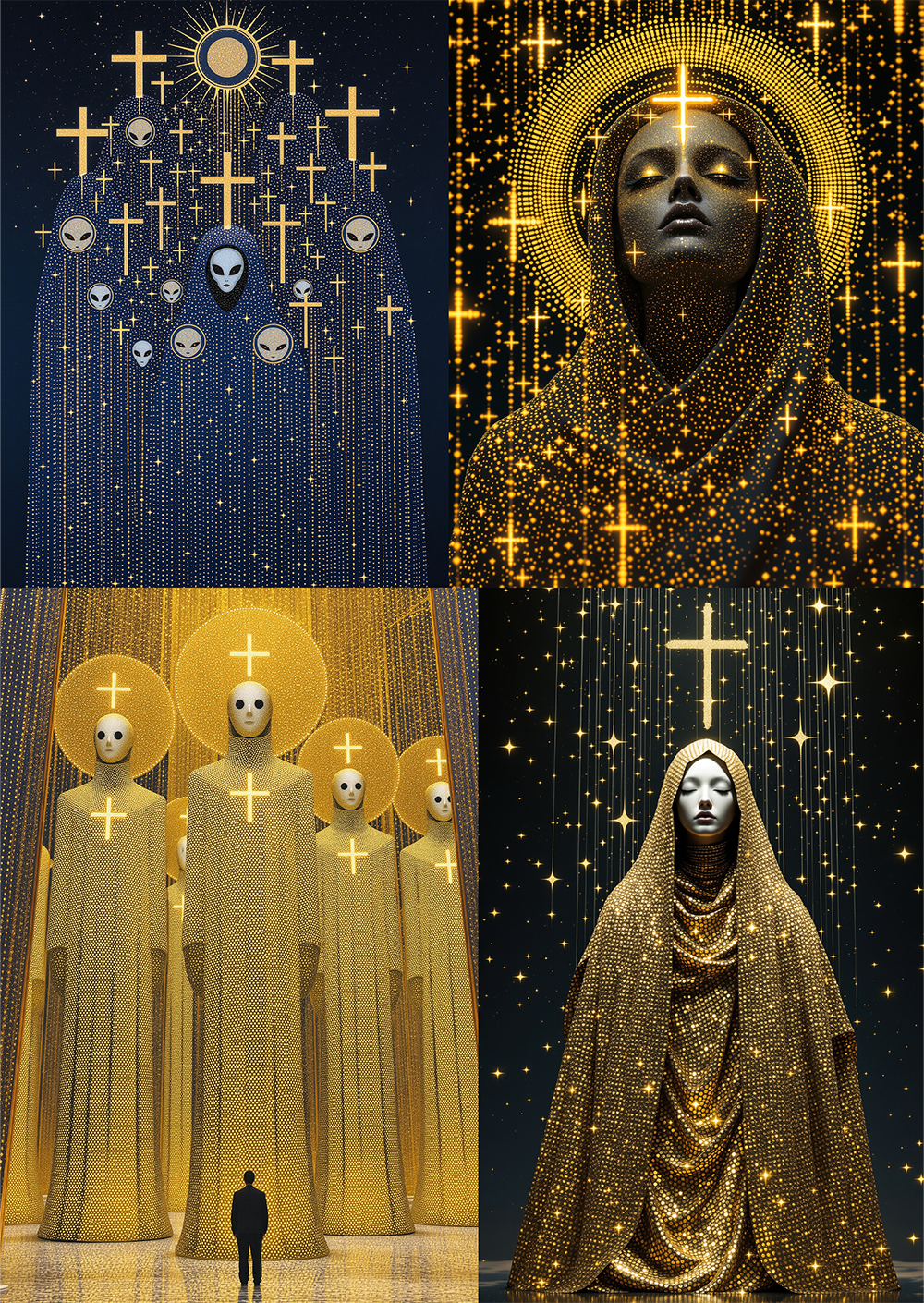
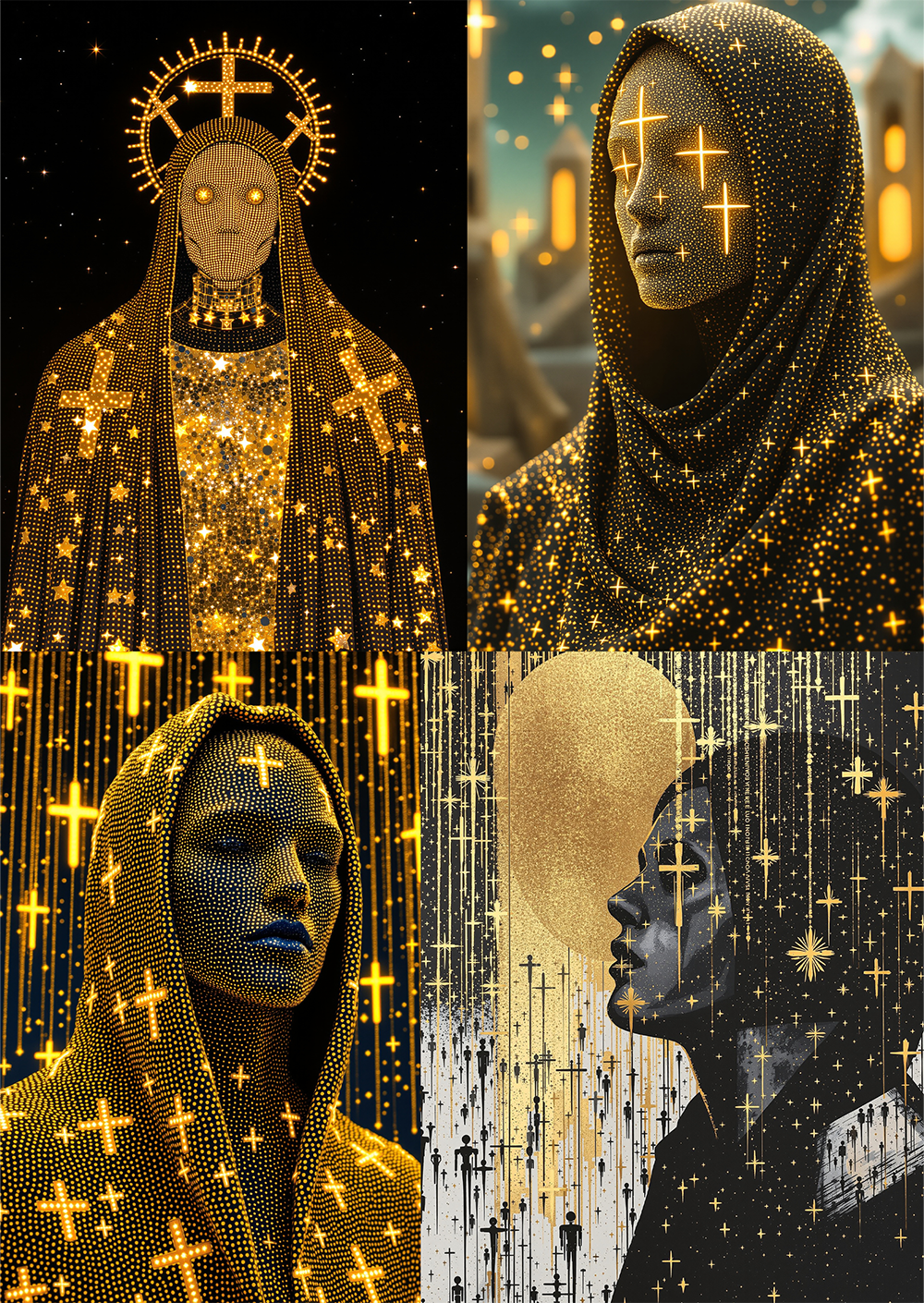
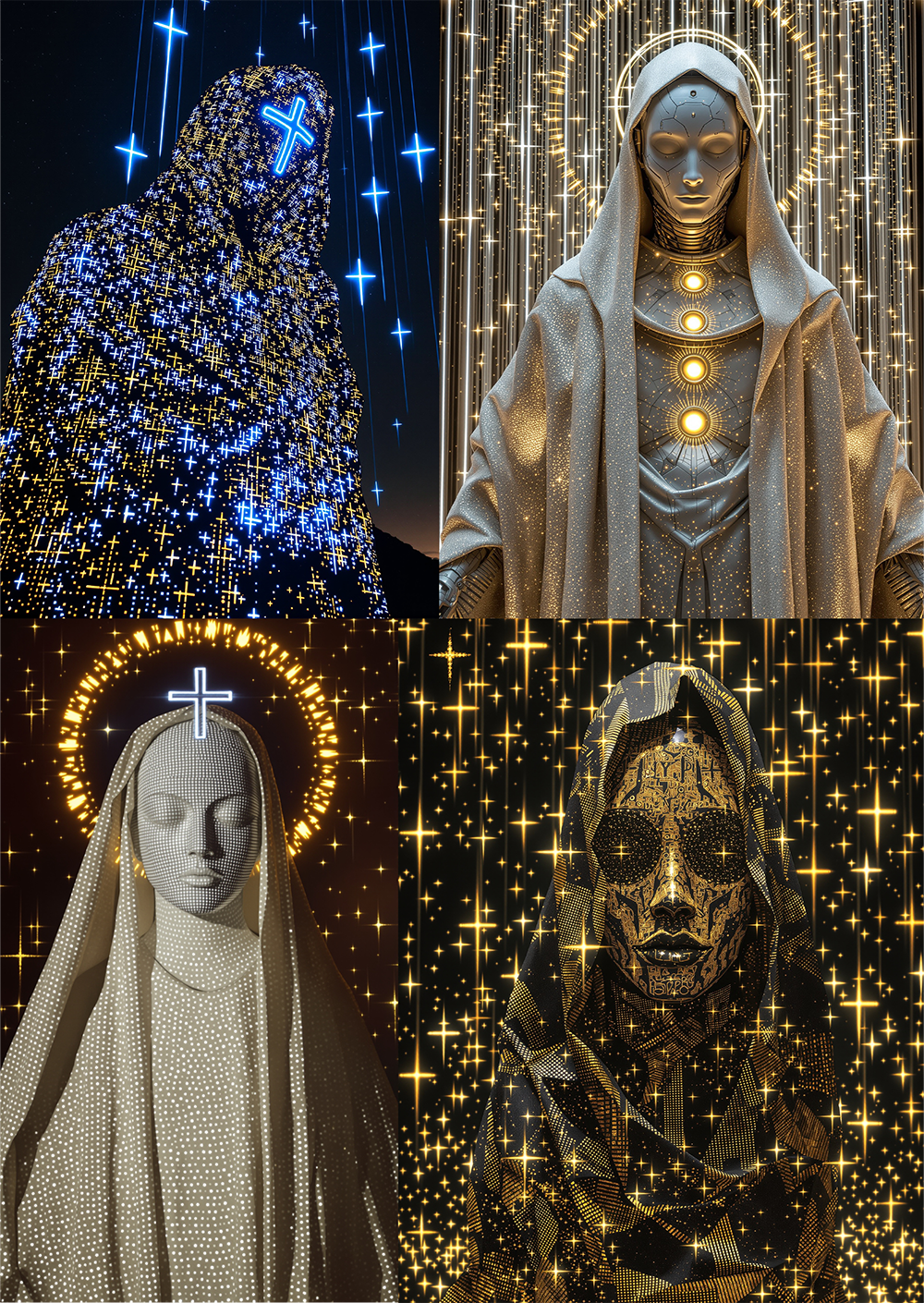
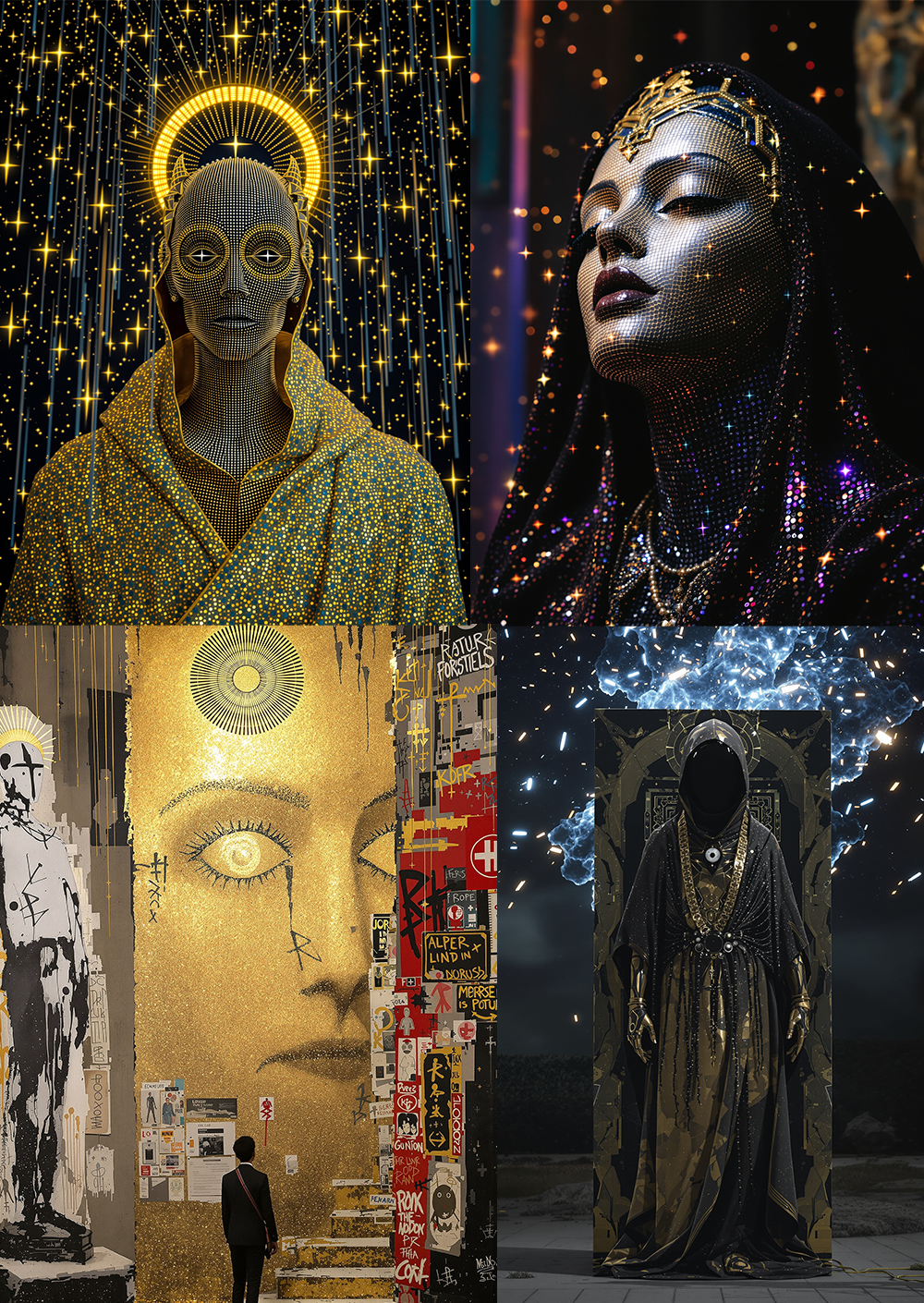
Saints of the Signal is a series of AI-assisted icon-images that remixes religious visual grammar, halos, veils, crosses, procession, gold-leaf radiance, into a contemporary vocabulary of networks, masks, and synthetic bodies. The figures are not “religion” in the devotional sense; they are interfaces for belief: witnesses to how authority and comfort are manufactured through light, repetition, and spectacle. The work sits in tension: sanctity versus surveillance, tenderness versus dogma, salvation versus branding. By staging techno-hooded saints, faceless congregations, and radiant voids, the series asks what we will call holy when images are generated at scale, and what kinds of power return disguised as beauty.
DXARTS relevance: This series treats iconography as a media system, testing how generative image tools, aesthetic repetition, and symbolic design manufacture belief, authority, and emotional regulation in contemporary culture.
-
![]()
Method: AI-assisted iconography + compositing + “ritual design”
Icon research: studying visual codes of sanctity (halo geometry, gold illumination, veiling, frontal portraiture, procession).
Generative iteration: prompt-cycles to produce “saint variants,” masks, robes, city-thresholds, and starfield/cross atmospheres.
Authorial selection: curating outputs as if casting roles—choosing facial affect, distance, stillness, and symbolic density.
Photoshop compositing: collage-assembly of figures, backgrounds, halos, and particle fields; scale calibration; tonal unification; gold/blue palette control.
System consistency: repeatable motif rules (cross-as-signal, halo-as-interface, veil-as-filter, gold-as-authority).
Output: print-ready icon plates + a developing “ritual toolkit” (motif dictionary + compositional templates).
-
![]()
Motifs (what repeats and why)
Halo / aureole: not holiness—an attention device (a UI for reverence).
Veil / hood: filtering (identity masked; power protected; grief contained).
Crosses as particles: belief as network signal; faith as data pattern. B
Gold field: authority, wealth, spectacle; the seduction of certainty.
Faceless congregations: institutions without intimacy; belonging without personhood.
City / skyline: the modern cathedral; where control and desire converge.
-
![]()
Procession of the Faceless
Tall, identical forms with halo-discs and cross marks gather like a corporate clergy. A small human figure anchors scale and vulnerability. The scene is not dystopia for its own sake; it’s a question of proportion: what happens to the individual inside the monumental aesthetics of certainty?
-
![]()
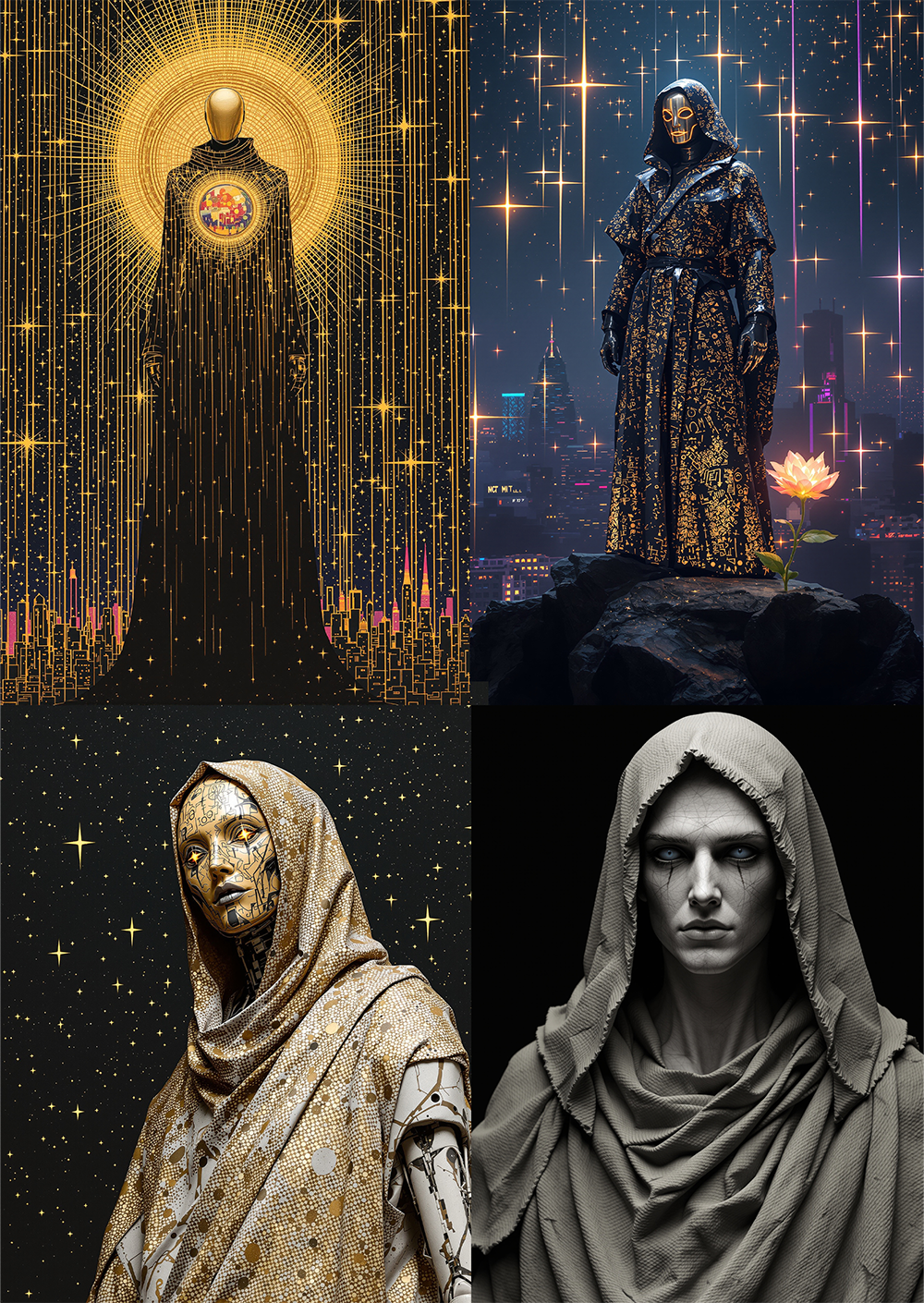
City Guardian / Lotus Threshold
A robed figure stands against a night city as gold particles fall like coded rain; a single flower glows nearby. The plate introduces the possibility of tenderness inside the system—beauty not as domination, but as a fragile alternative. It’s a threshold image: witness, resistance, and care.
-
![]()
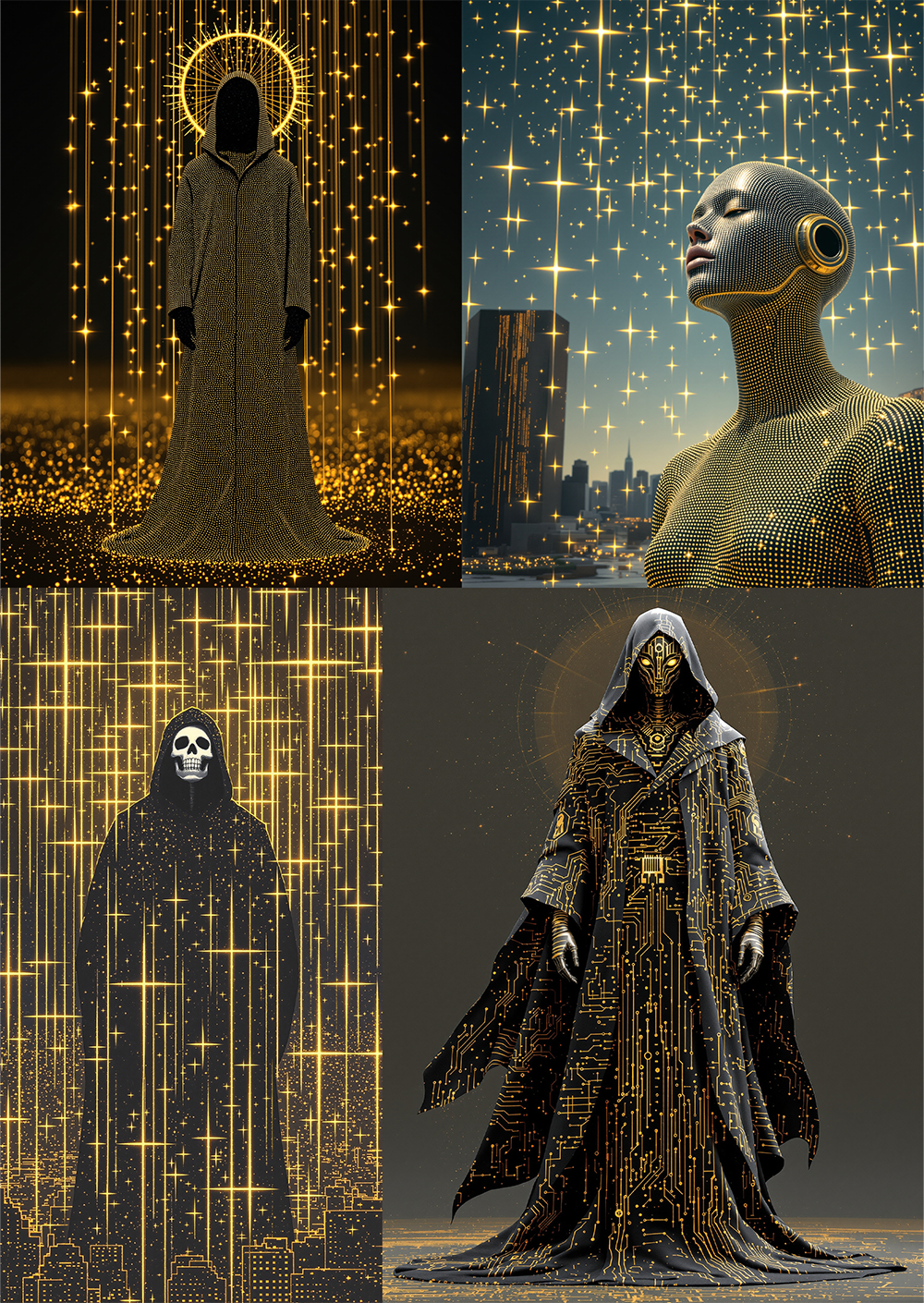
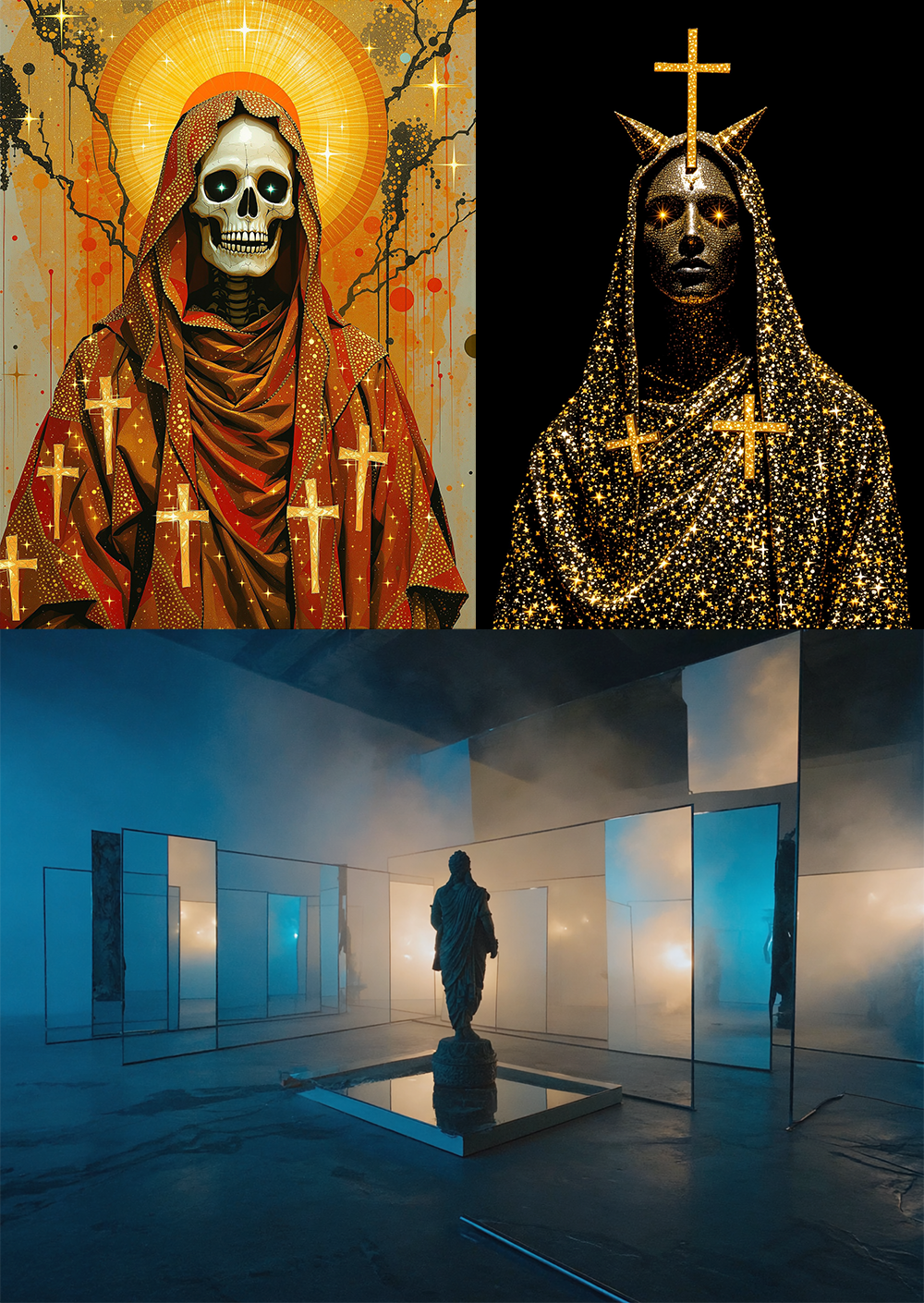
Death in the Lightfield
A skull-faced robe appears as a clean silhouette within gold grids, memento mori meets interface design. This work punctures the glamour: behind the “sacred UX” of images, mortality and violence remain. It reframes the icon tradition as a confrontation with what systems prefer to hide.
-
![]()
-
![]()
Xeno-Topographies: Field Notes from the Far Archive
-
![]()
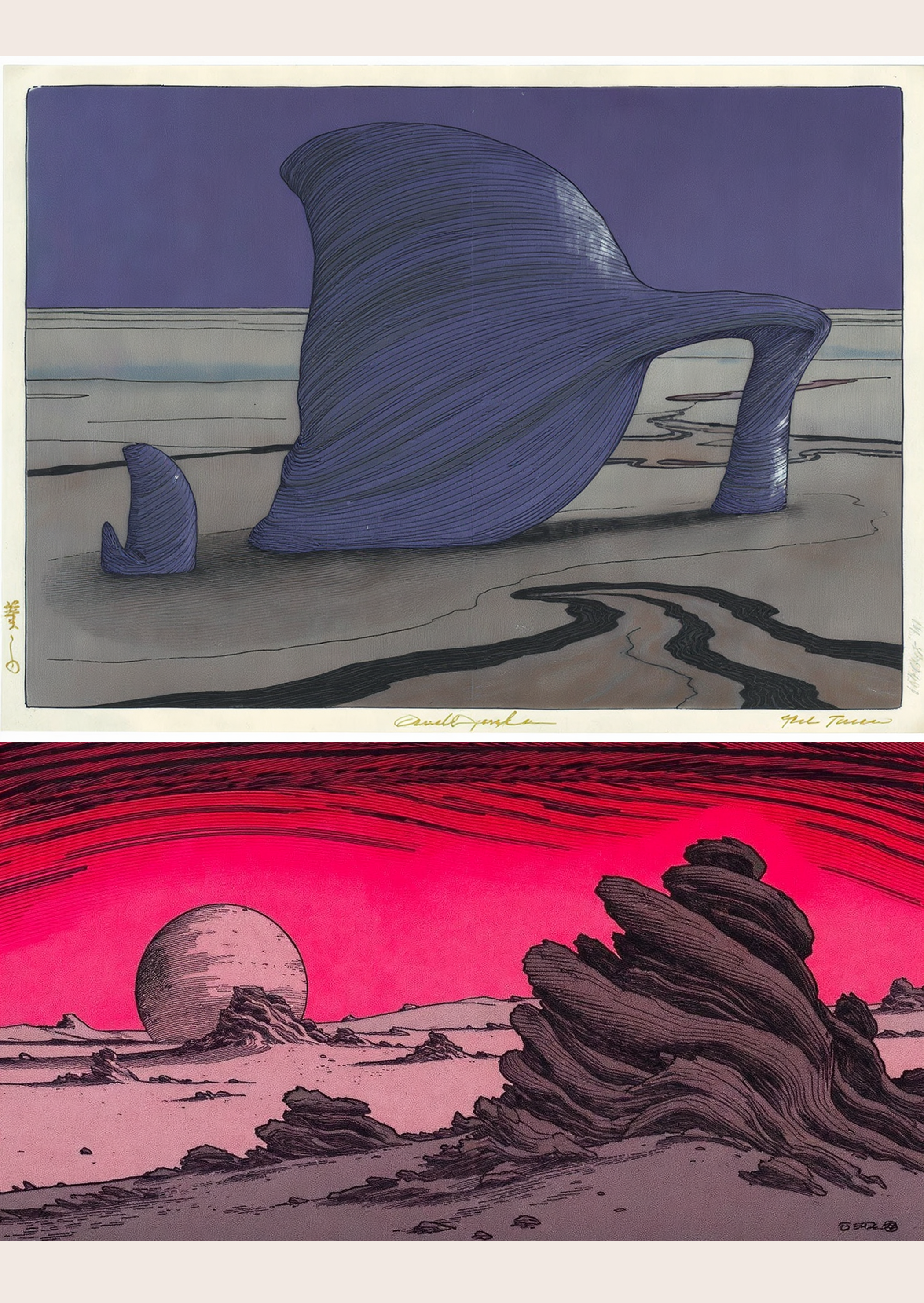
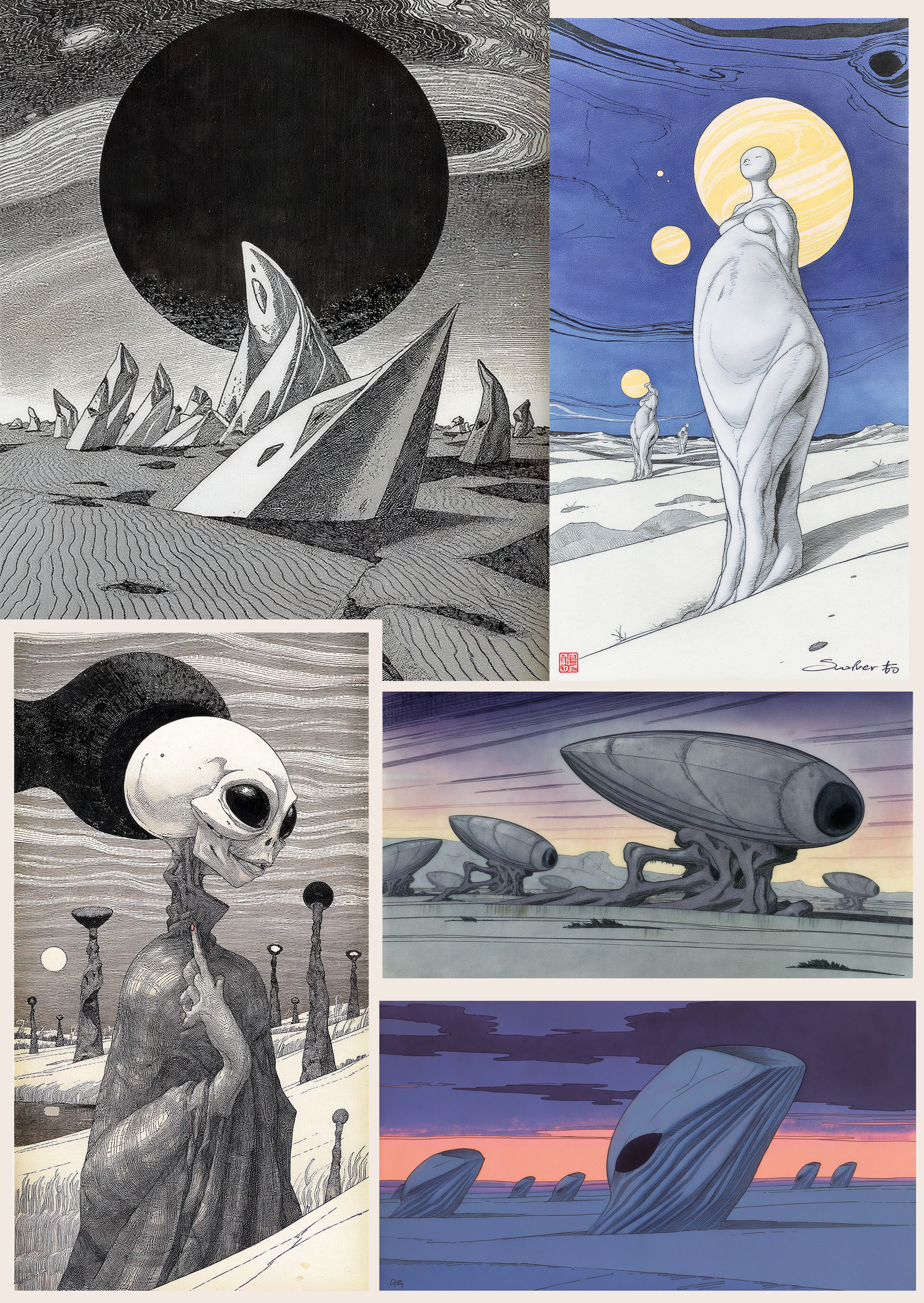
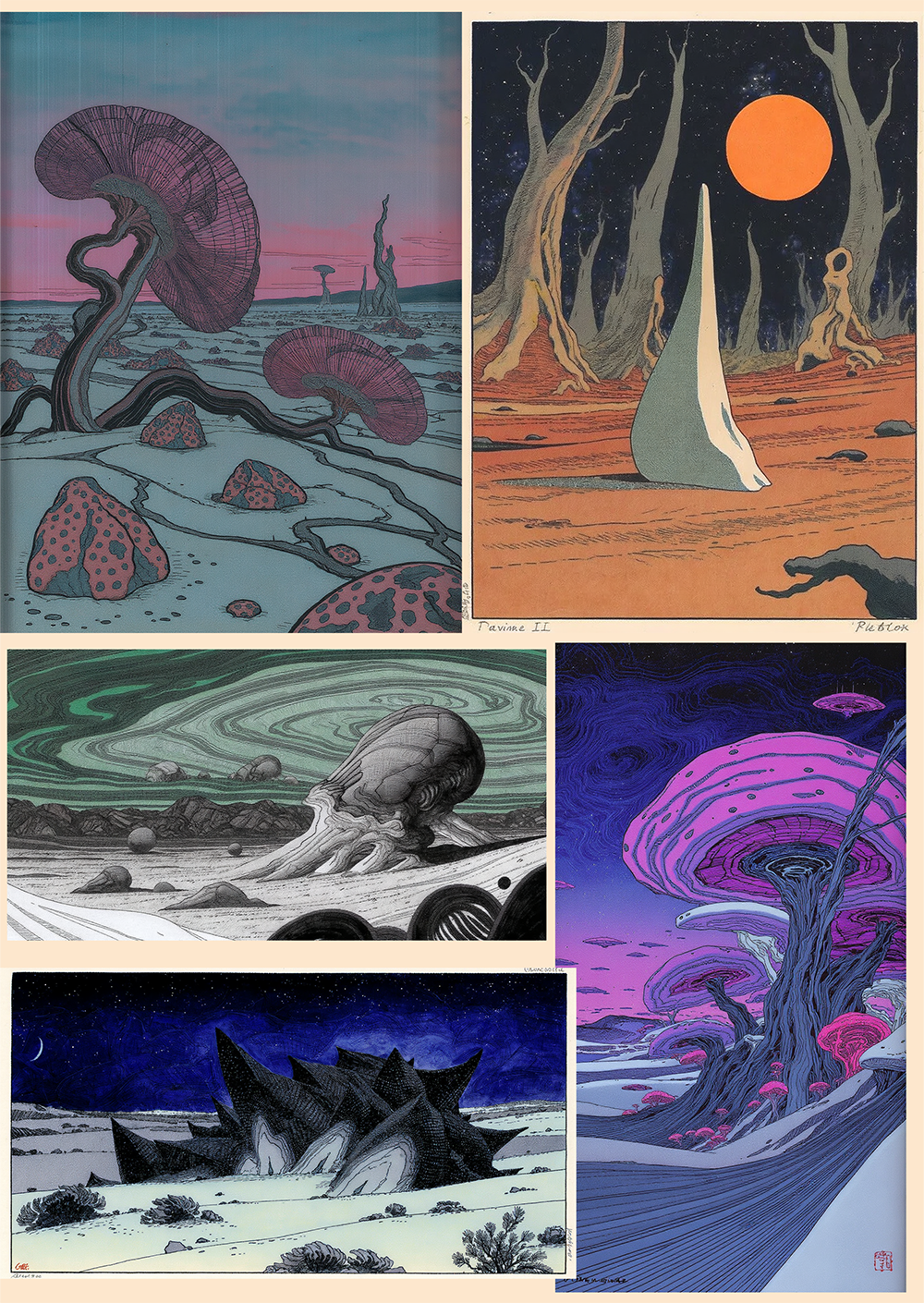
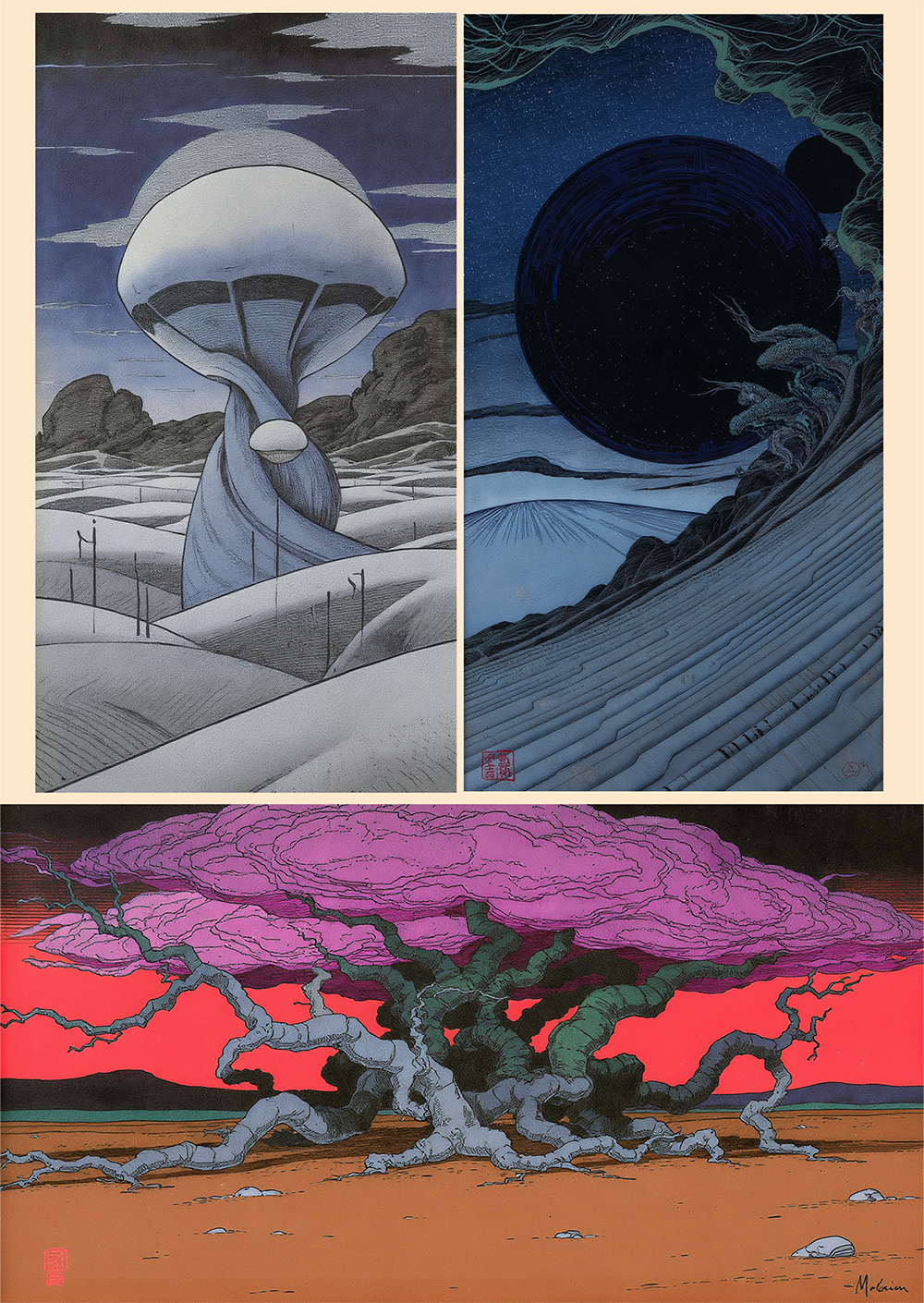
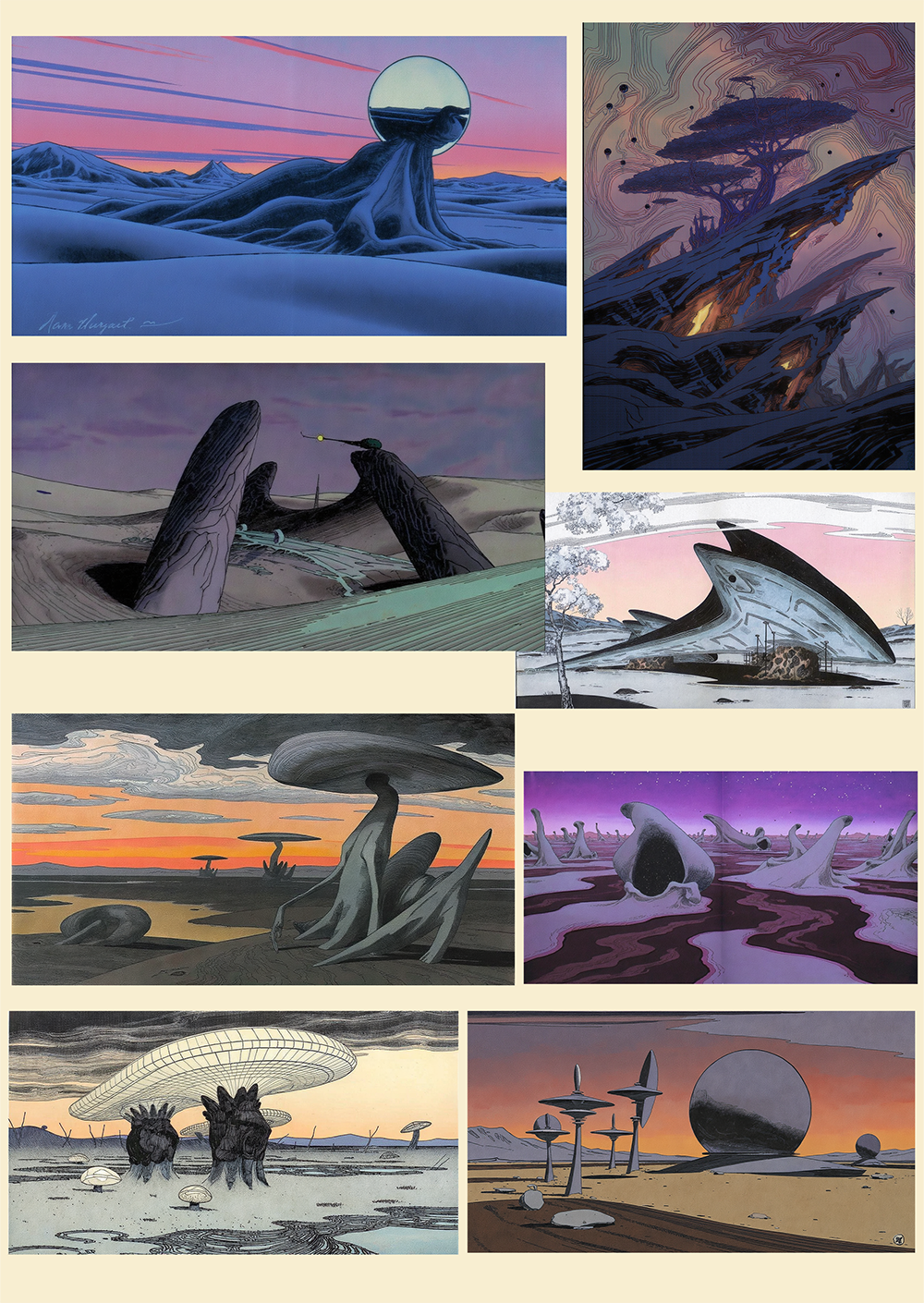
Xeno-Topographies: Field Notes from the Far Archive is a series of AI-assisted, hand-edited image plates that treat the landscape as an archive, a place where history becomes geology and belief becomes architecture. Each plate functions like a “specimen slide”: dunes inscribed with grids, monoliths wrapped like relics, mushroom-towers that behave like infrastructure, and black spheres that read as gravitational temples or data-wells. I build these sequences to test a simple research question: what does power look like when it has no human face, only climate, scale, and pattern? The work is intentionally legible (comic-panel logic, repeated motifs, color scripting) while staying uncanny, inviting viewers to read, infer, and complete the narrative.
DXARTS relevance: At the University of Washington, I want to prototype this as an interactive atlas/installation: viewers navigate plates as a living archive (zoomable map, audio field-notes, responsive typography), testing how narrative meaning changes when the audience controls scale, sequence, and proximity.
-
![]()
Method: AI image synthesis + iterative prompt-writing + curation as authorship + Photoshop compositing (panel layout, masking, scale corrections) + color scripting + grain/print unification.
Working mode: produce many candidates → select for motif continuity (spheres / monoliths / spore-forms / lone witness) → edit for a consistent visual grammar → sequence into plates that read like a report.
Research-through-making: each plate is a hypothesis about perception, scale, and “reading” images.
Systems thinking: environments behave like interfaces (grids, portals, observatories, infrastructural organisms).
Expandable into installation/interaction: the plates can become a navigable atlas (sound, text, AR, map logic, audience choice).
-
![]()
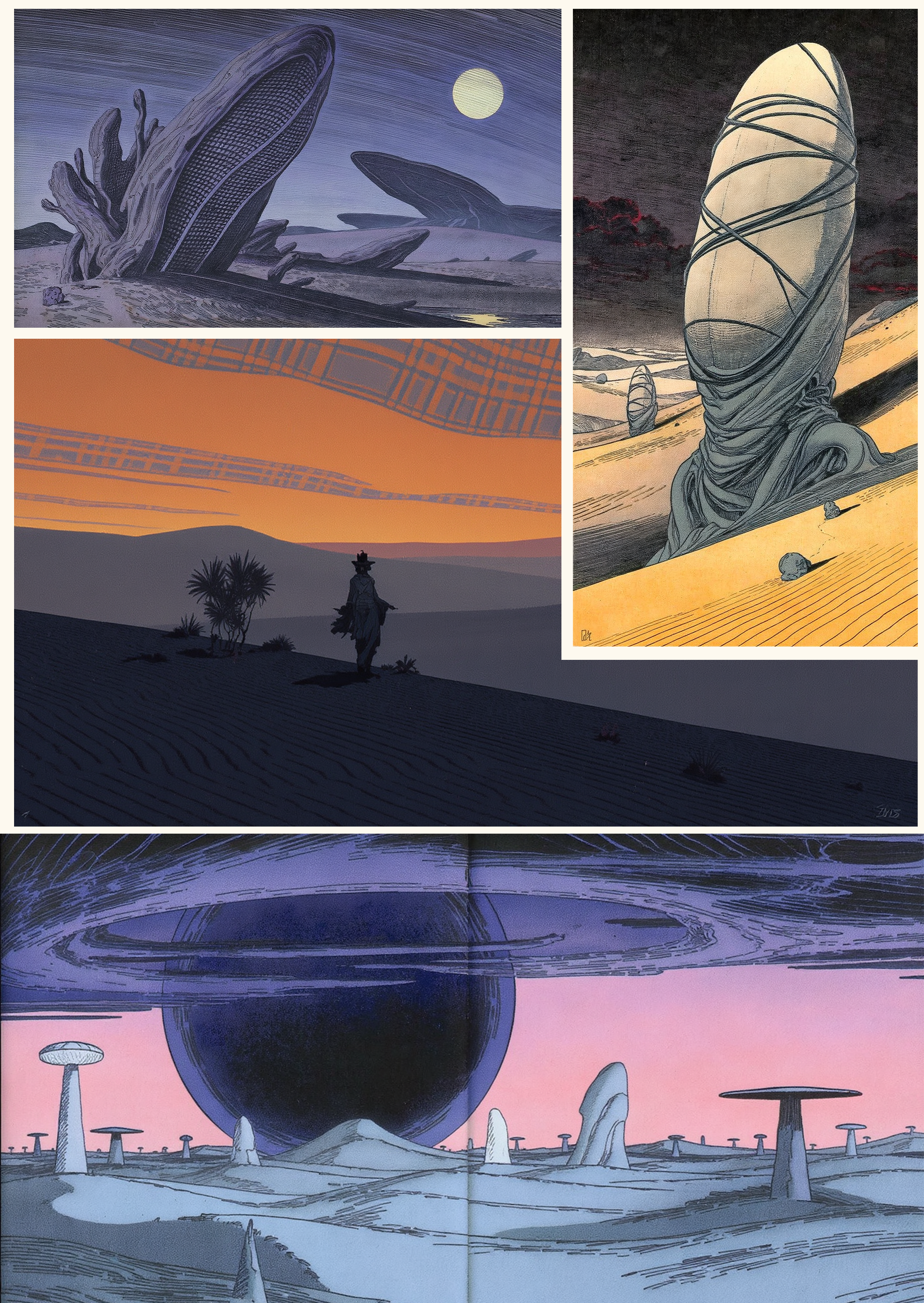
Reliquary Monolith
A wrapped structure: preservation, concealment, and ritual engineering collapse into one form.
-
![]()
Witness Figure
A single body for scale; not a hero, but a measurement tool, proof that the world exceeds us.
-
![]()
The Listening Dunes
A desert that records movement as pattern; the horizon behaves like a memory surface.
-
![]()
Ruin as Interface
Remains of a system whose purpose is unreadable, yet its aesthetics still command belief.
-
![]()
Black Sun Observatory
A gravitational icon that reorganizes the landscape; worship and data storage become indistinguishable.
-
![]()
Cartographic Sky
Grids in the atmosphere: mapping as control, navigation as ideology.
-
![]()
Spore Infrastructure
Mushroom-towers as living architecture: soft tech, ecological networks, distributed intelligence.
-
![]()
-
![]()
Threshold Forms
Objects that look like portals but behave like monuments; entry is promised, never guaranteed.
Spear & Signal: An Afro-Futurist Sentinel Cycle
-
![]()
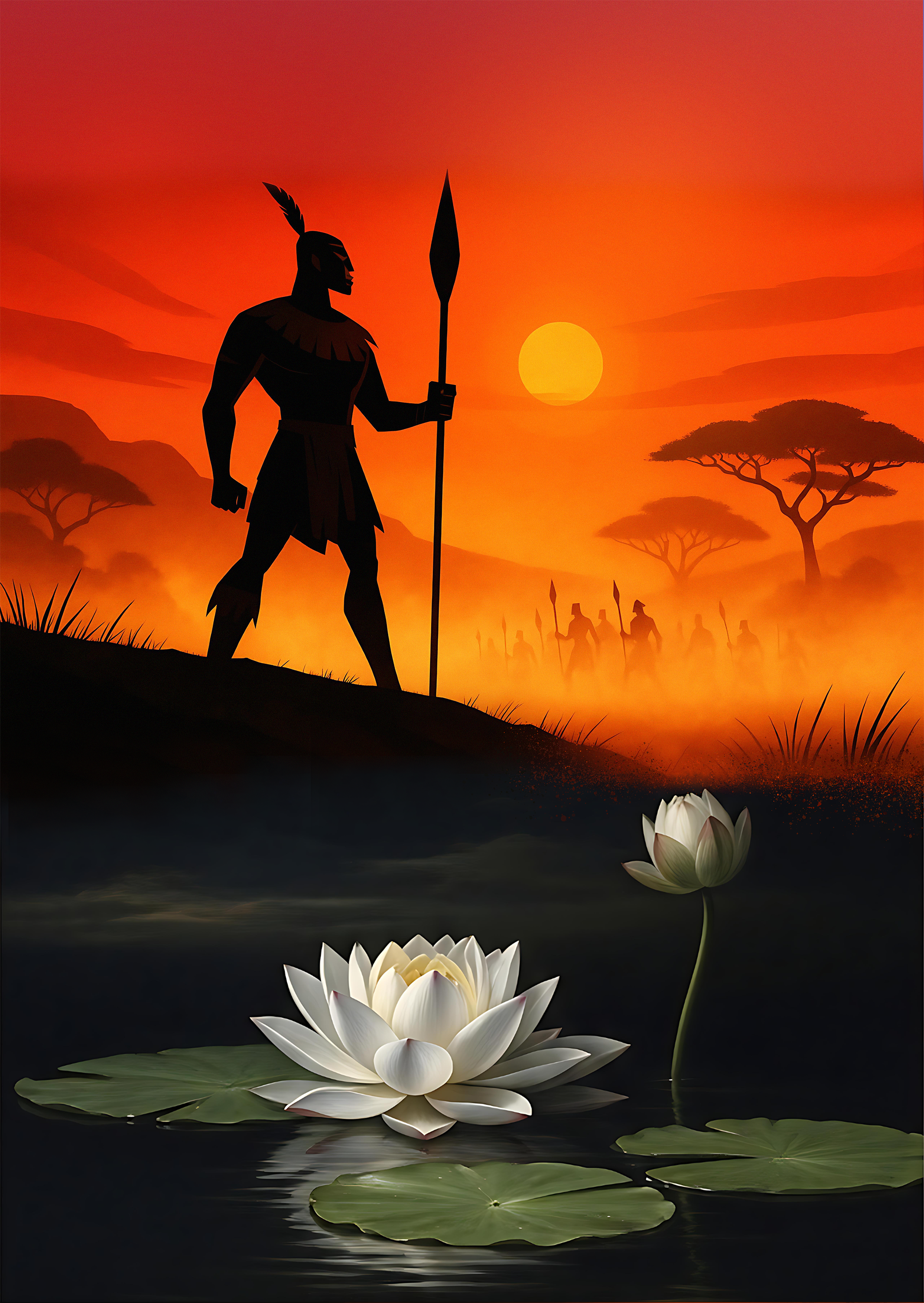
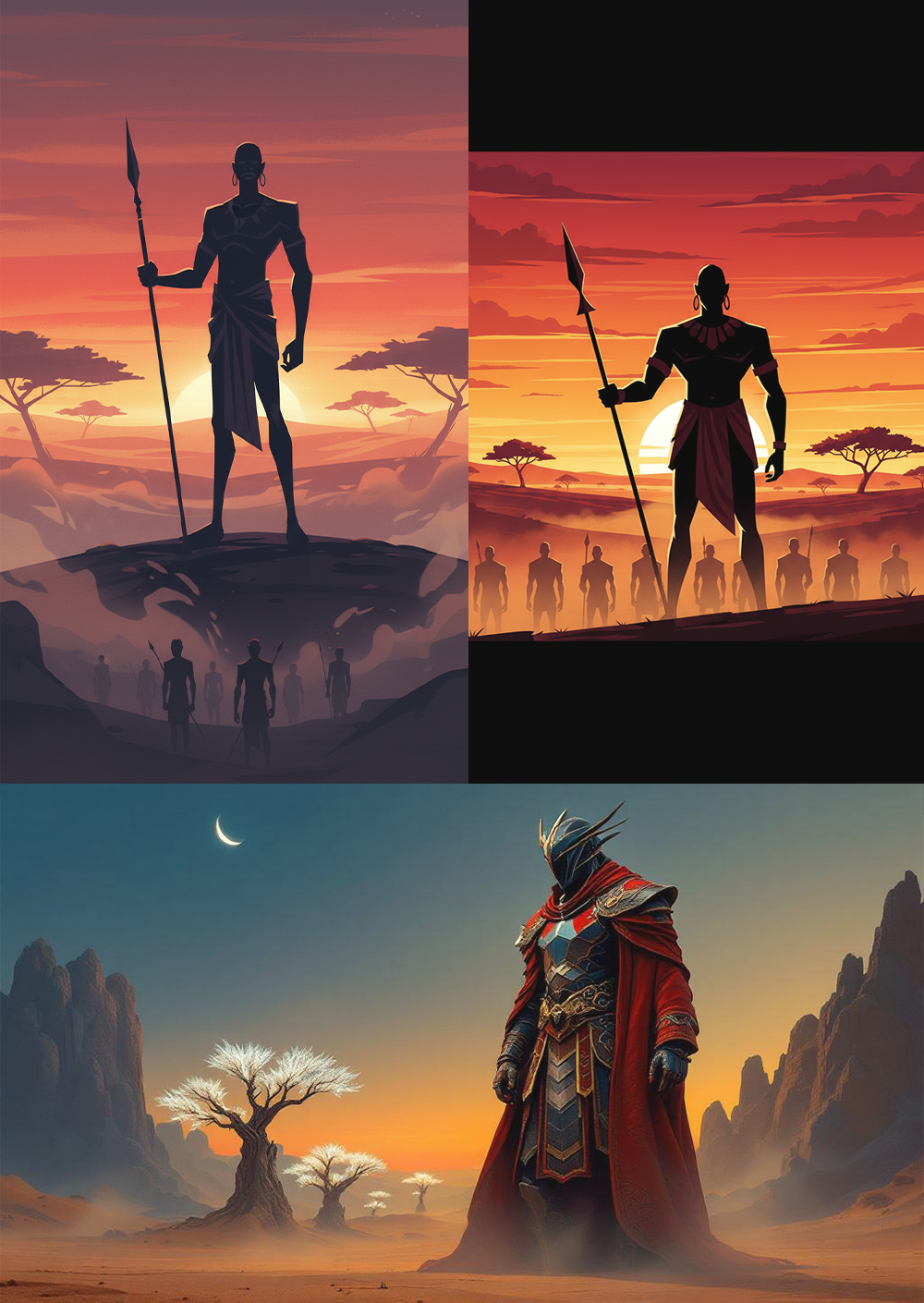
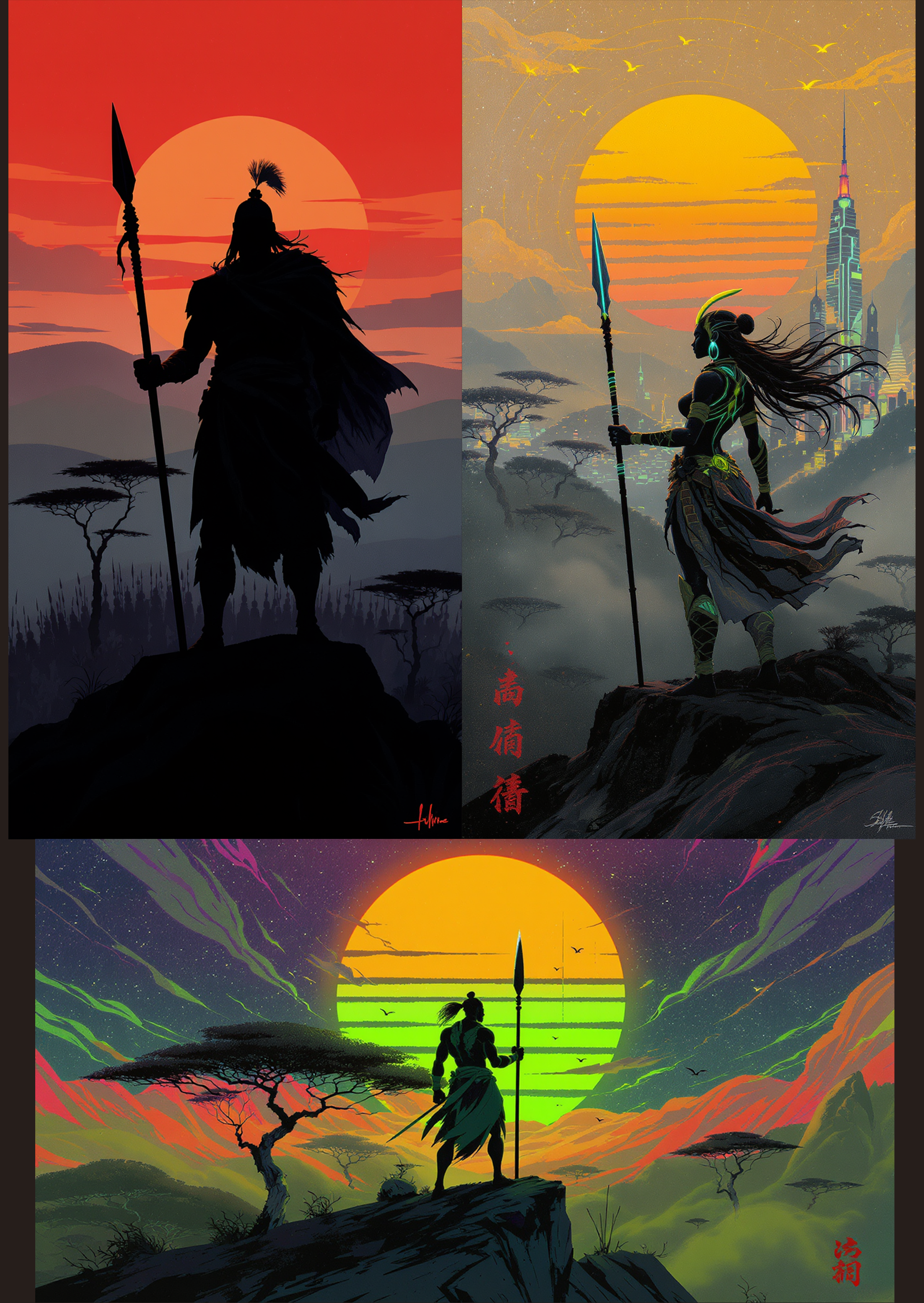
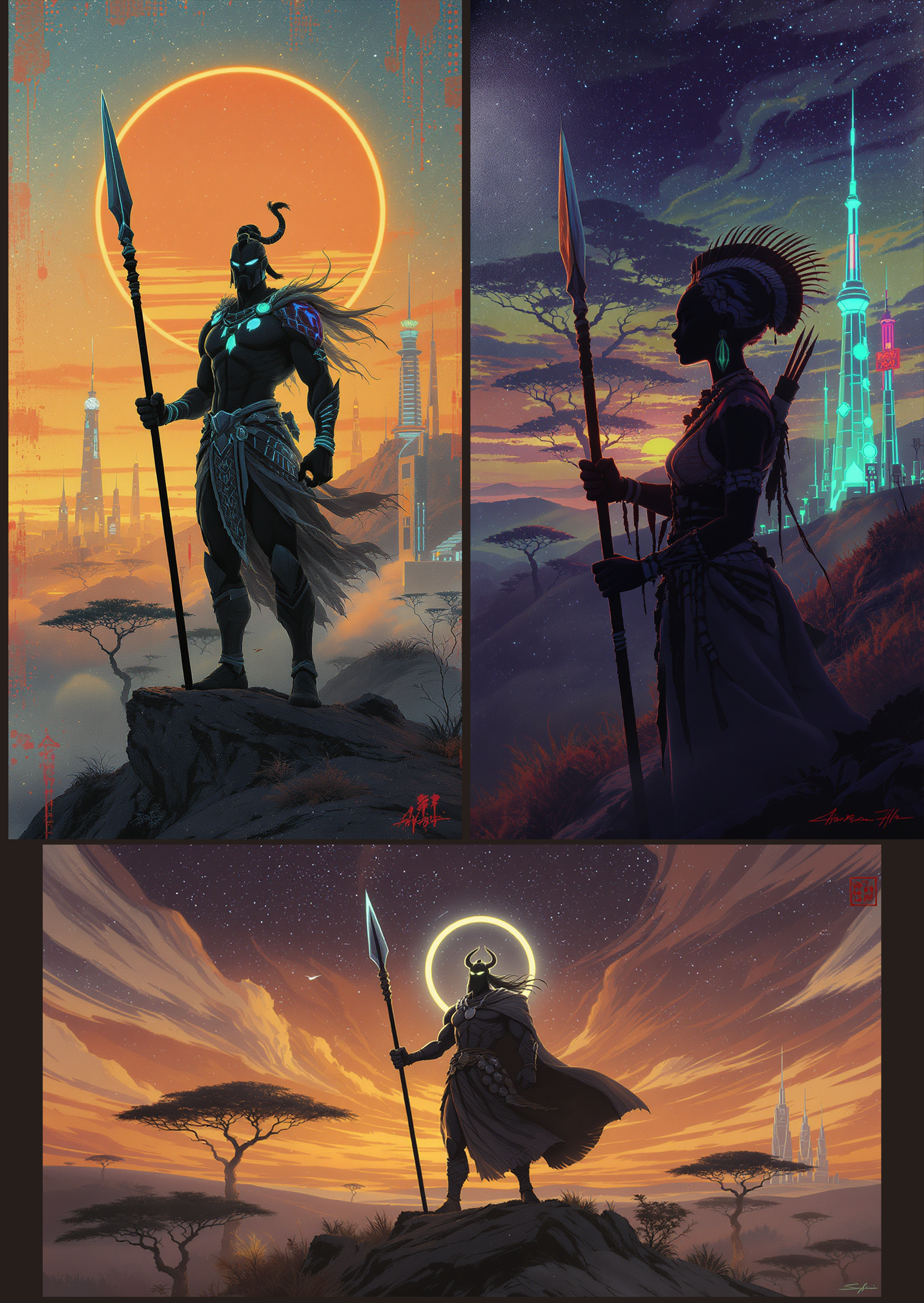
Spear & Signal is a suite of AI-assisted icon-images that reframes the African warrior archetype as a future sentinel, standing at the edge of savannah, desert, and city-temple skylines. The recurring spear becomes an axis of witnessing; the sun becomes a halo; the horizon becomes a threshold between ancestral memory and technological destiny. These figures are less “characters” than interfaces for sovereignty: guardians of land, time, and moral orientation in an era where power is increasingly mediated by spectacle, data, and design. The series holds a deliberate tension, ritual vs. circuitry, silence vs. propaganda, tenderness vs. force, asking what protection, leadership, and dignity look like when tradition and futurity must share the same sky.
-
![]()
Method: AI-assisted concept illustration + variant iteration + cinematic grading
Visual research: African silhouette language (spear, shield, plume), savannah topology, heroic staging, sunset atmospheres, and Afrofuturist city cues.
Generative iteration: prompt-cycles producing sentinel variants (pose, armor, textile, skyline, halo/sun disc, dust/fog).
Authorial selection: curating outputs like casting—choosing stillness, authority, distance, and symbolic clarity.
Compositing + finishing: tonal unification, silhouette control, rim-light discipline, and palette consistency (ember/orange, dusk violet, teal/neon accents).
System consistency: repeatable motif rules (spear-as-axis, sun-as-halo, acacia-as-root, skyline-as-cathedral, dust-as-history).
-
![]()
Motifs (what repeats and why)
Spear: axis / boundary marker / moral direction (a tool that reads as a symbol).
Sun disc / halo: authority + radiance + mythic scale (power made visible).
Acacia silhouettes: rootedness, endurance, ancestral continuity.
City-temple skyline: the modern cathedral—desire, control, ambition, destiny.
Dust / fog / haze: history in the air; time made atmospheric.
Lotus (rare, crucial): tenderness and renewal inside the warrior grammar.
-
![]()
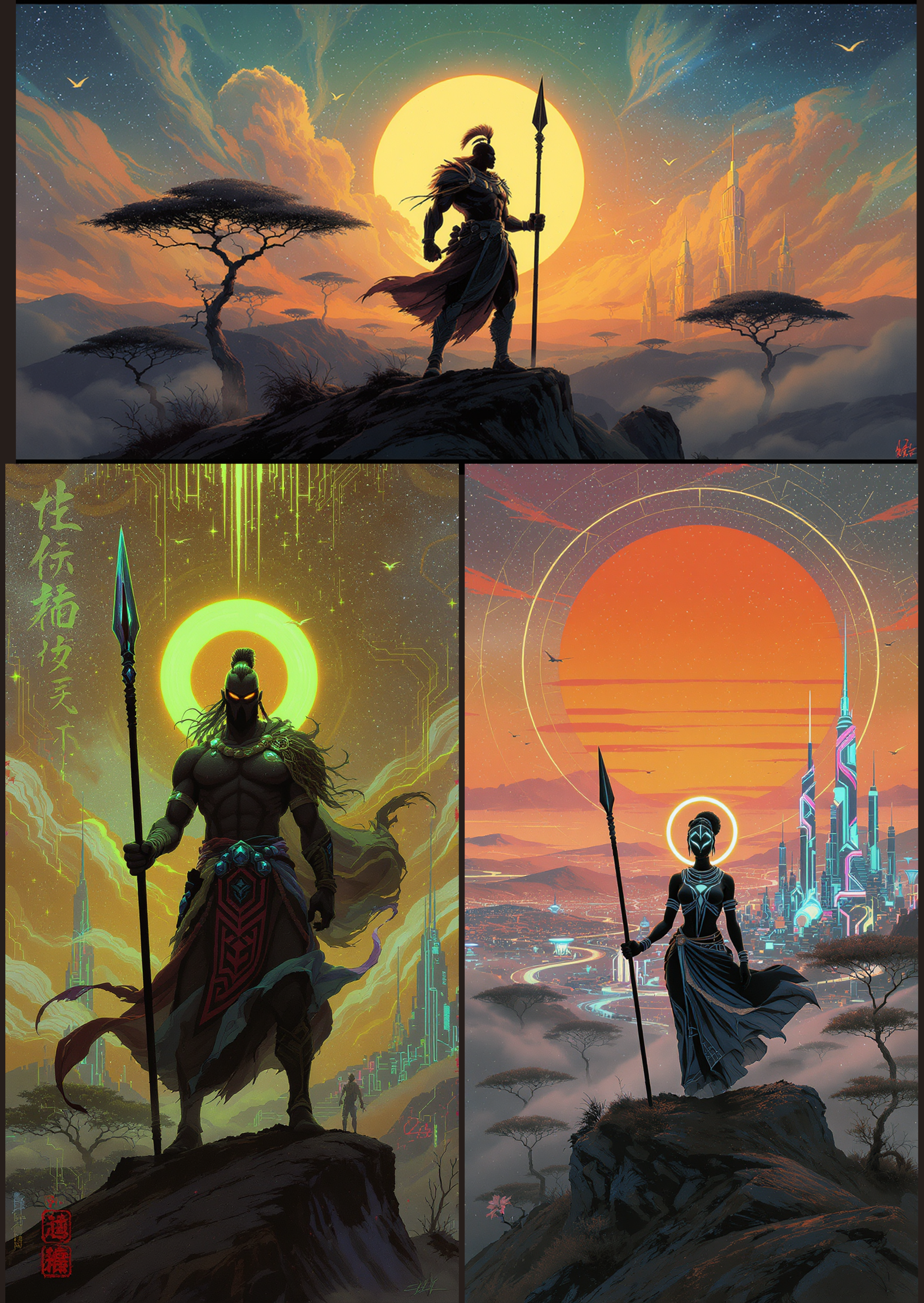
Twin Guardians of the City-Savannah
A pair of sentinels, masculine/feminine energies, stand as parallel icons facing the same future-temple skyline. The work suggests stewardship as dual: force and discernment, protection and perception.
-
![]()
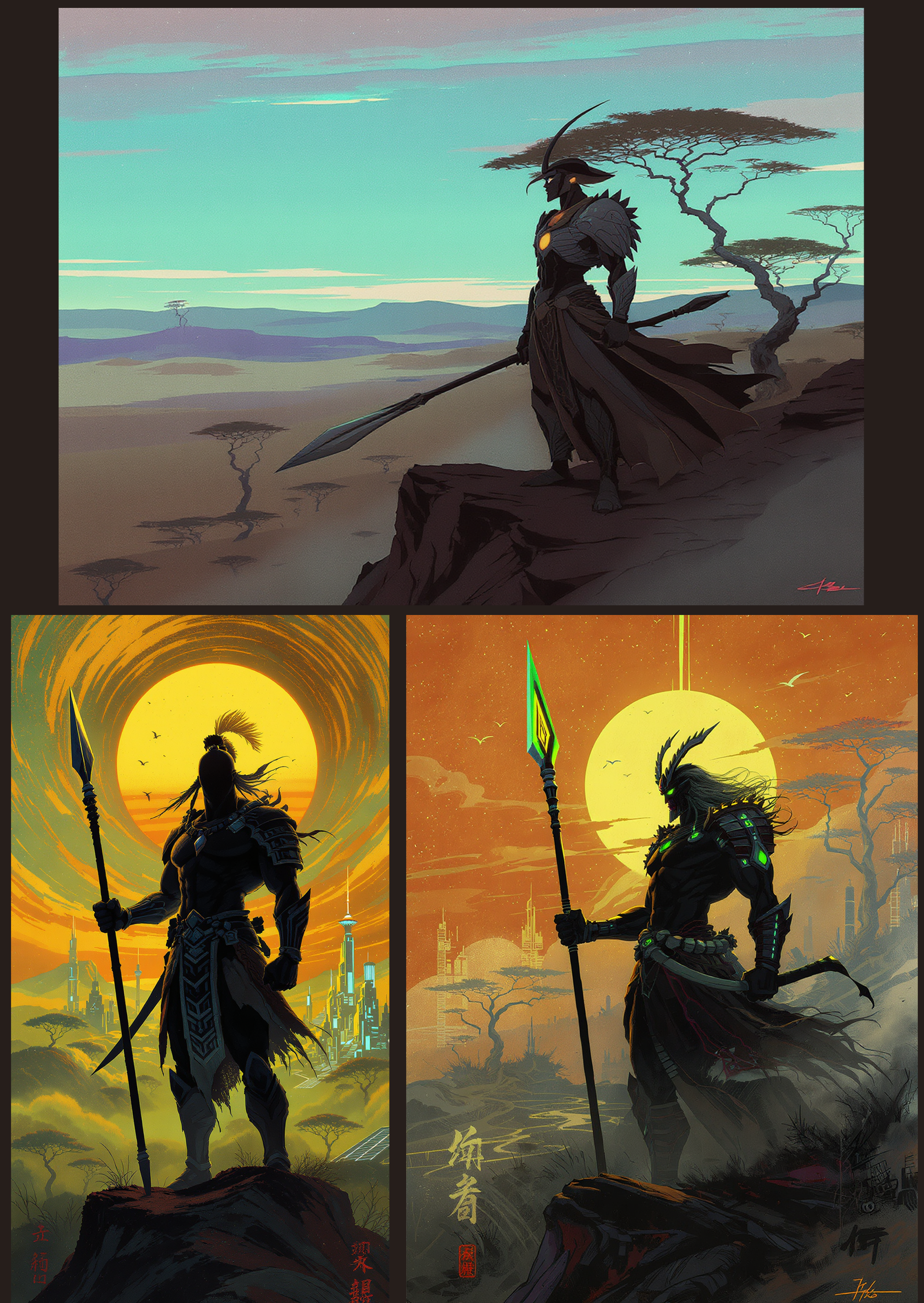
Cliffwatcher Triptych
A lone figure holds the high ground while variant portraits below intensify armor, glow, and ritual detail. The page is about scale: one body against an entire world-system, deciding what it means to stand firm.
-
![]()
Horizon Guardians
A wide, cinematic hero shot anchors the page, while the lower images sharpen the archetype into emblematic forms. The repeated stance becomes a visual mantra: return, witness, protect.
-
![]()
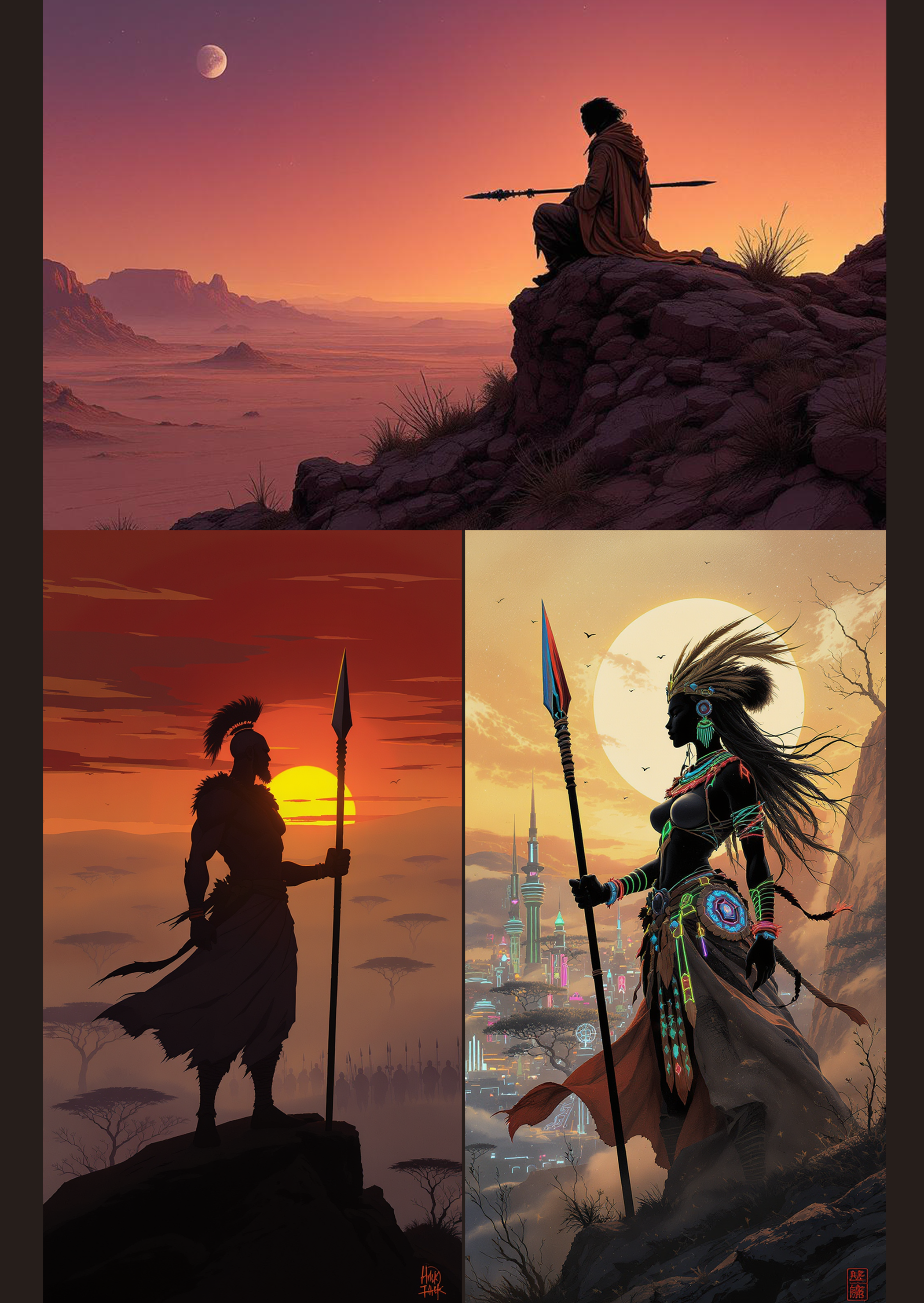
Meditation Above the Plains
The sentinel shifts from proclamation to contemplation, seated, quiet, watching the world unfold. By pairing stillness with the armed silhouette, the page argues that true power includes restraint and interior discipline.
-
![]()
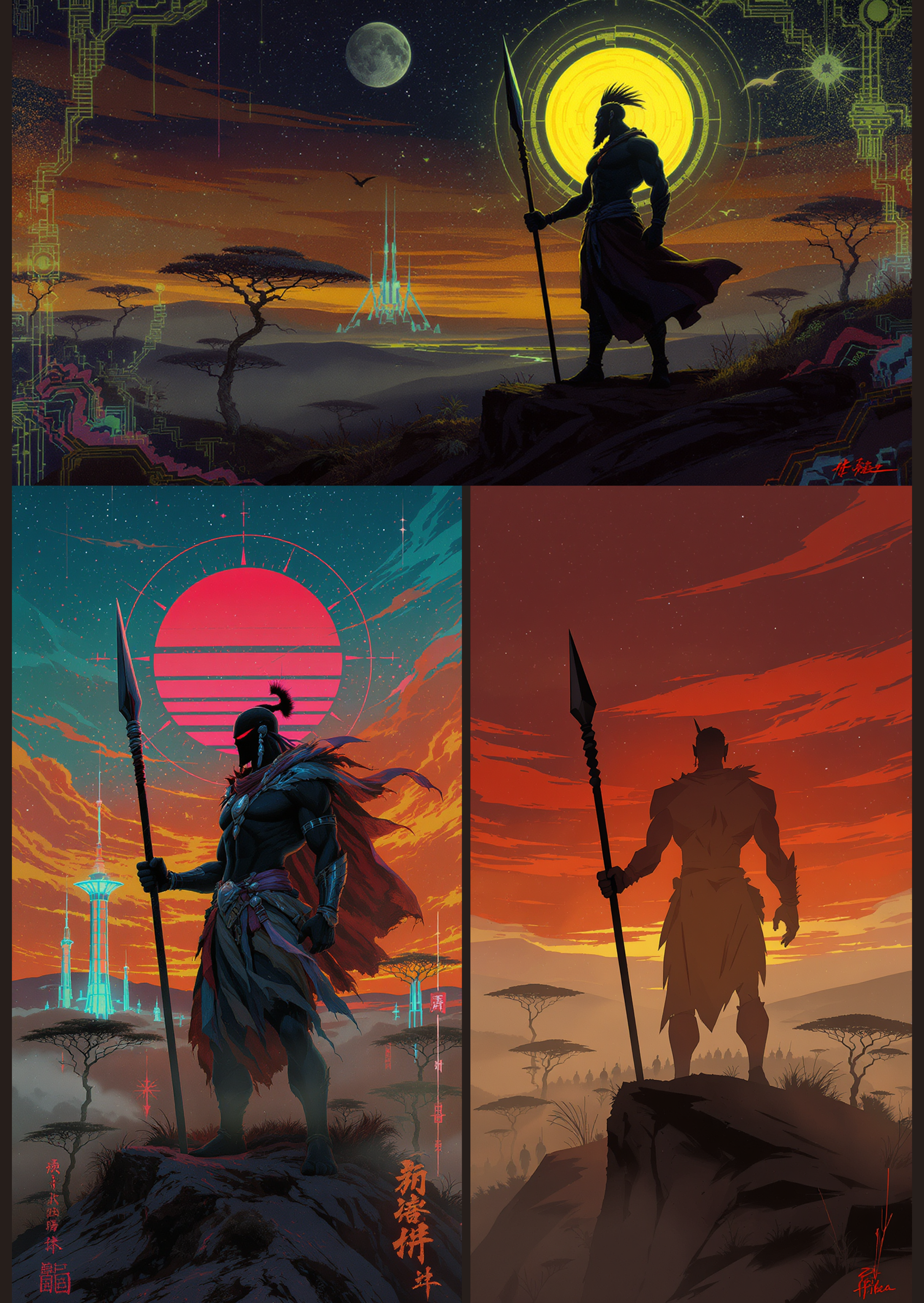
Circuit Halo Over the Savannah
Halo imagery merges with circuitry-like borders and synthetic skies, turning sanctity into a designed interface. The warrior becomes a node in a larger system—raising the question: who controls the halo?
-
![]()
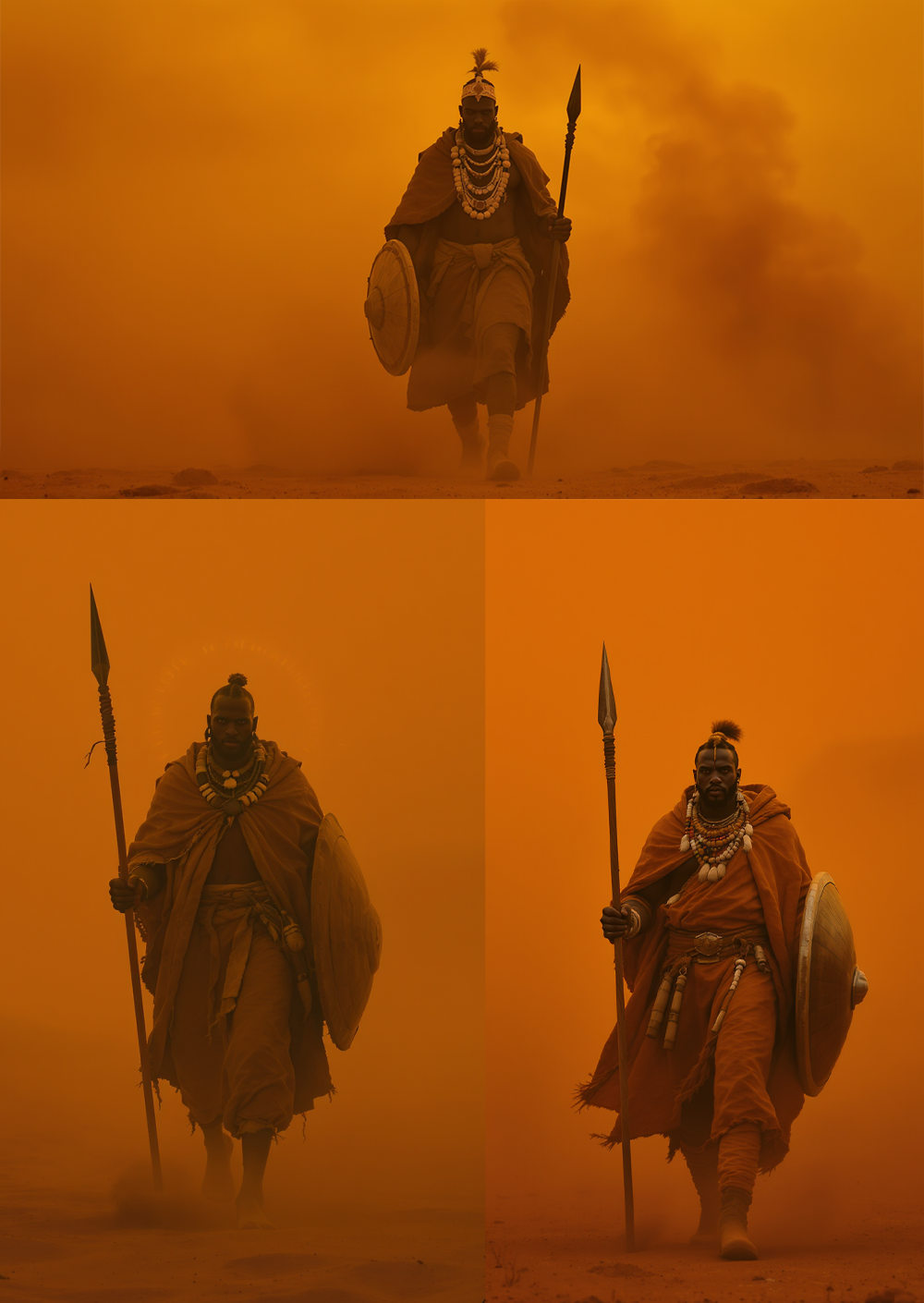
Dust Procession
A warrior emerges through a storm of ochre and grit, history rendered as weather. The repetition of the walking figure reads as endurance: identity maintained under pressure, visibility earned through survival.
Xenogeography: Field Notes from Imagined Biomes
-
![]()
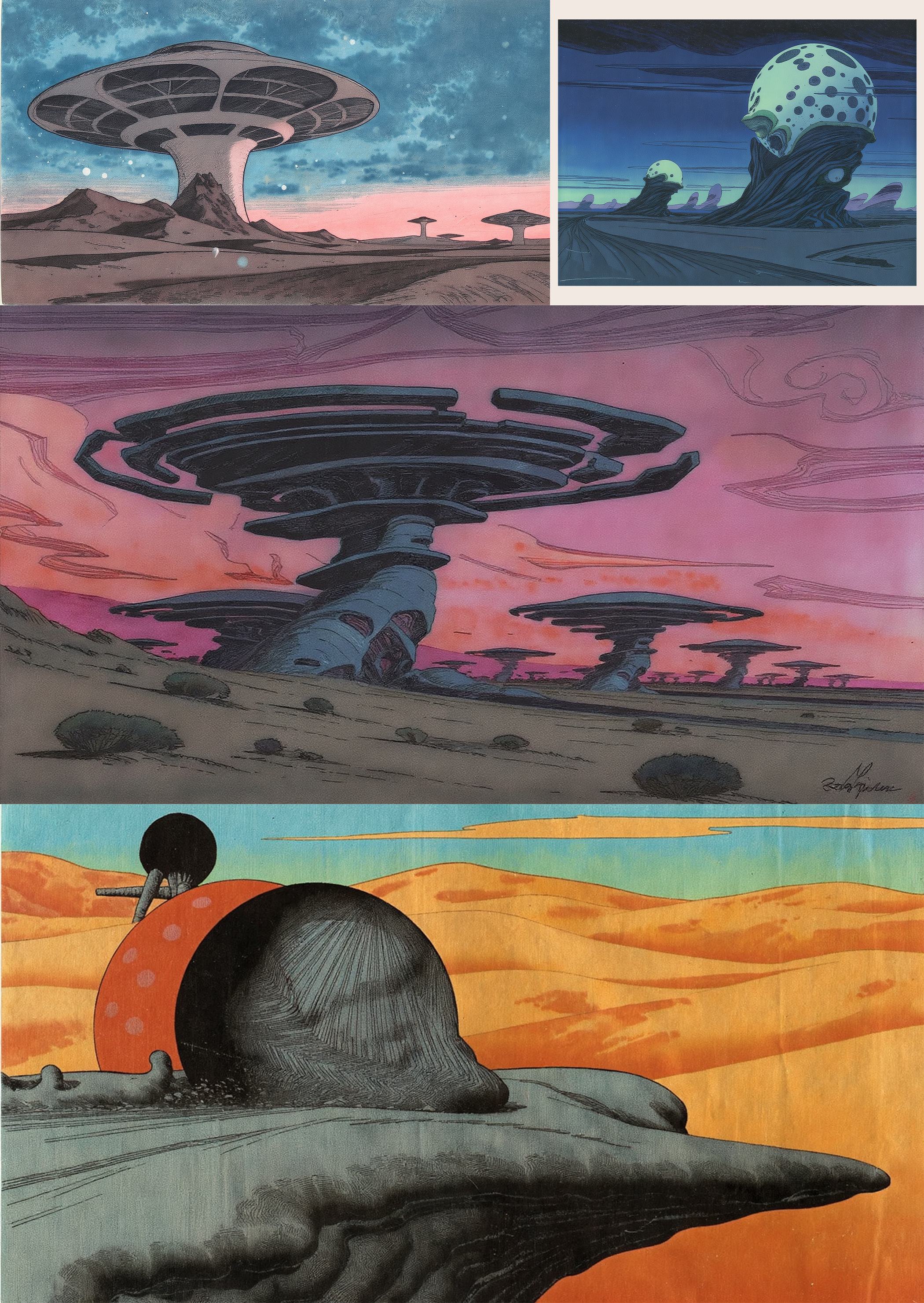
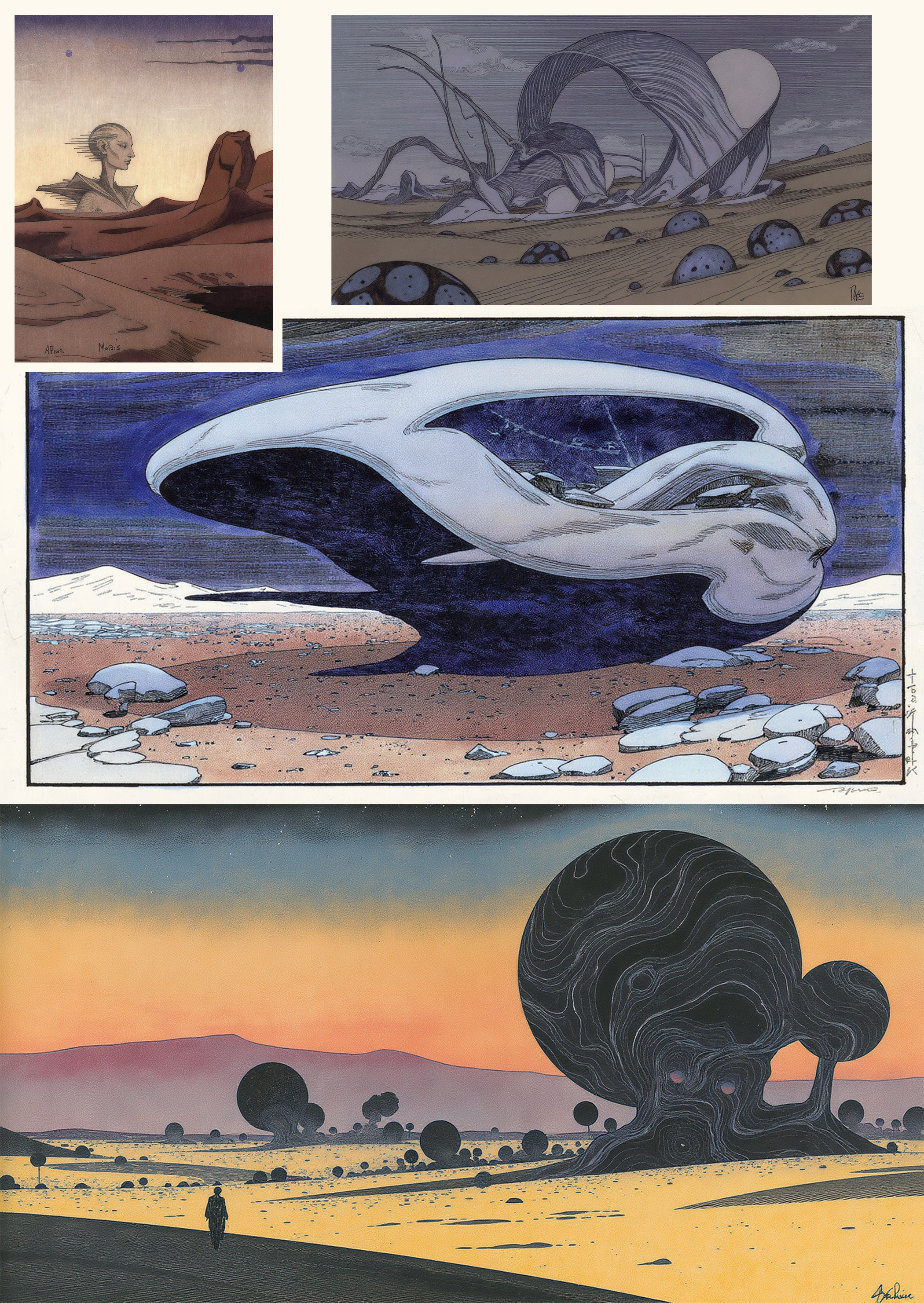
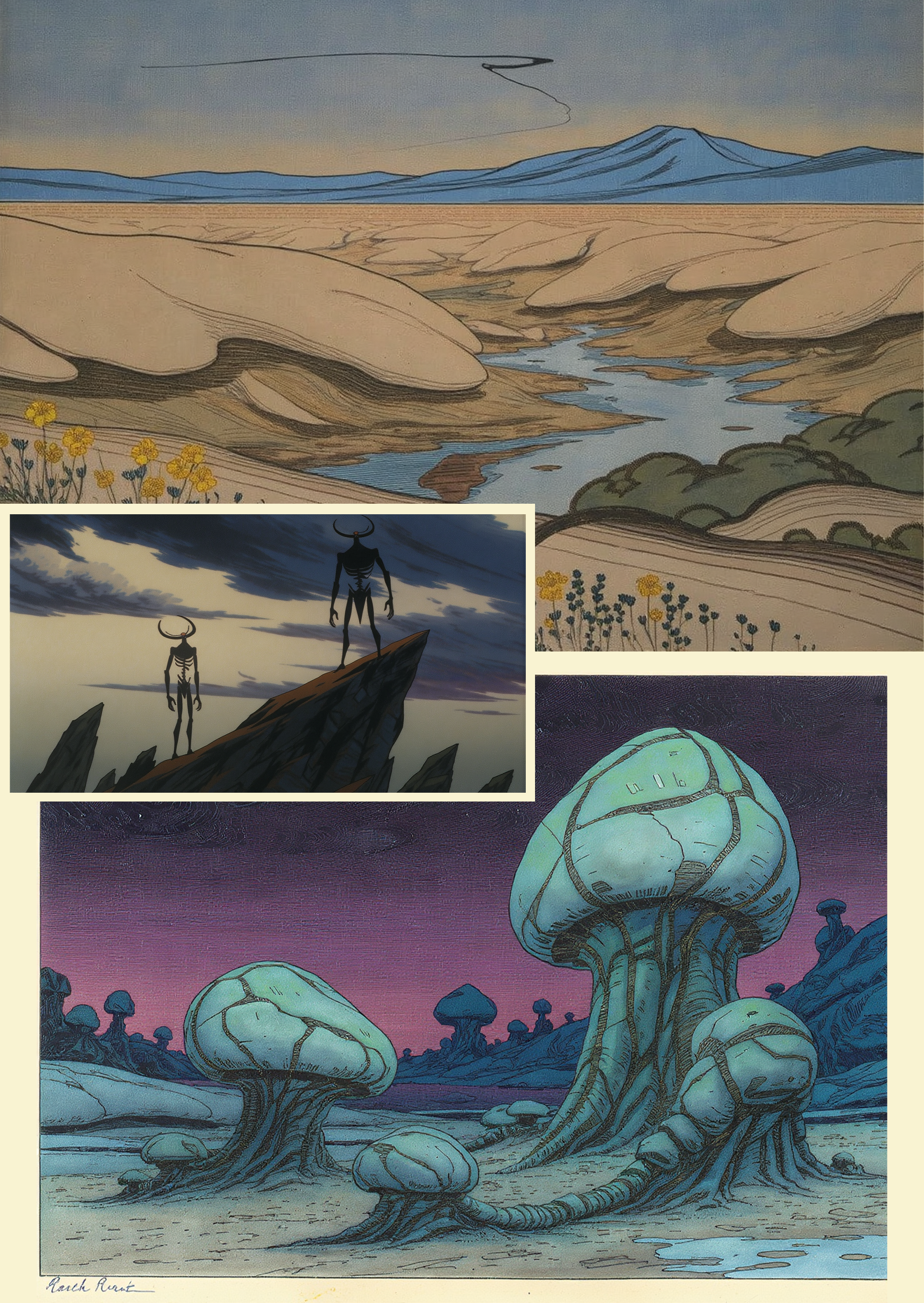
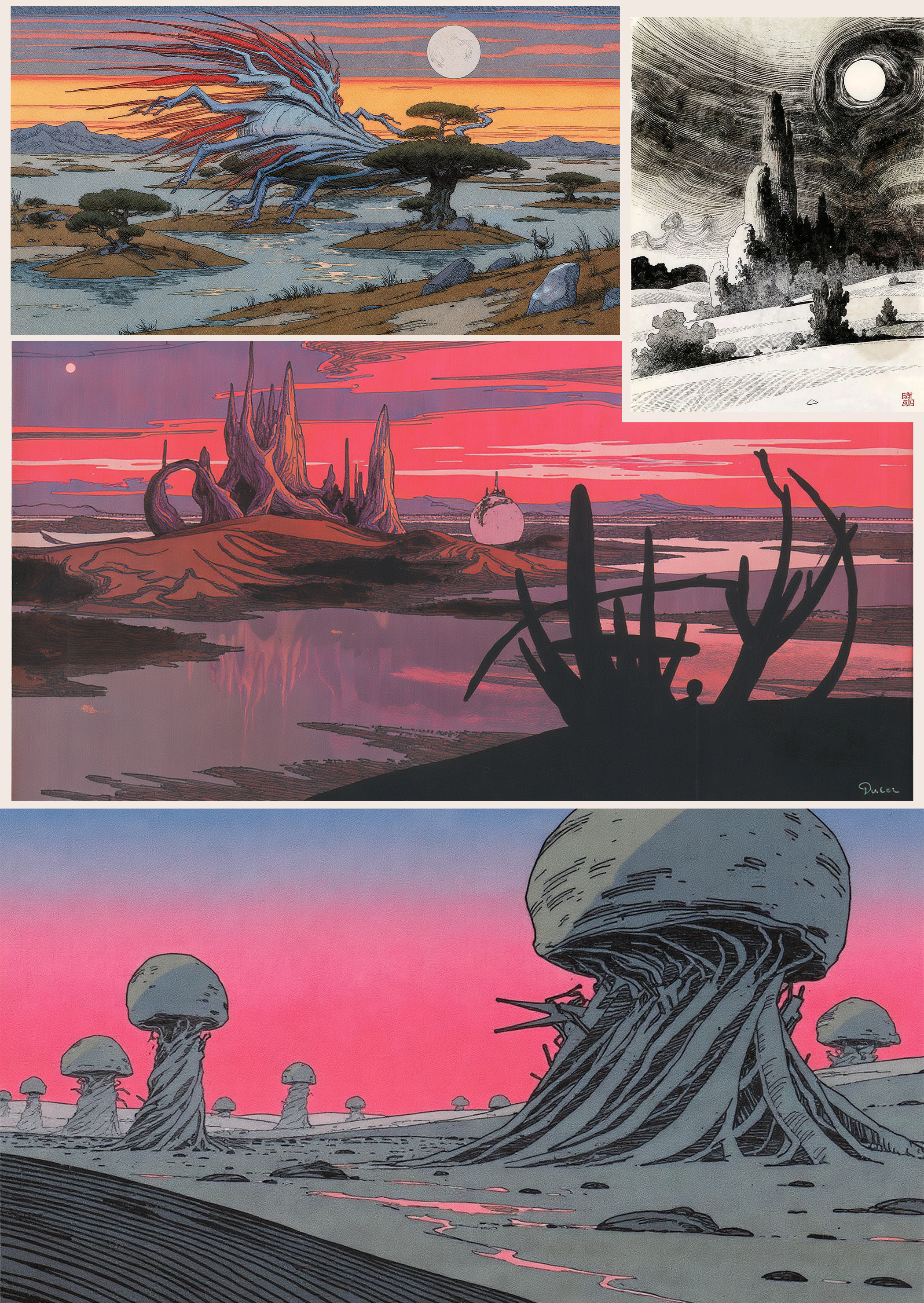
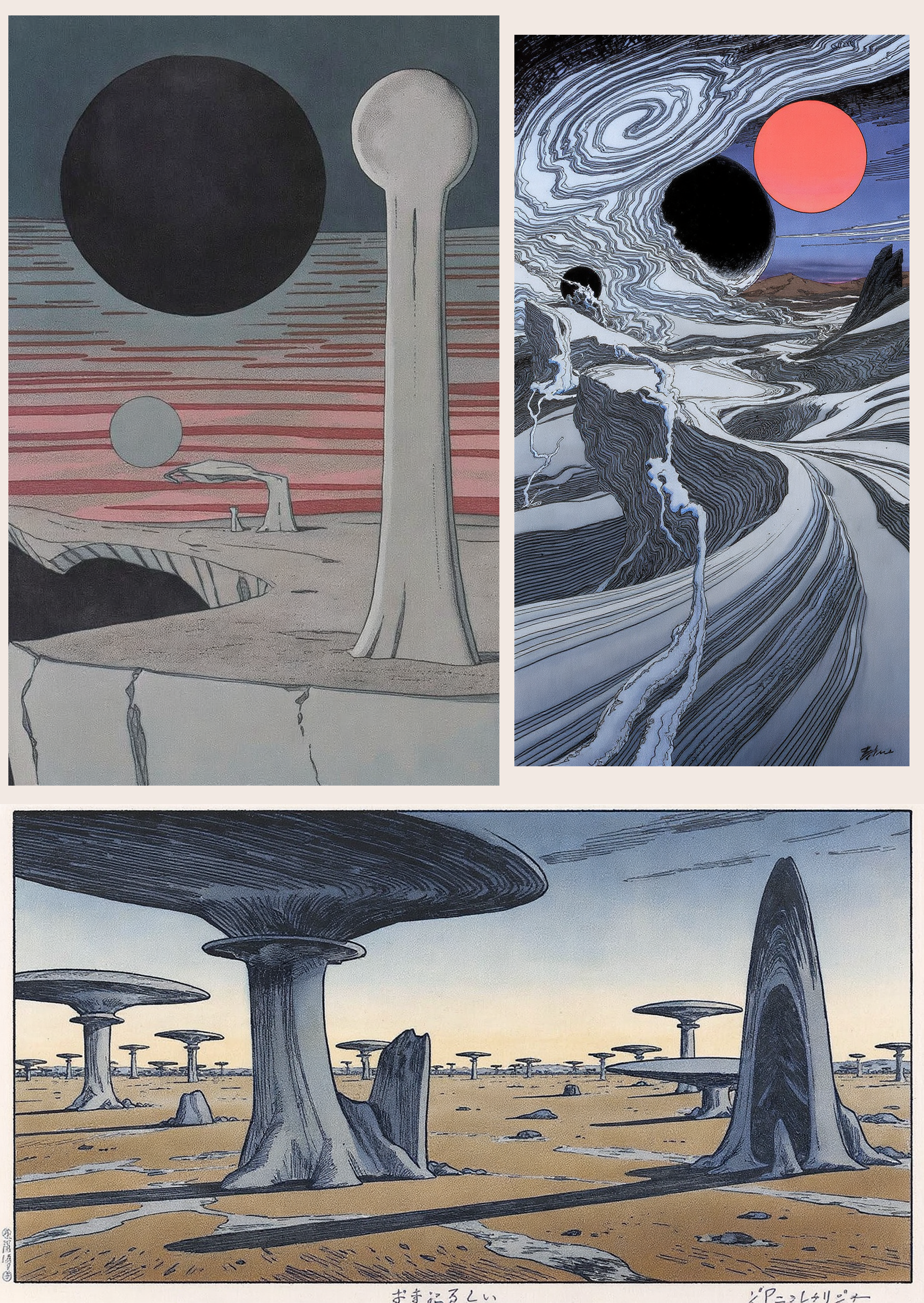
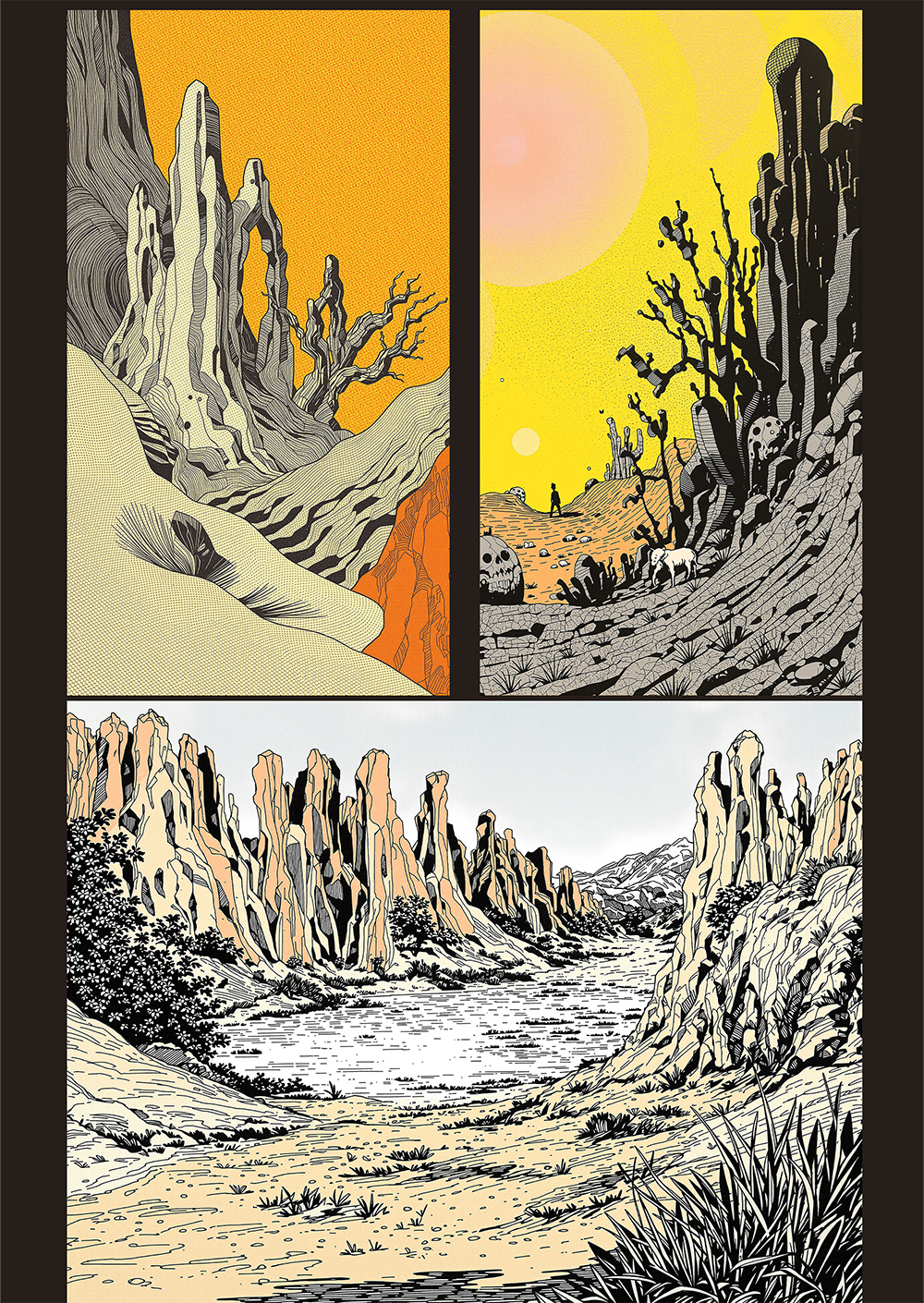
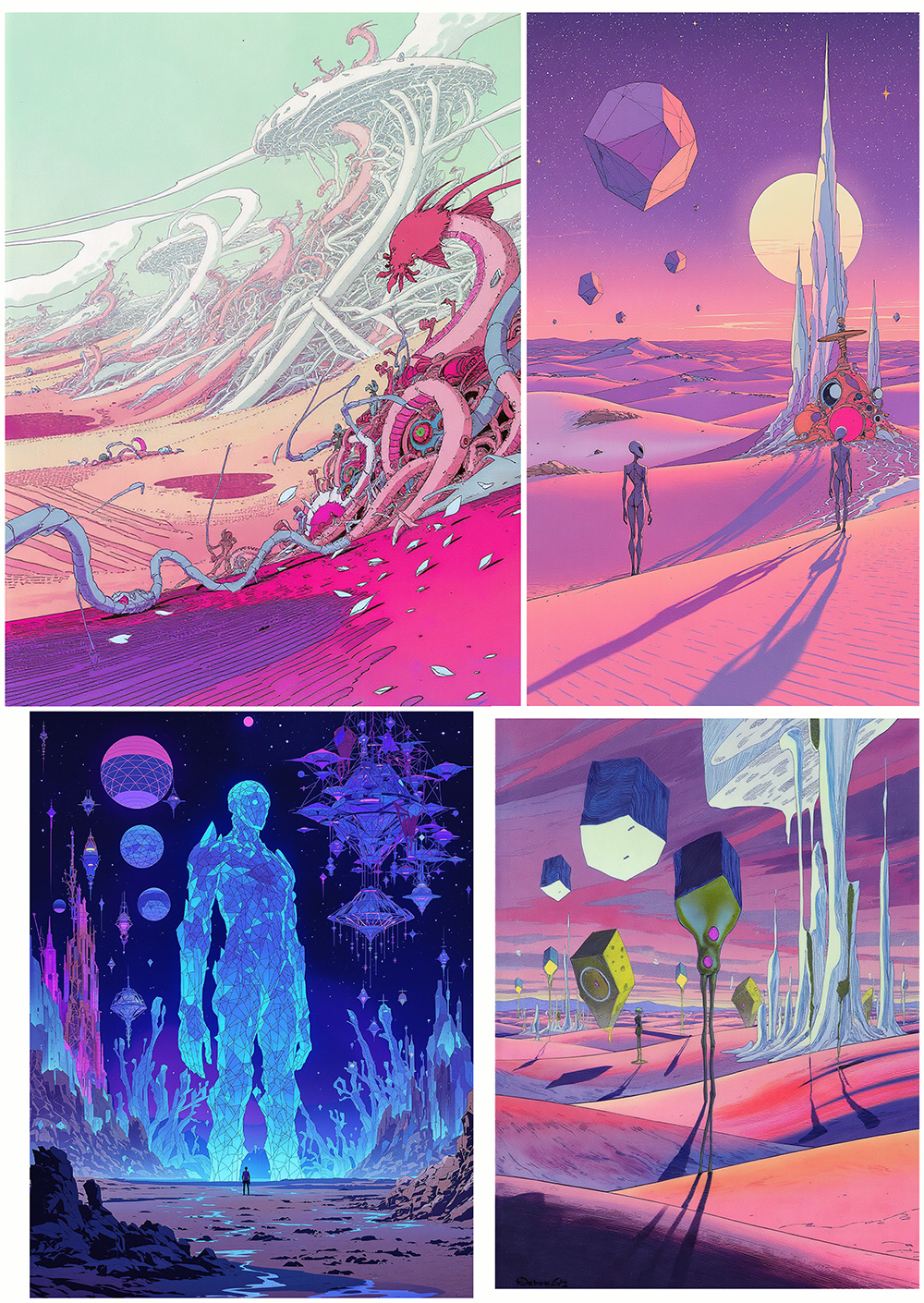
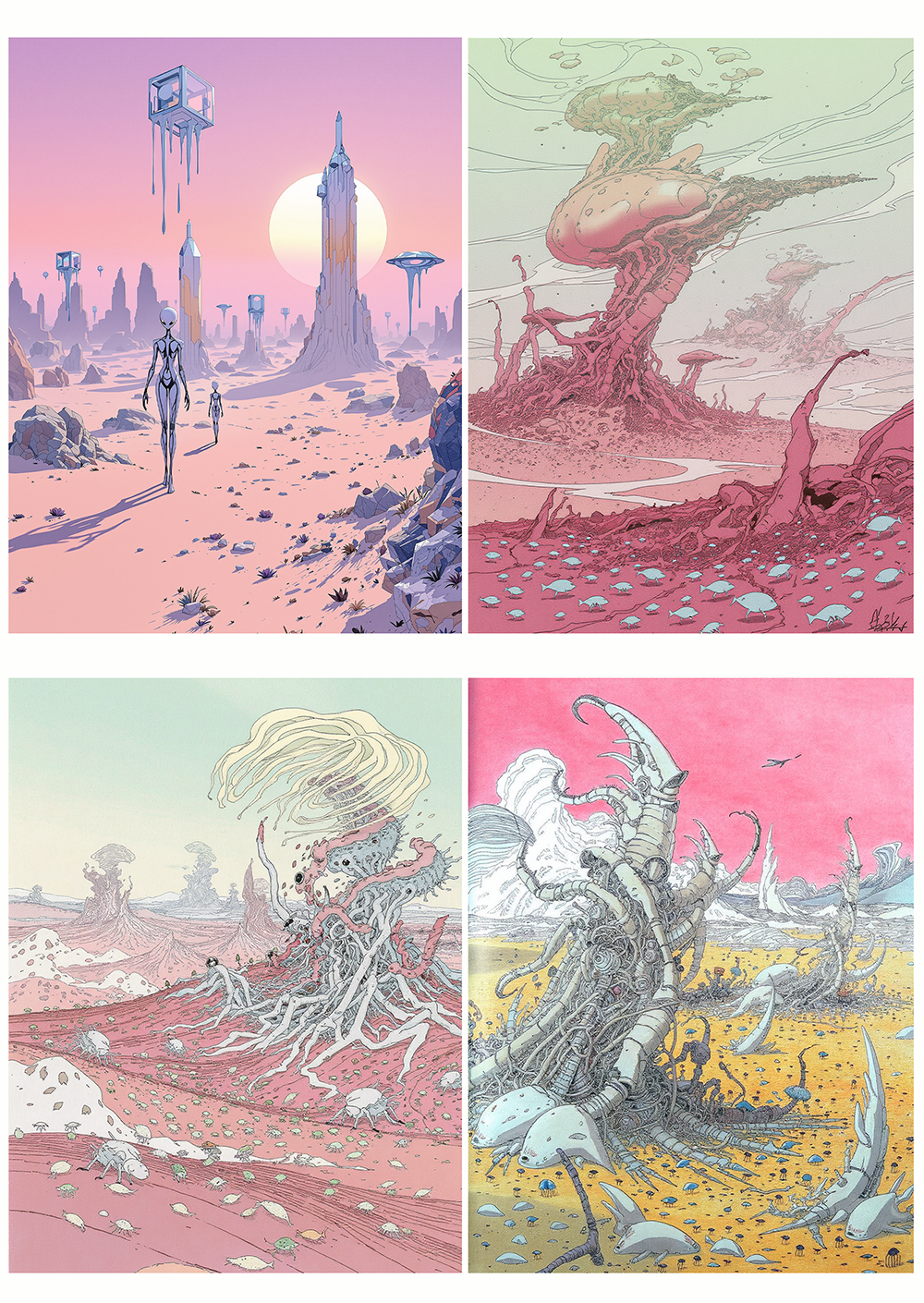
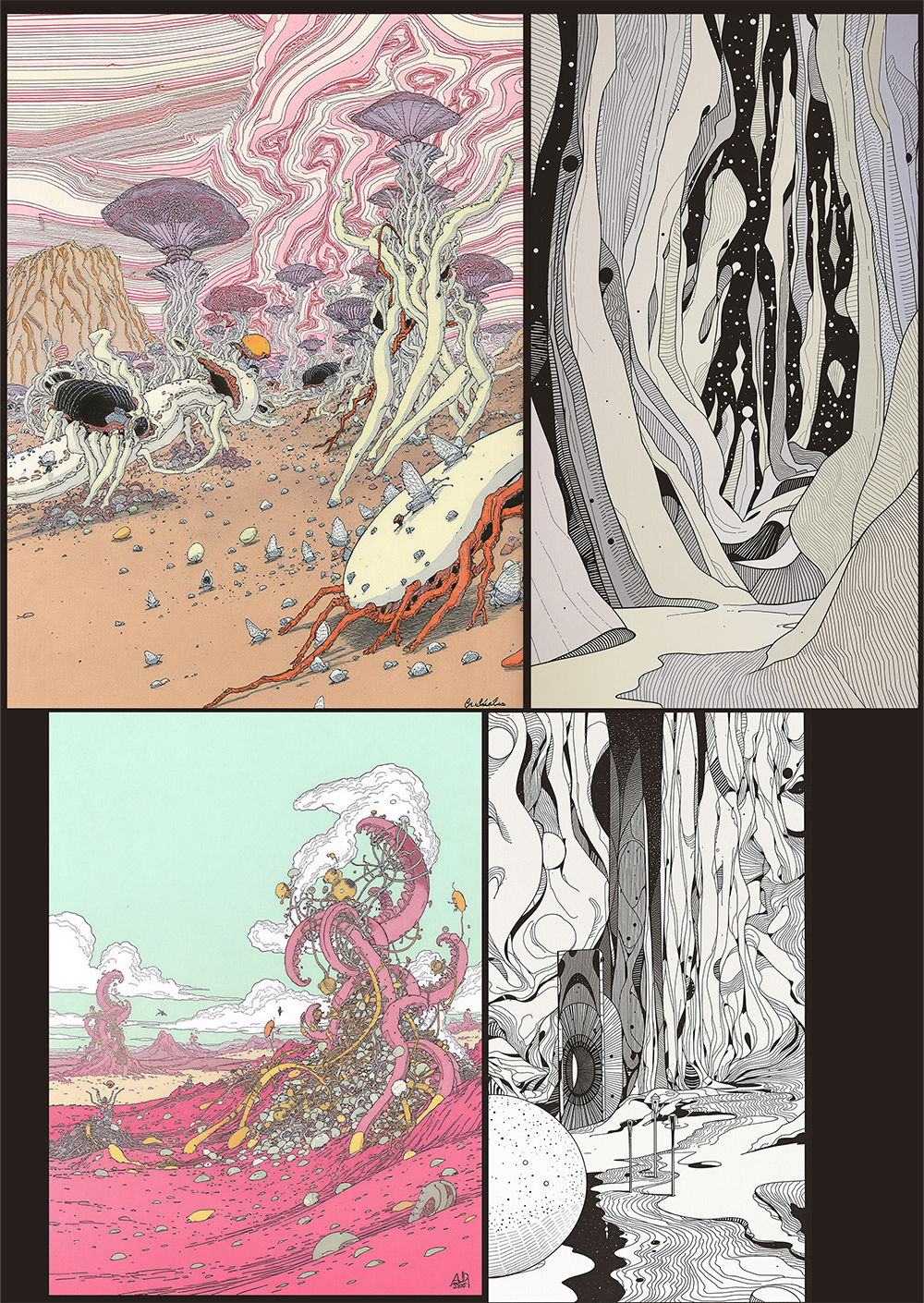
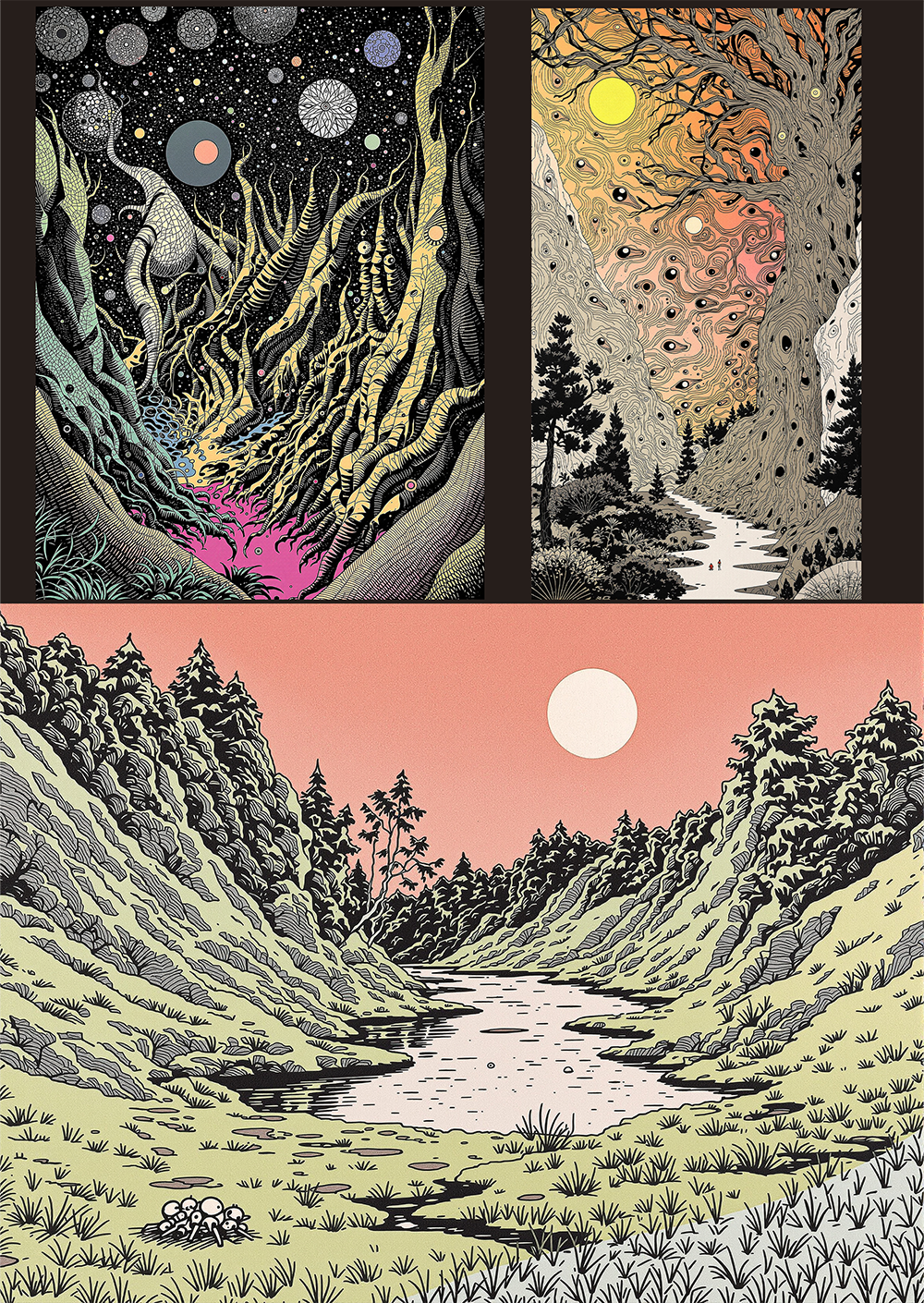
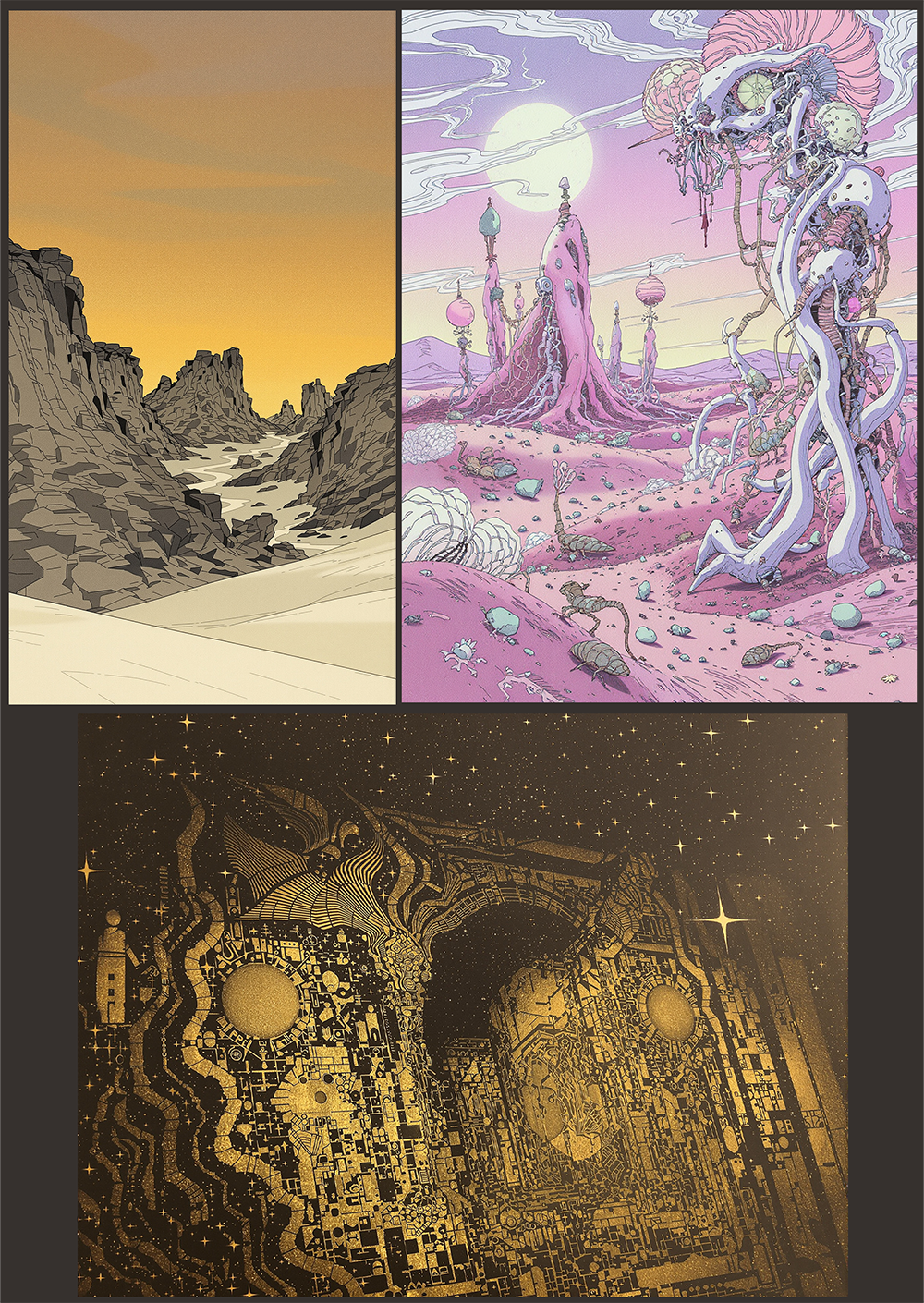
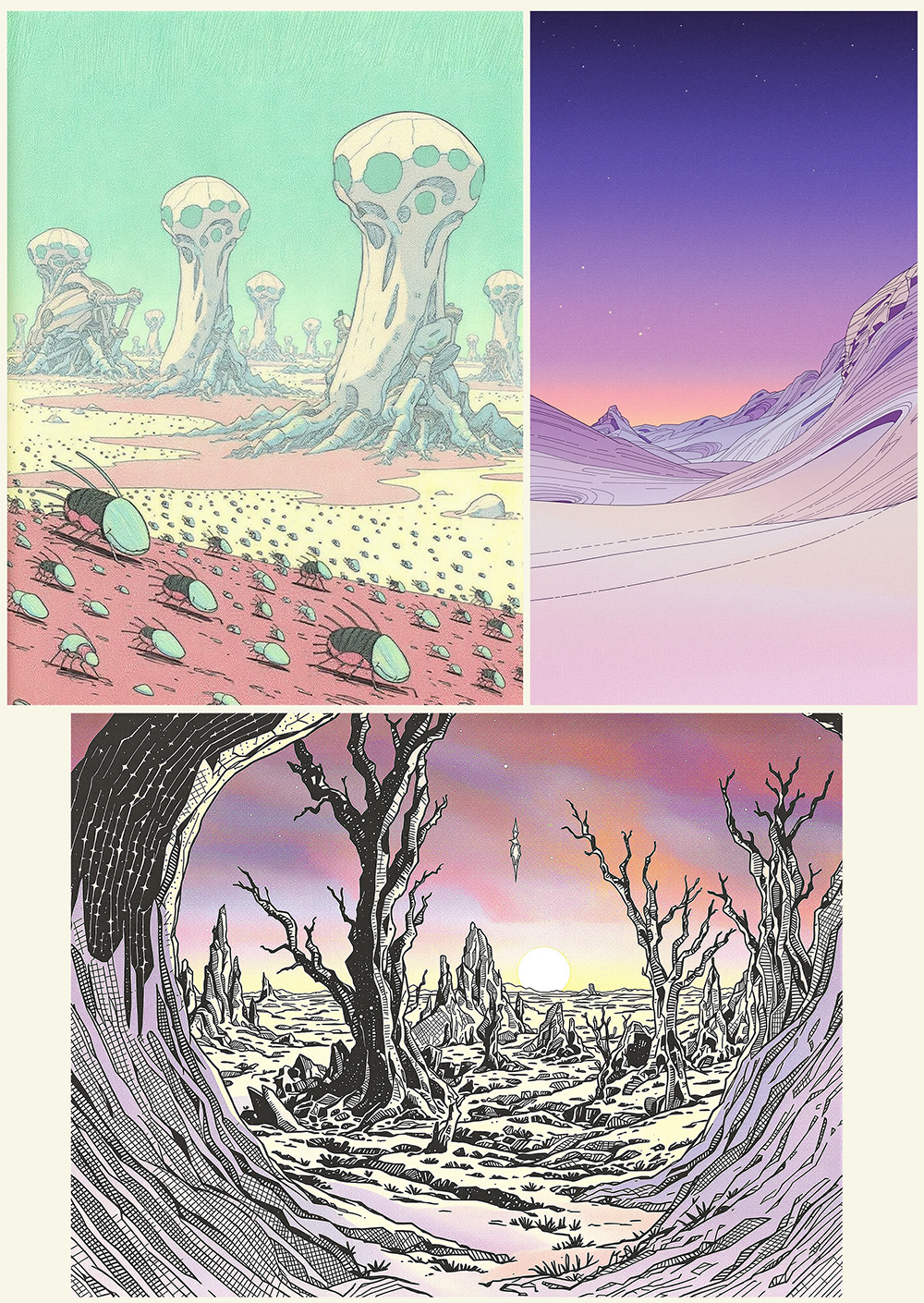
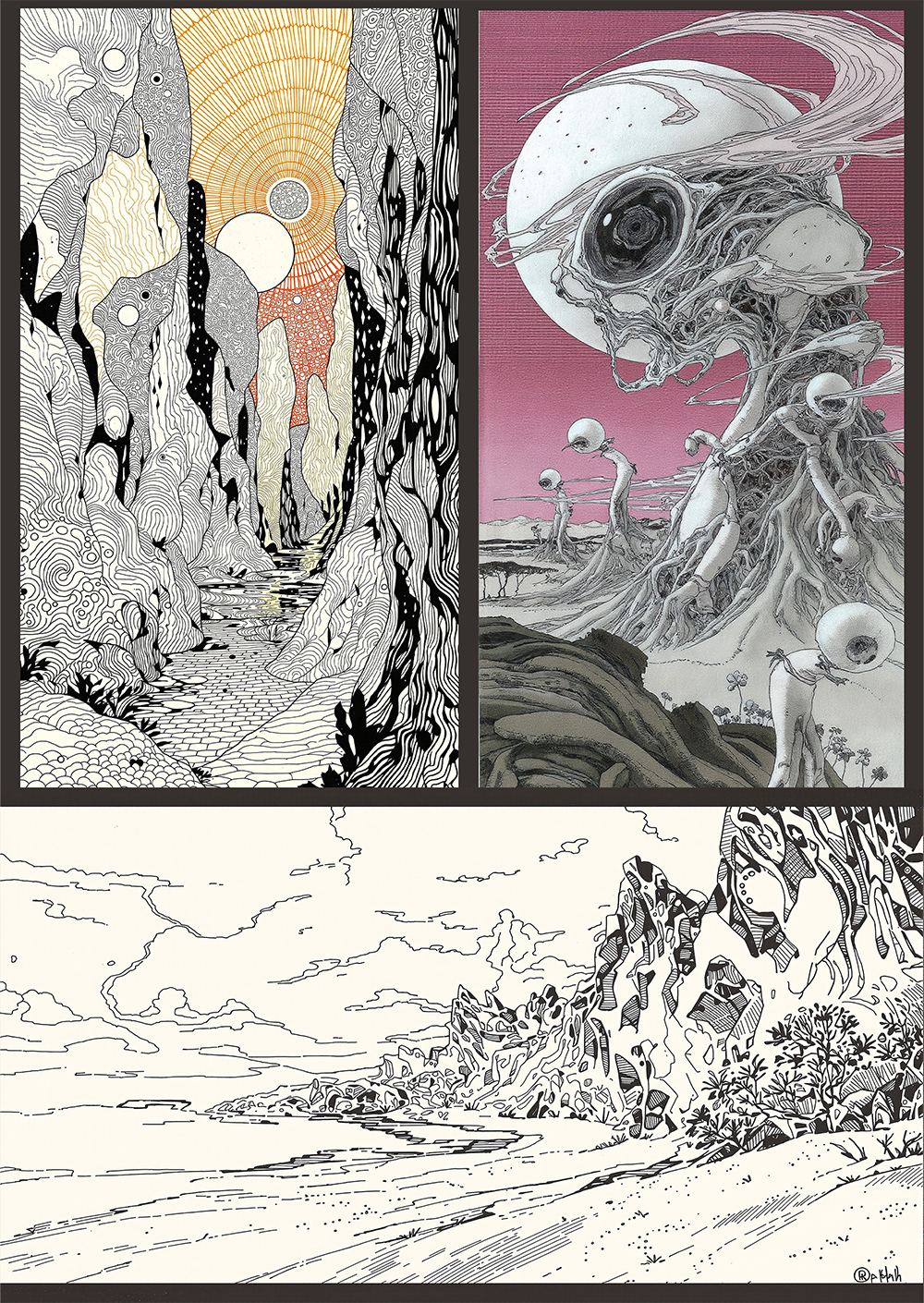
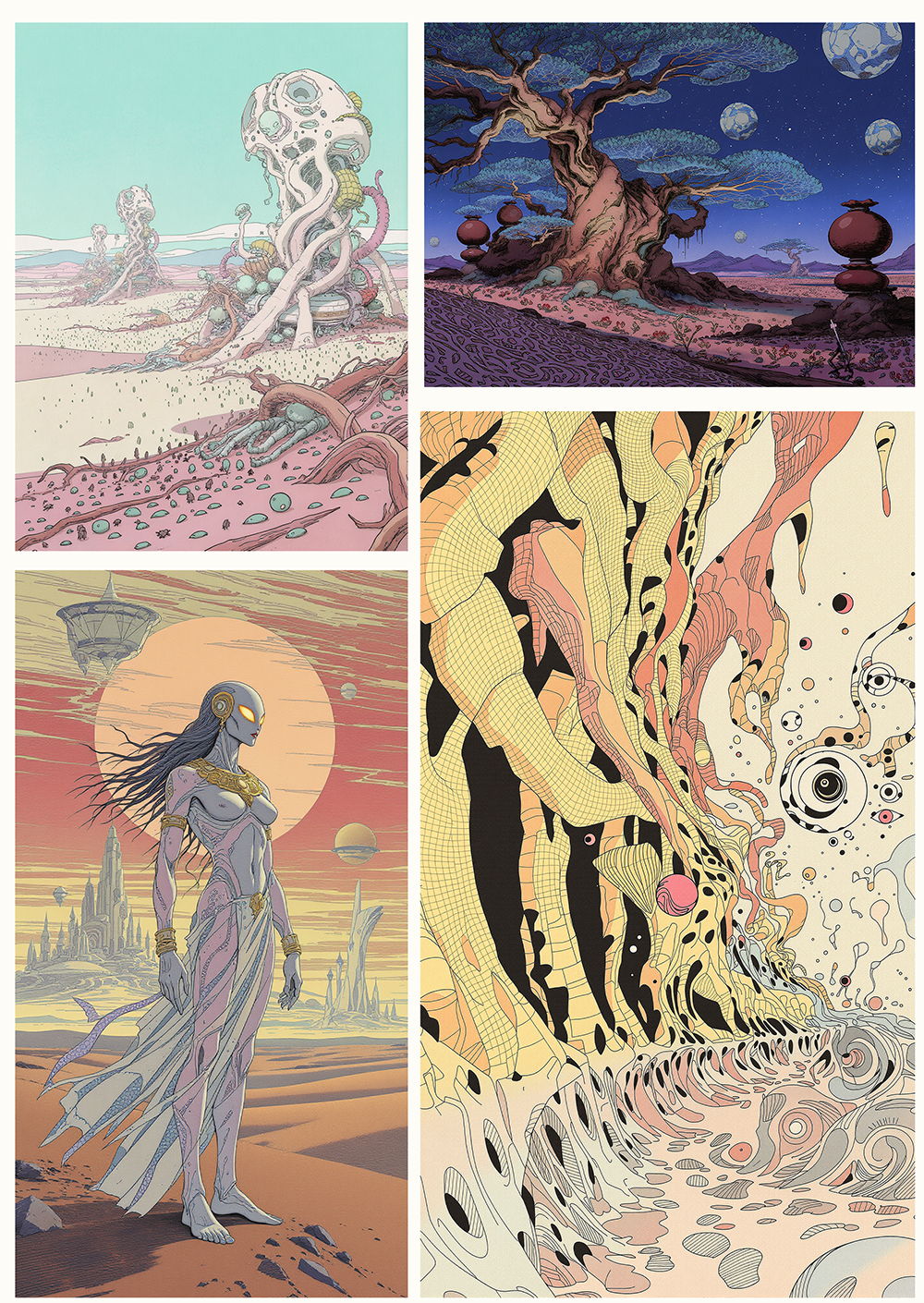
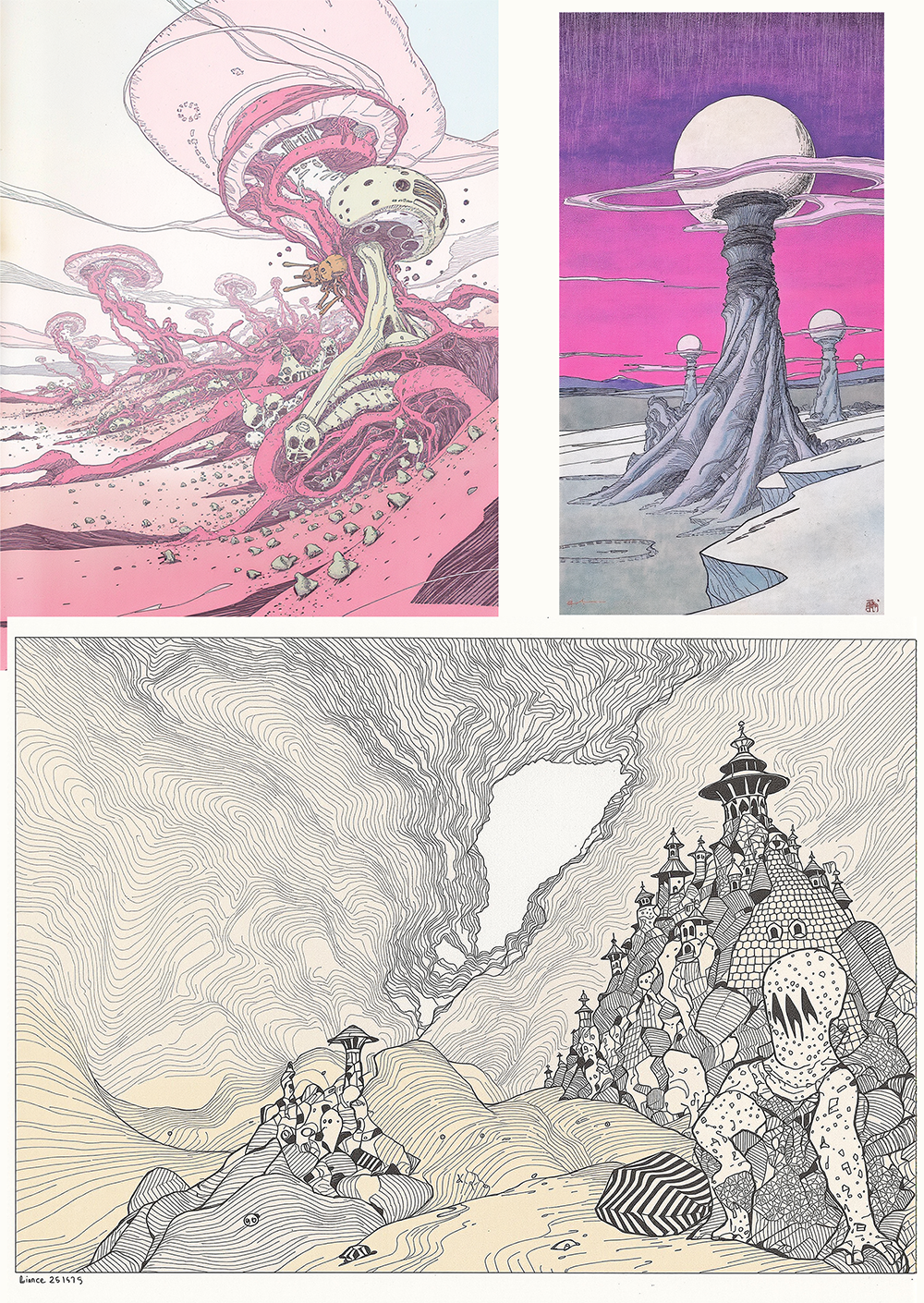
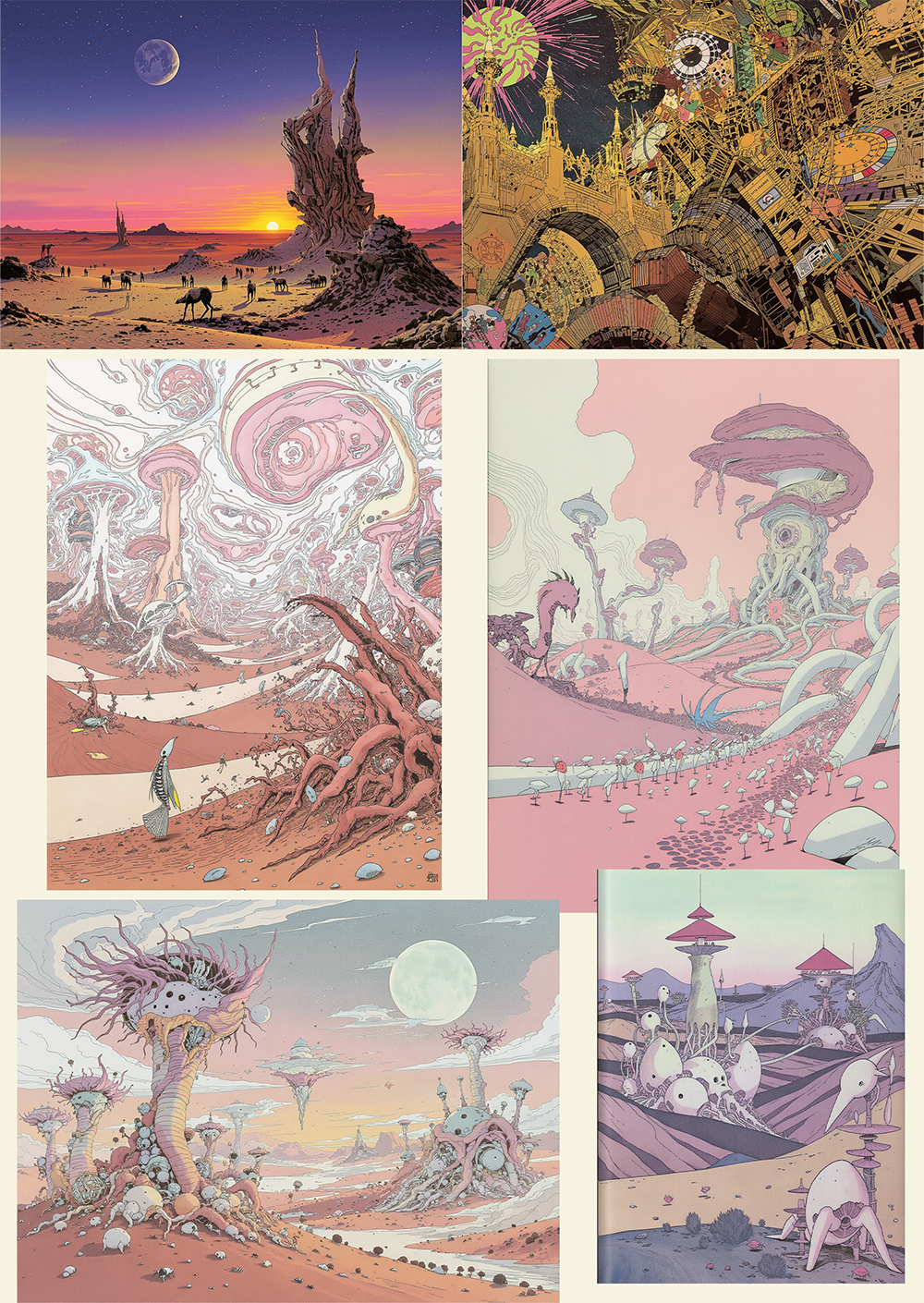
Xenogeography is a series of AI-assisted landscape plates that treat worldbuilding as a form of observation: geology, weather, flora, ruins, and scale cues rendered in a restrained comics/engraving vocabulary. These scenes borrow the visual authority of scientific illustration and bande dessinée linework, clean contour, hatch-shading, limited palettes, then tilt it into speculative ecology: fungal “cathedrals,” cube-drifting sentinels, ringed-planet monoliths, and desert architectures that read like both fossils and machines. The work asks how environments become belief-systems, how a horizon can function as a narrative engine, where “place” is not a backdrop, but an active intelligence shaping the viewer’s sense of time, threat, wonder, and pilgrimage.
-
![]()
Method: AI-assisted environment design + atlas-style curation + compositing
Visual research: Moebius/European comics line traditions, cartographic illustration, sci-fi environment concept art.
Generative iteration: prompt-cycles to generate consistent terrain grammars (monolith geology, fungal forms, deadwood silhouettes, desert architecture).
Authorial selection: curating outputs like field plates—prioritizing legibility, scale cues, and motif continuity.
Palette discipline: constrained pastel and “sunset science” palettes (apricot, mint, violet, gold) to maintain a unified atlas tone.
Compositing + cleanup: horizon calibration, texture unification, edge control, and print/portfolio readiness.
-
![]()
Motifs (what repeats and why)
Monolith spires / needle rock: permanence, witness, deep time.
Fungal towers / bio-structures: alien ecology as architecture; growth as infrastructure.
Cube drift / hovering forms: “signal objects” — technology as weather.
Pilgrim figures / androids: scale + vulnerability; the body as measurement.
Caves with star-fields: interior becomes cosmos; geology as portal.
Dead trees / ash plains: aftermath without explanation; narrative tension.
Dune cities / diagrammatic ruins: civilization rendered as pattern, not portrait.
-
![]()
Sunlit Rifts (Desert Monolith Studies)
A set of harsh, graphic deserts where rock behaves like sculpture, spires, shadows, and carved valleys. The shift between high-chroma skies and near-monochrome ground makes the landscape feel “archival,” as if it’s being catalogued after the fa
-
![]()
Cosmic Groves (Astral Forest Topographies)
A river-valley calm sits beside cosmic-root interiors and a marbled tree-canyon, nature rendered as cosmology. This page reads like an atlas entry for “the sacred ordinary,” where landscape becomes a contemplative device.
-
![]()
Pilgrim & Circuit-Sky (Relic Landscapes)
A towering, uncanny presence share the same quiet desert logic, while a gold schematic/city plate hints at infrastructure beneath the myth. It’s a hinge-page: ecology → system → symbol.
-
![]()
Pastel Badlands (Dunes, Spores, and Ash Trees)
Muted dunes and cratered plains hold dead trees and sparse growth like evidence. The palette is gentle, but the forms imply an event, an ecosystem continuing after rupture, indifferent to explanation. -
![]()
Bone Towers & Ink Coastlines
A page of cleaner “study plates”: coastal linework, canyon paths, and a bone-like tower-form that feels both creature and monument. It frames environment design as drawing practice, worlds built from decisions about line, contour, and silence.
-
![]()
Oracle Dunes (Sentinels, Trees, and Signal-Storms)
An android sentinel, a moonlit tree-world, and an abstract “signal-vortex” share the same visual grammar: calm surfaces hiding complex forces. This page reads like a thesis statement on atmosphere as narrative.
-
![]()
Mushroom Monuments & Dune Cities
Fungal megastructures, ringed-planet towers, and a dense ink city in dunes, civilization as geology, geology as organism. It closes the set with a strong “atlas finale”: the built and the grown become indistinguishable.
-
![]()
Xenobiome Atlas (Rooted Machines)
A plate-family of organisms that look half botanical, half engineered: coral-root growths, skeletal spines, and soft-body structures. These scenes propose ecology as a hybrid technology, life that has learned to build like circuitry.
-
![]()
-
![]()
-
![]()
-
![]()
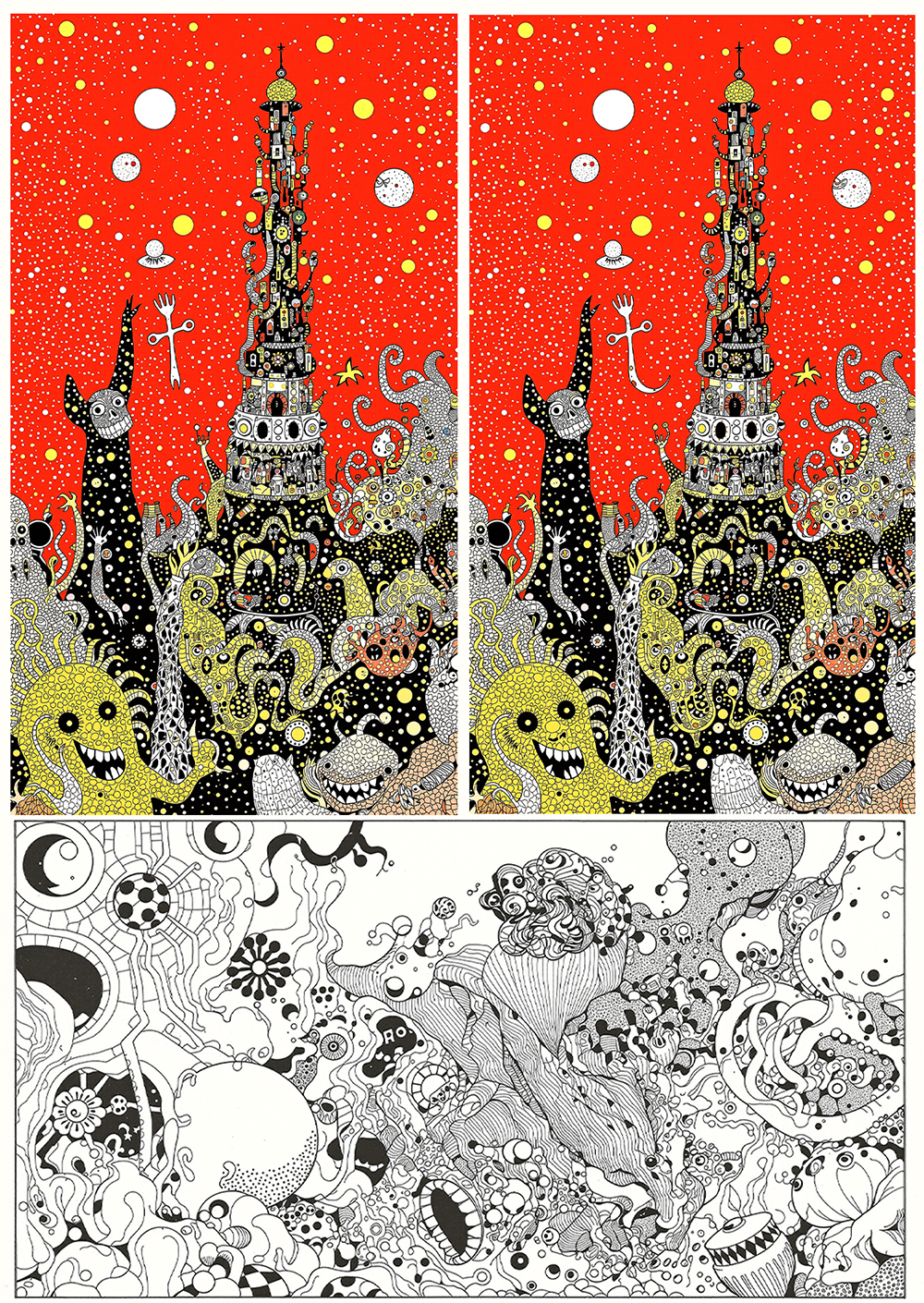
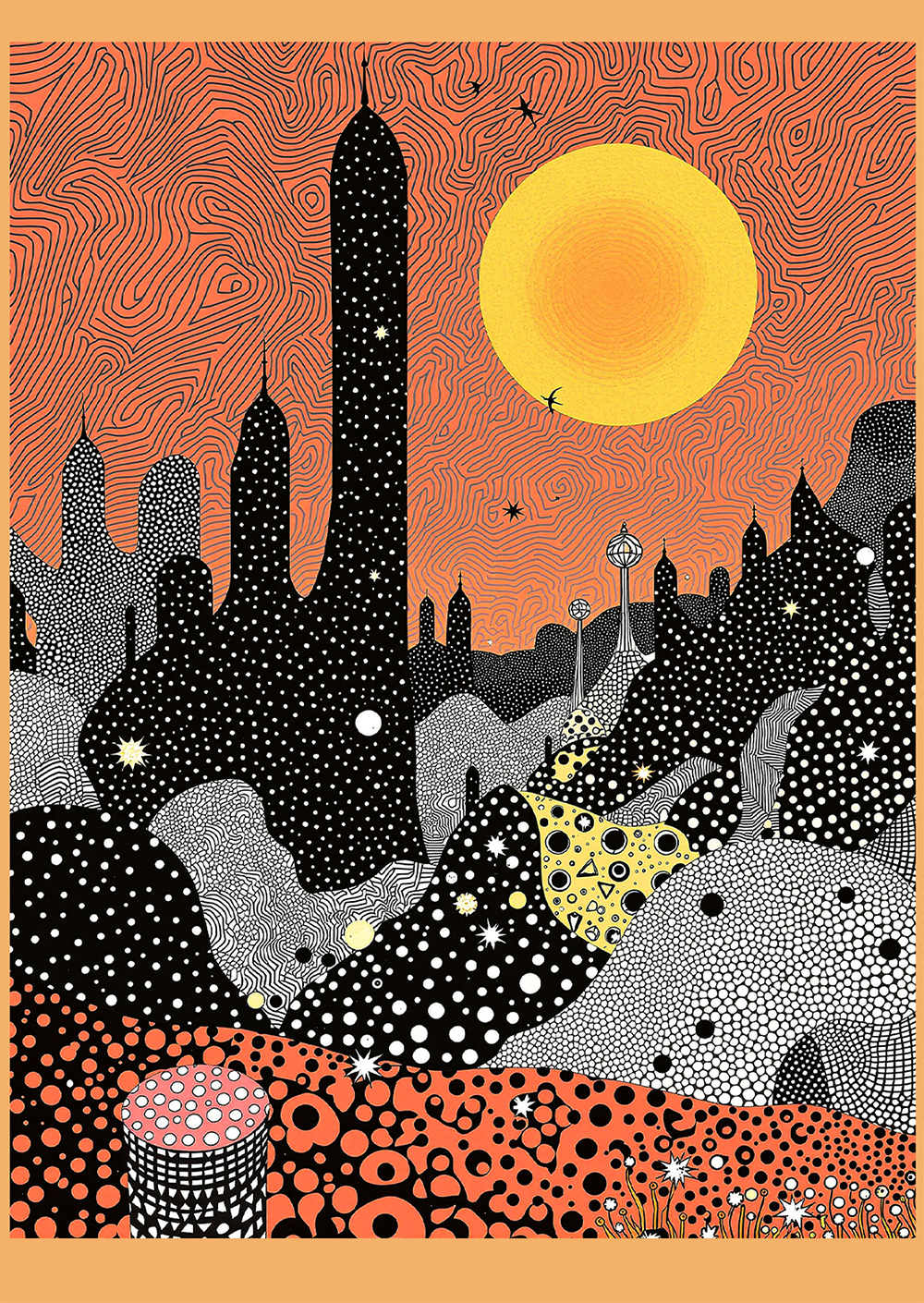
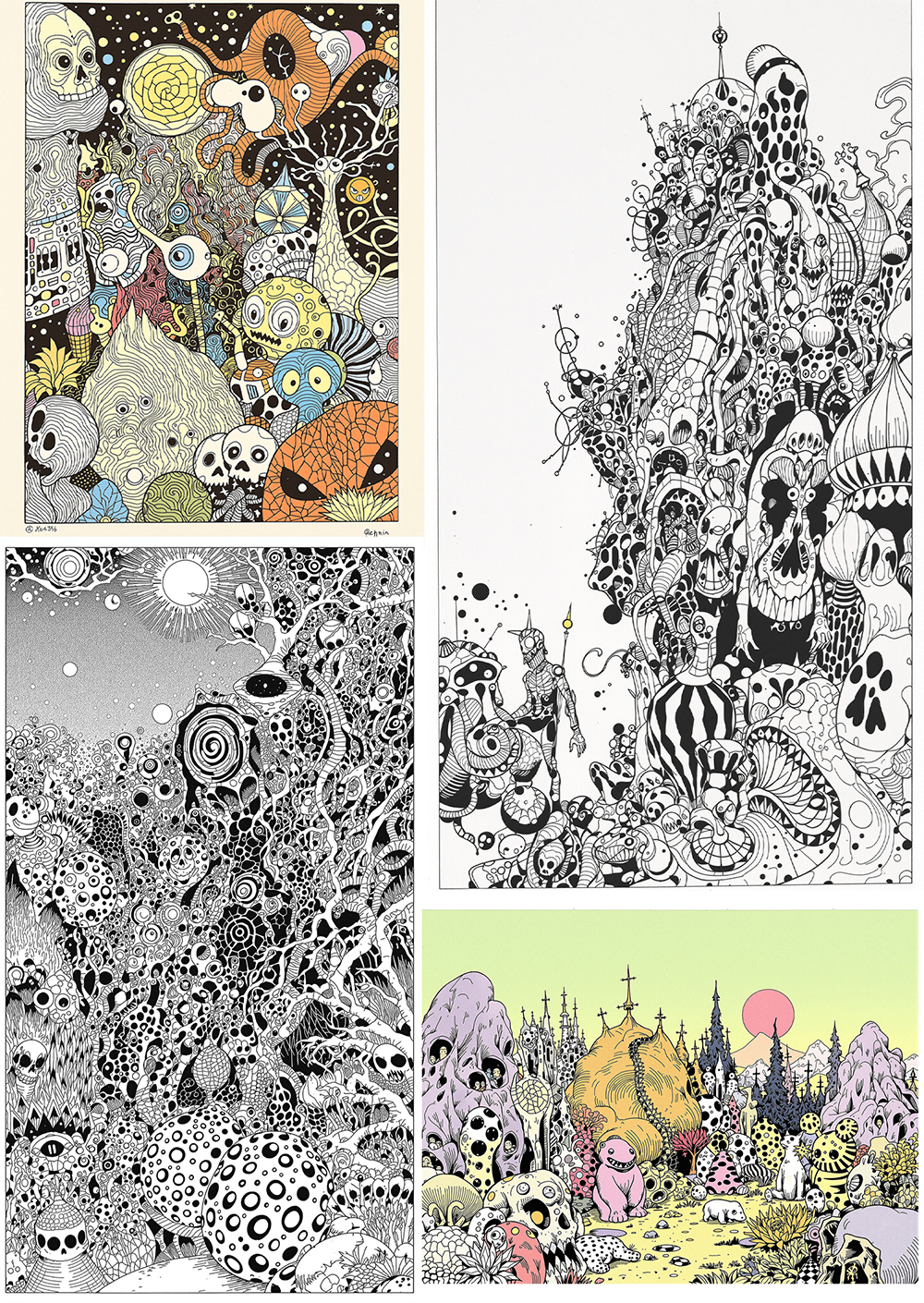
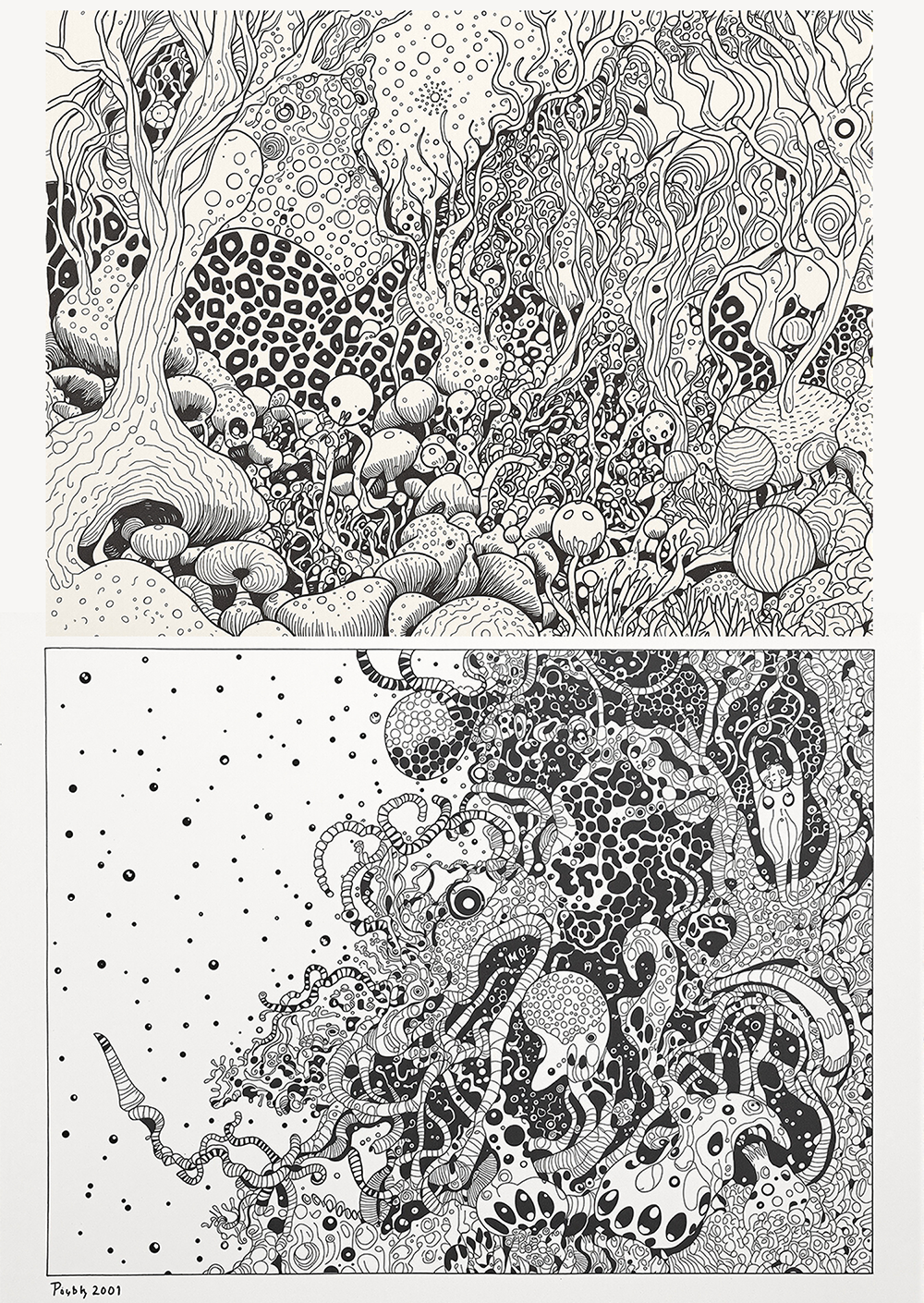
Totem Protocols: Posthuman Monuments
INANNA / DMT / ALIEN: Graffiti Reliquaries
-
![]()
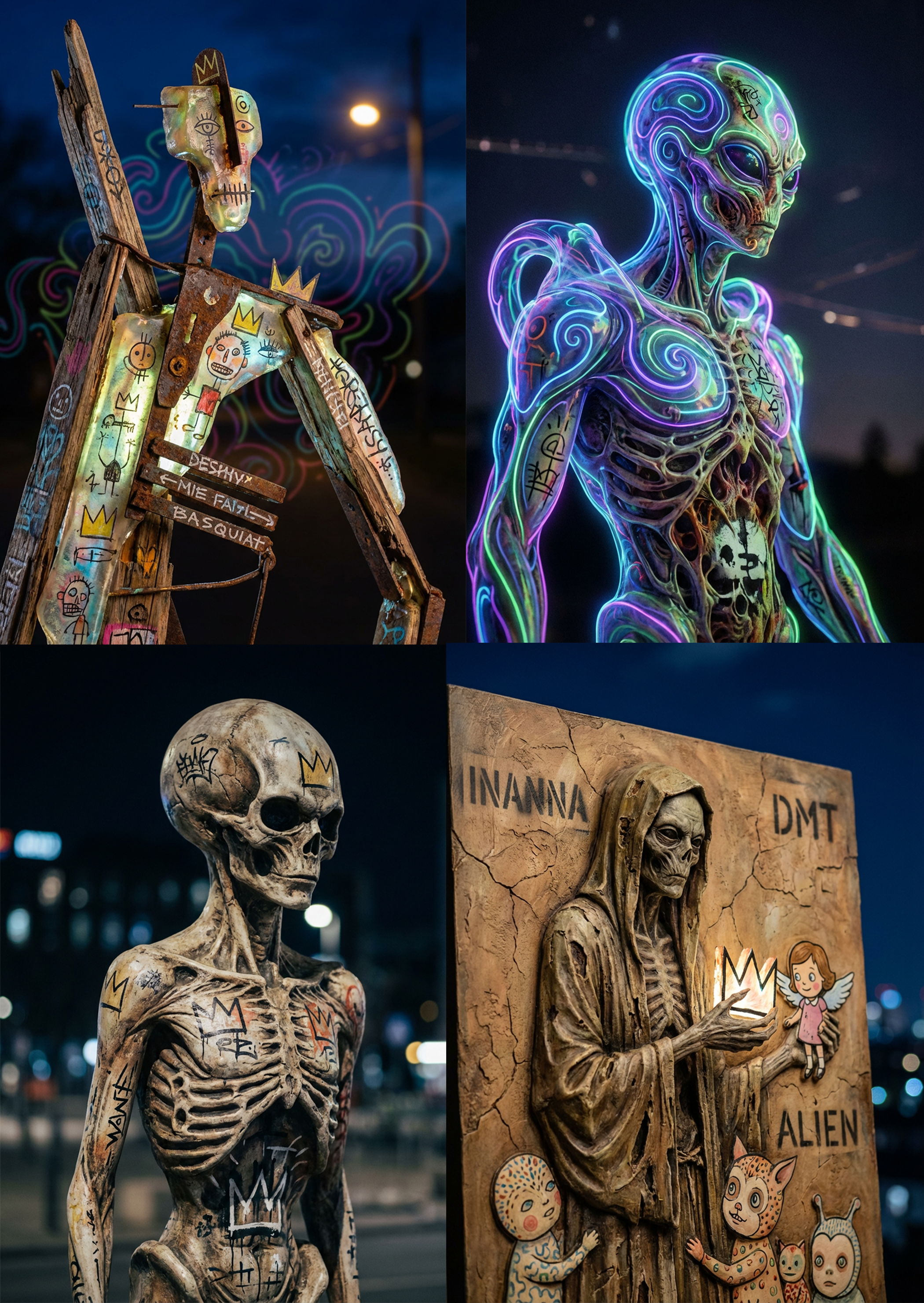
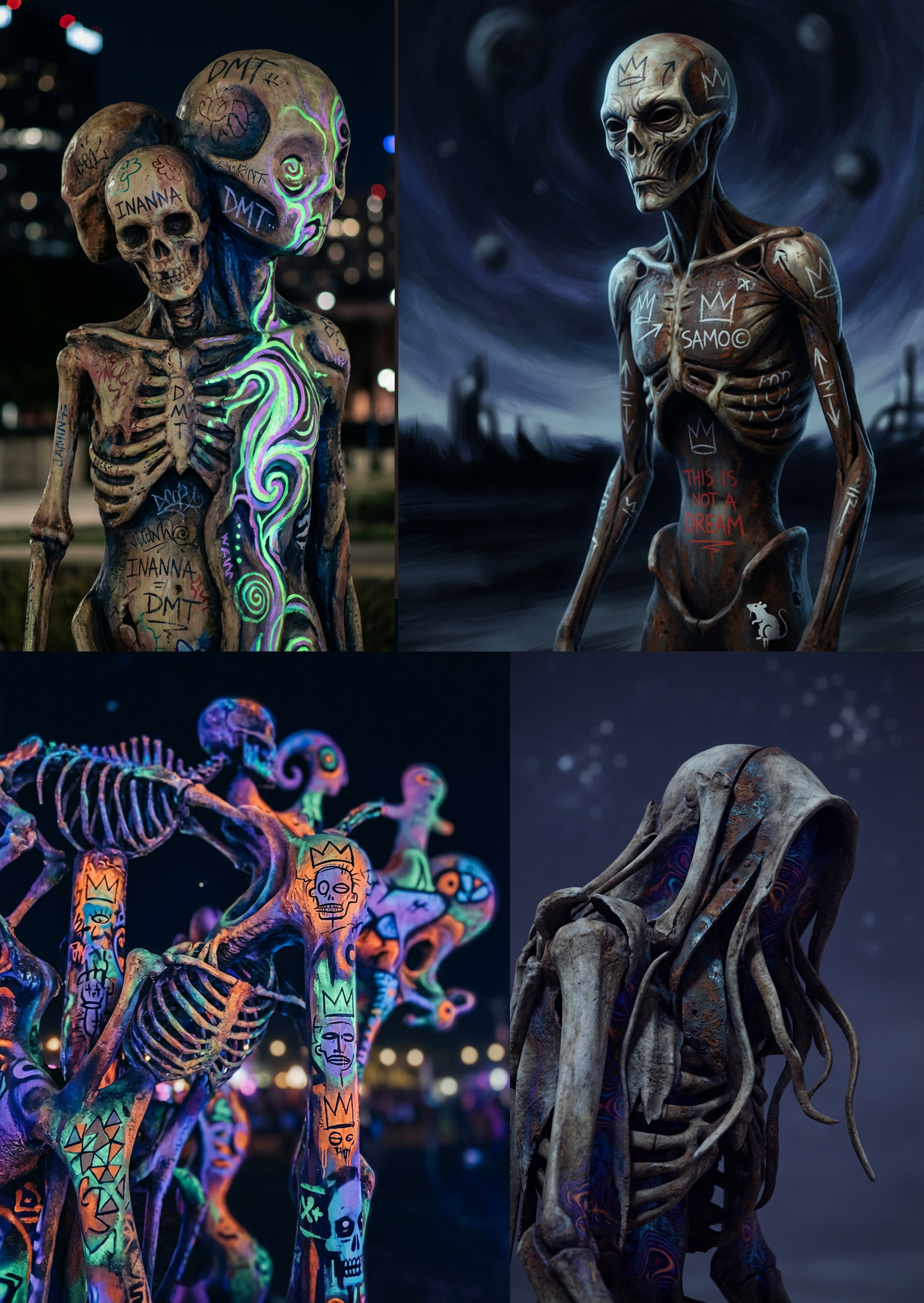
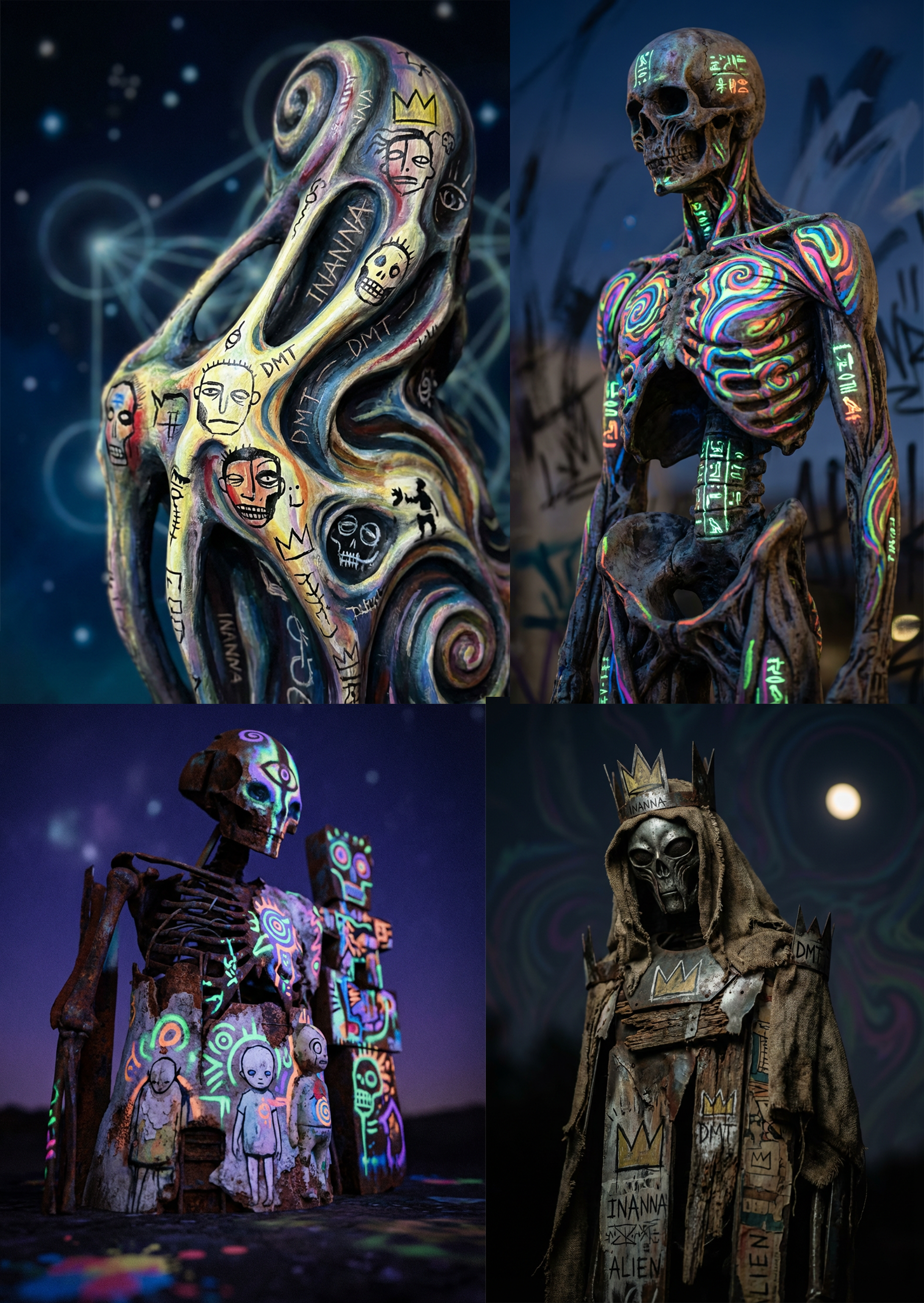
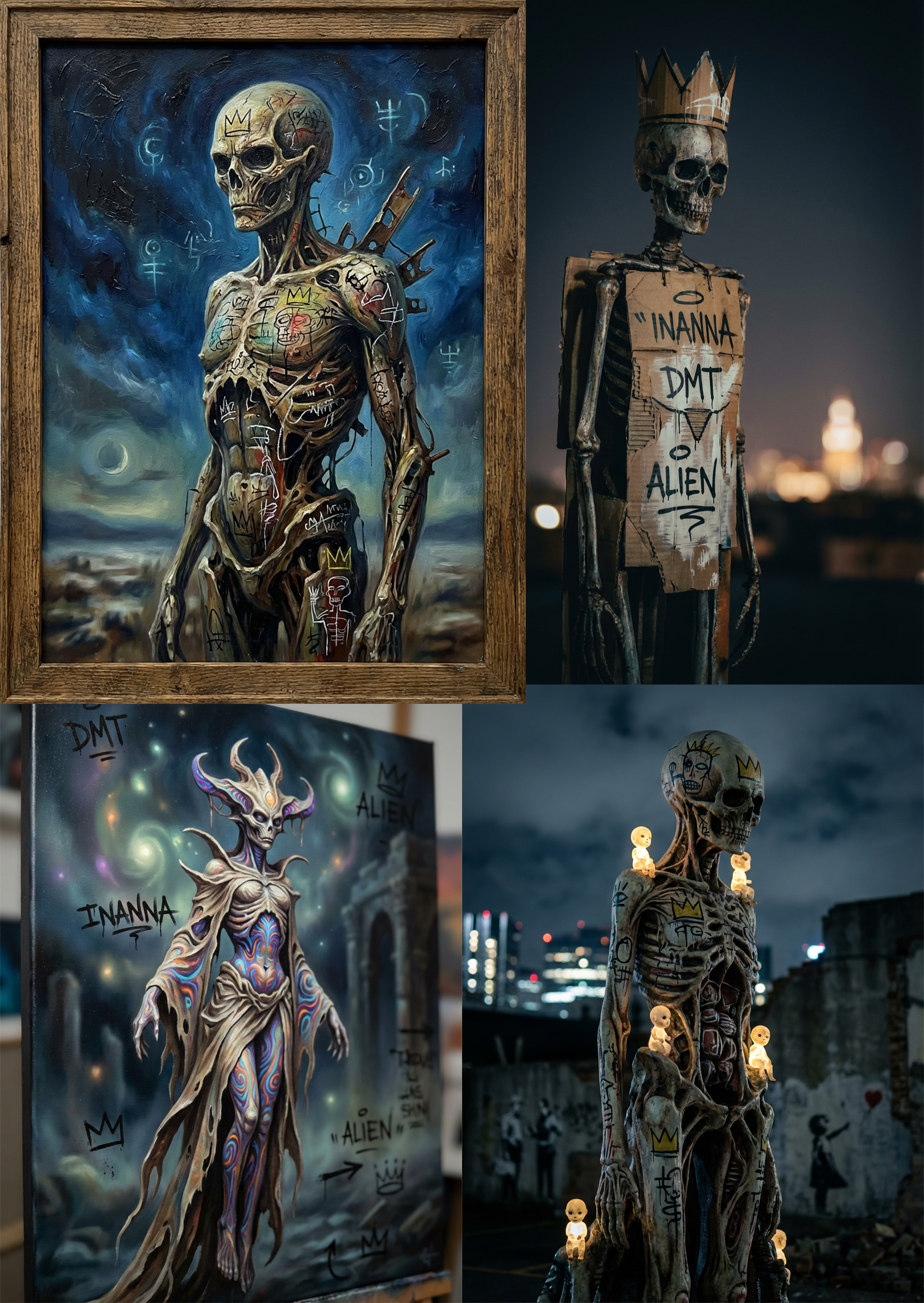
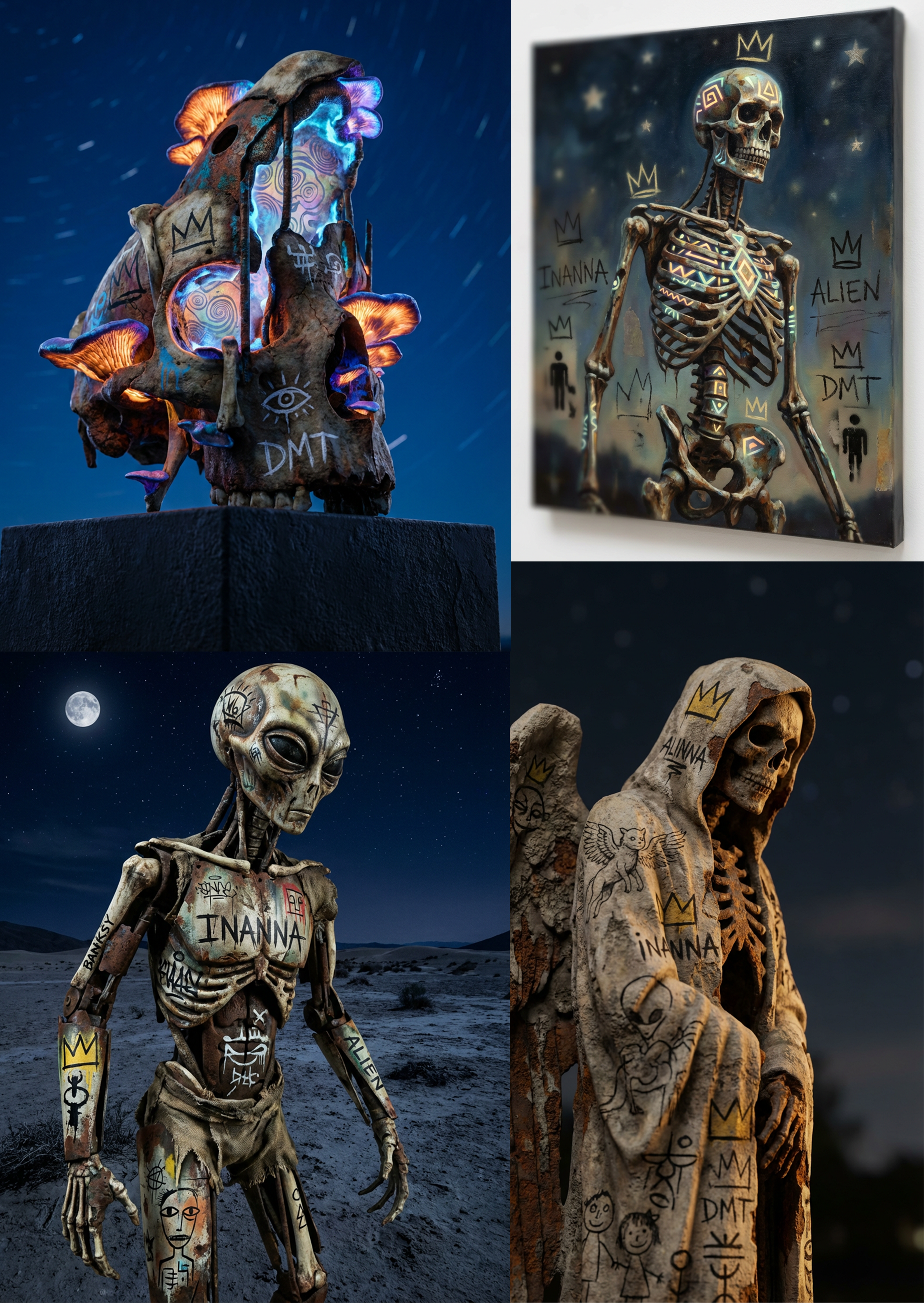
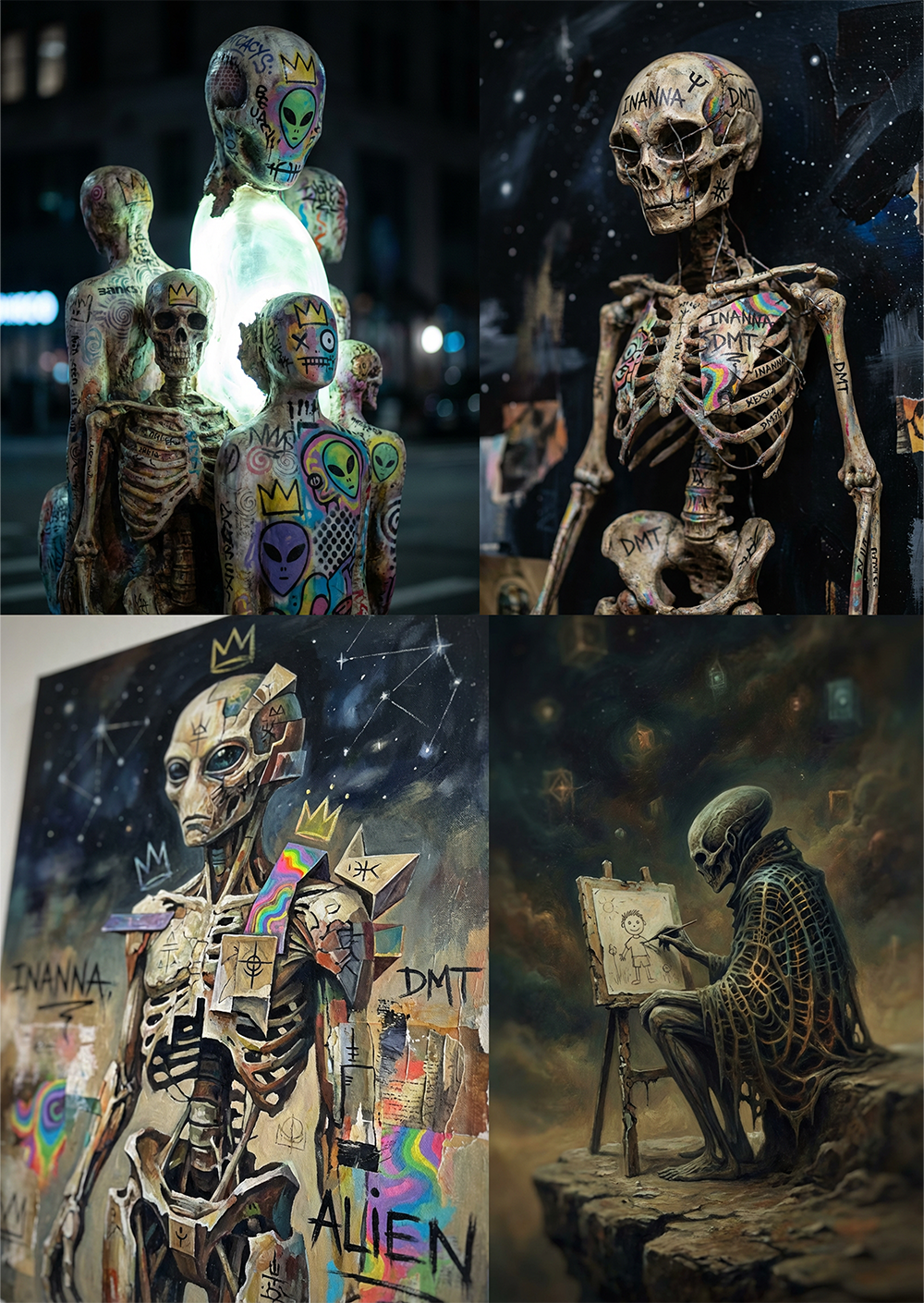
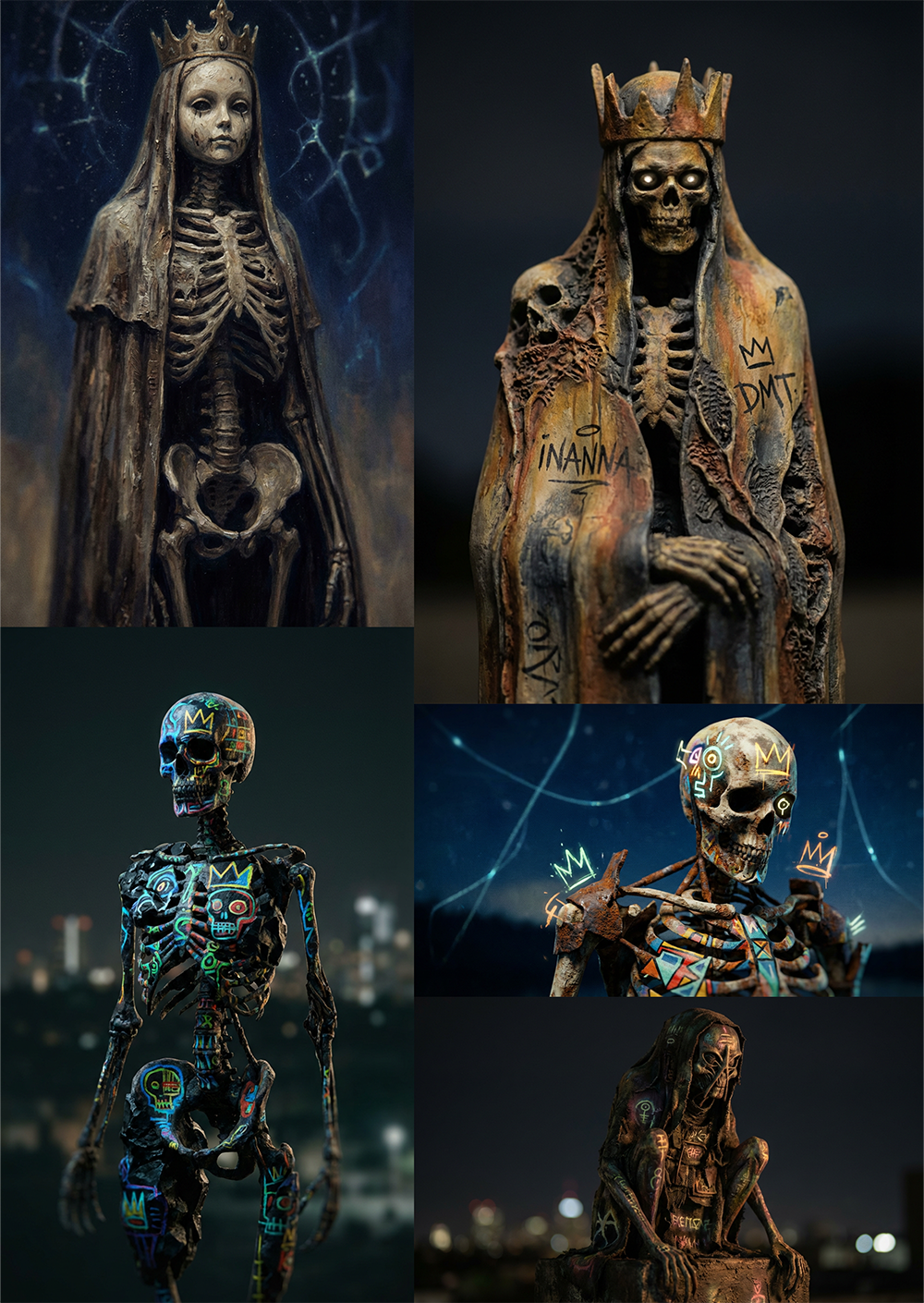
INANNA / DMT / ALIEN: Graffiti Reliquaries is a sequence of AI-assisted “object images” that stage skeletal figures as contemporary devotional artifacts, part street sculpture, part museum relic, part mythic witness. The recurring crown marks and tag-language (Basquiat-adjacent) operate as a vernacular sacred script, while “INANNA” and “DMT” function like invocation keywords, signals of ancient goddess mythology refracted through altered-state aesthetics and post-internet iconography. Across these pages, the body becomes a bulletin board: mortality inscribed with culture; tenderness and childhood symbols placed beside ruin; sanctity rendered as graffiti, glow, and night-city bokeh. The work asks how belief is manufactured now, through images, subcultures, and symbolic repetition, and what new “saints” appear when the archive becomes the altar.
DXARTS relevance: This project treats iconography as a media system, using generative tools to prototype “devotional objects” and test how repetition (tags, crowns, invocations) constructs belief, identity, and collective emotion in contemporary image culture.
-
![]()
Method: AI-assisted icon/object design + staged realism + curatorial authorship
Iterative prompt cycles to generate reliquary variants (skeleton saints, hooded figures, crowned marks, neon-glyph anatomy).
“Speculative object photography” look: shallow depth-of-field, city-night staging, museum-frame cues, material aging (wood, plaster, stone).
Authorial selection for silhouette clarity, motif continuity (crowns / INANNA / DMT / alien faces), and narrative pacing per page.
Finishing pass for coherence: tonal unification, contrast control, and plate/page readability.
-
![]()
Coherence anchor (motifs)
The path: orientation, choice, narrative without characters
Dappled light / particles: attention as a designed phenomenon
Moon / starfield: time as mood; night as sanctuary
Clearings / thresholds: entry points; the “interface moment”
Guardian figure (angel): protection as presence (not dominance)
Savannah horizon: memory + ancestral scale; grounded vastness
-
![]()
Gallery Objects (Inanna / Alien)
Works shown as framed/canvas and “installed” objects, painting, placard-figure, and relic-like bodies punctuated by small luminous companions. The emphasis shifts to translation across mediums: image → artifact → exhibit.
-
![]()
Reliquary Head / Desert Chapel
Skull-shrine with luminous fungi, canvas-icon language, and moon-desert witness. This page feels like a chapel built from remains, tender light inside a ruin grammar.
-
![]()
Orb Choir / Drawing Lesson
A small congregation gathers around a glowing core; the skeleton becomes teacher/observer; the childlike drawing introduces pedagogy and care. The page reframes the cycle as community ritual, not just lone idols.
-
![]()
Crowned Ossuary (Royalty of the Ruin)
A queen-like figure, a crowned robed king, neon-ink bones, and a seated hooded witness. The page is about authority and inheritance: who wears the crown when the body is already dust.
Luminous Ecologies (Paths, Guardians, Atmospheres)
-
![]()
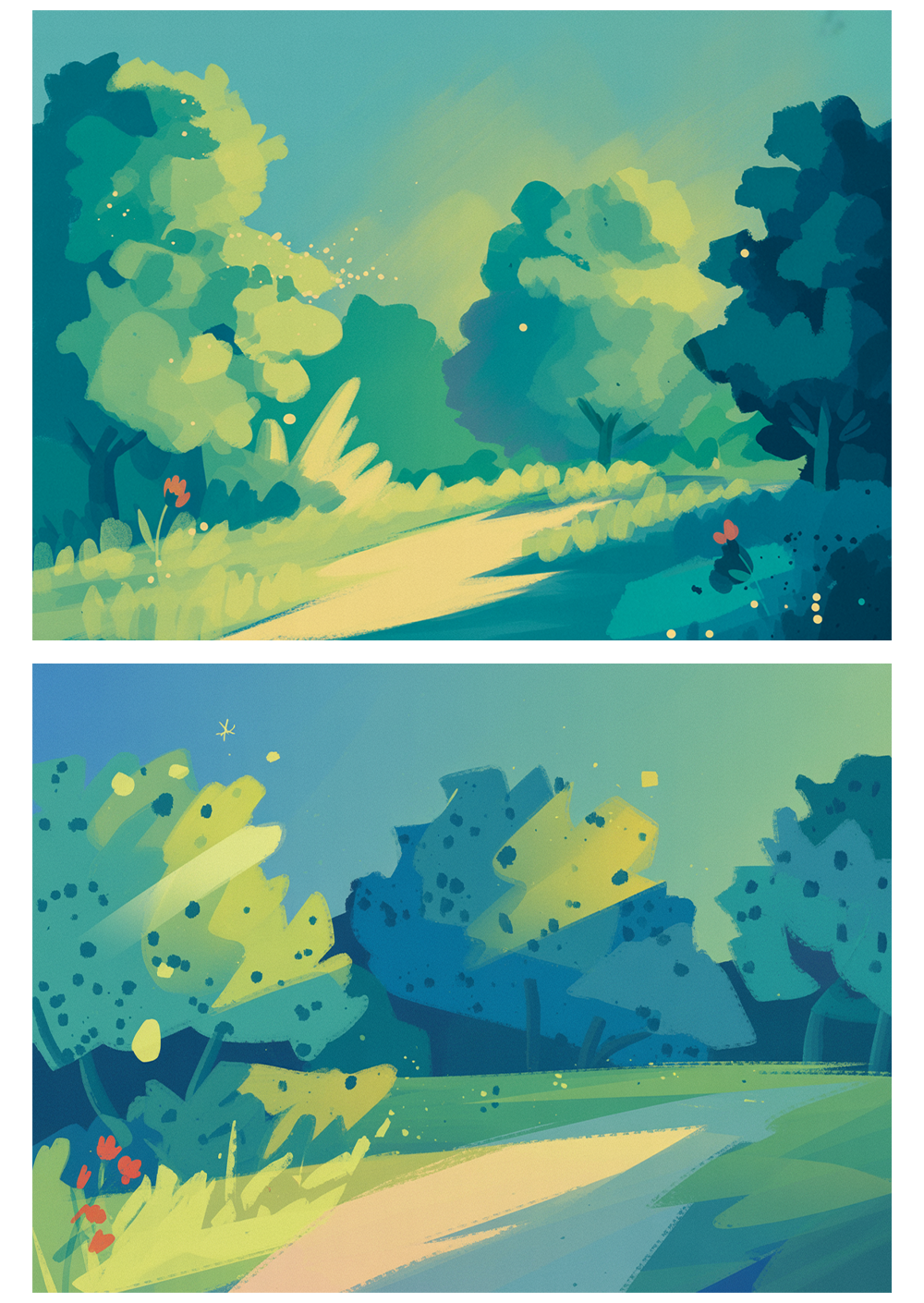
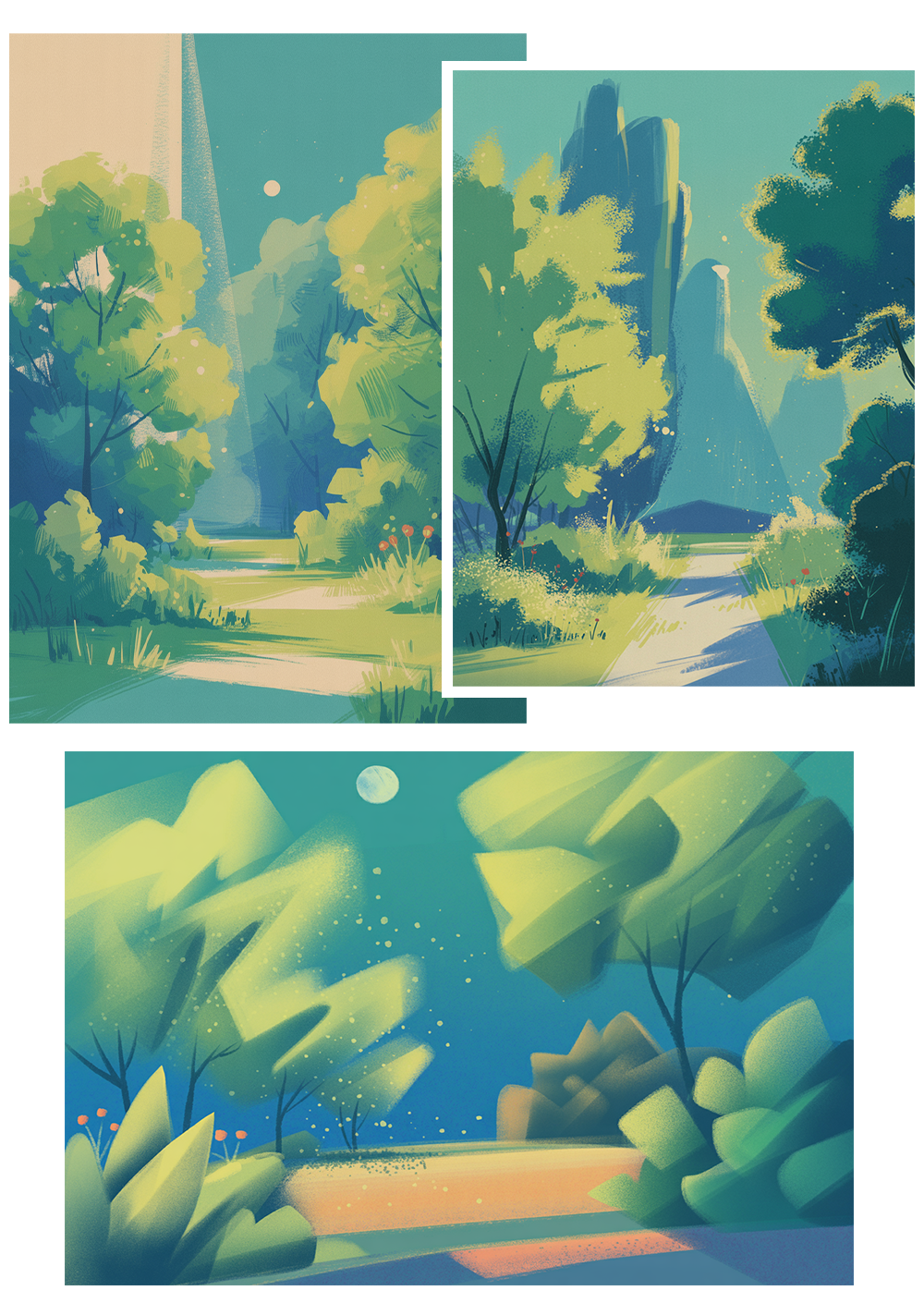
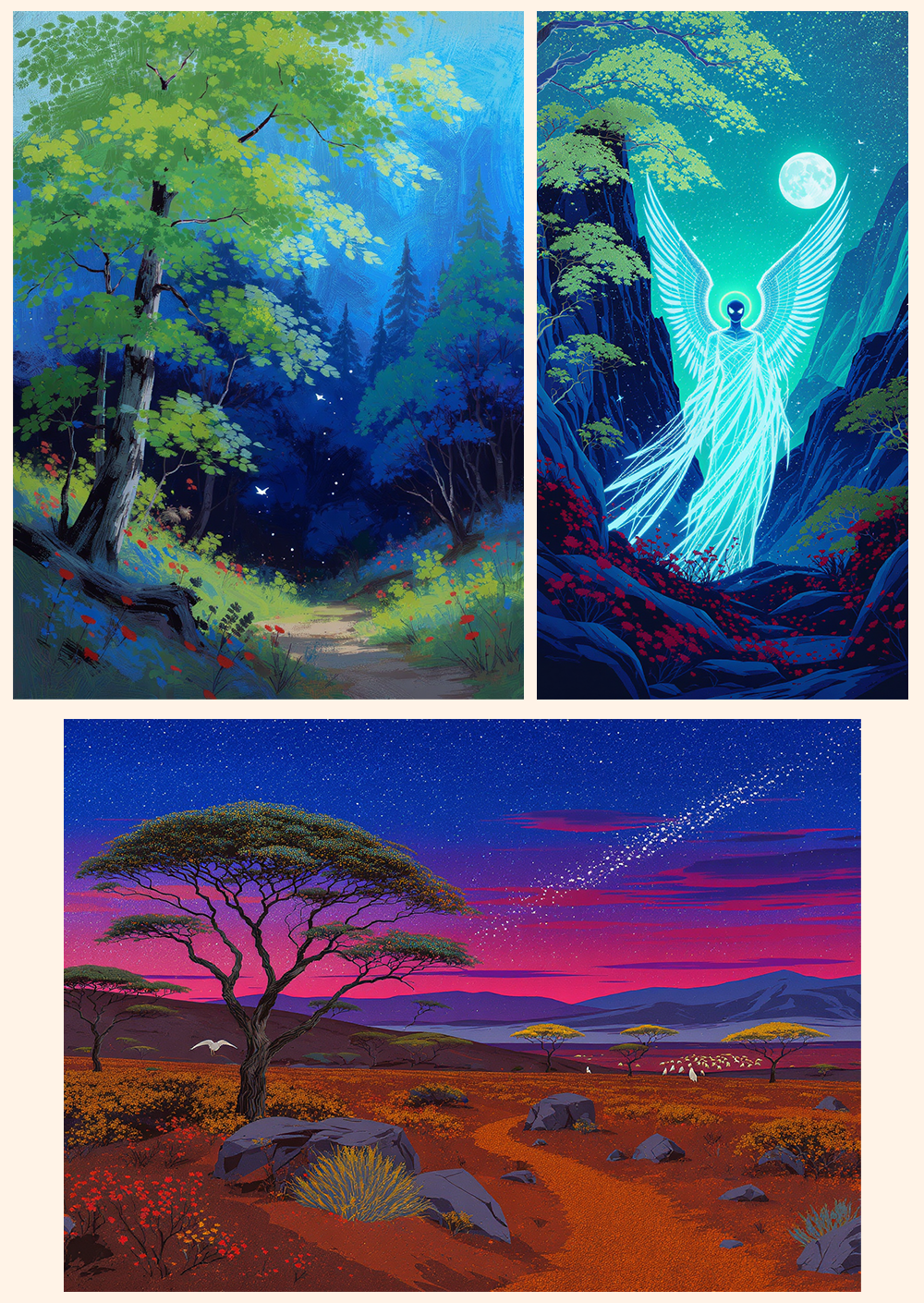
Luminous Ecologies is a series of AI-assisted landscape plates that treat environment as an emotional interface: paths that invite entry, canopies that hold dappled light, and horizons that function as calm thresholds. Across these pages, the “world” is built from soft gradients and simplified forms, but the logic is rigorous—color scripting, consistent light behavior, and repeated compositional motifs (the path, the clearing, the moon, the guardian). The work asks how gentleness can be engineered without becoming decorative: how visual systems can produce safety, orientation, and awe—and how a viewer’s attention shifts when the world is designed for repair rather than shock.
DXARTS relevance: These works treat atmosphere as a media system, testing how light, palette, and compositional rules can reliably generate orientation, safety, and awe as embodied viewer experiences.
-
![]()
Method: AI-assisted environment painting + color scripting + curation as authorship
Iterative prompt cycles focused on light behavior (glow, haze, particles, moonlight).
Authorial selection for legible composition (path leading-lines, focal clearings, depth layers).
Palette discipline (teal/green-gold “day calm”; indigo/violet “night calm”; savannah dusk).
Finishing pass for coherence: edge control, contrast tuning, atmospheric perspective, and page-to-page continuity.
-
![]()
Coherence anchor (motifs)
The path: orientation, choice, narrative without characters
Dappled light / particles: attention as a designed phenomenon
Moon / starfield: time as mood; night as sanctuary
Clearings / thresholds: entry points; the “interface moment”
Guardian figure (angel): protection as presence (not dominance)
Savannah horizon: memory + ancestral scale; grounded vastness
-
![]()
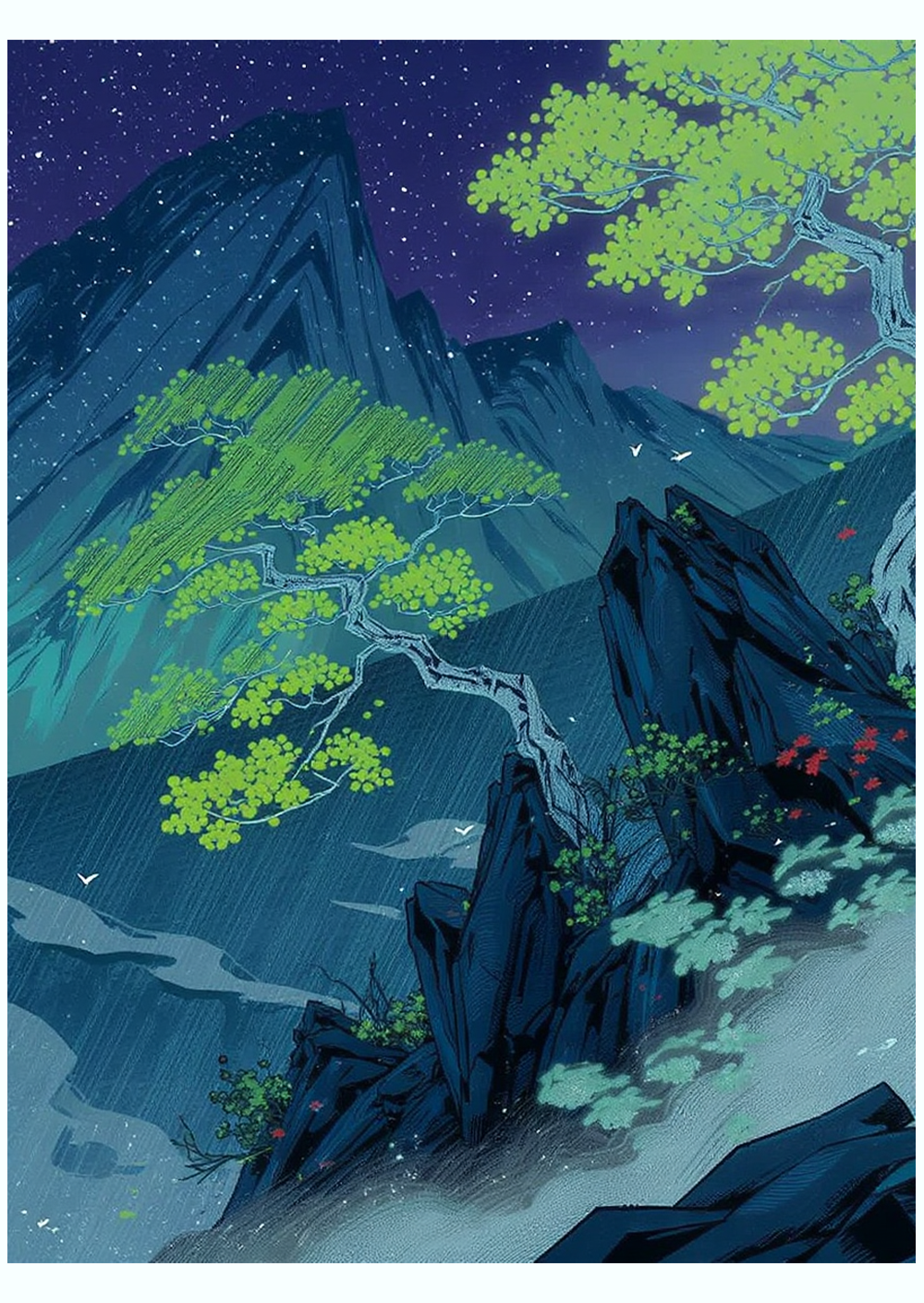
Night Ridge (Starfield Mountain)
A single, strong nocturne: mountain mass, bright leaves, and a sky that reads like velvet—quiet power. This page closes the set by shifting calm into awe.
Crownscript Cities (Graffiti as Architecture)
-
![]()
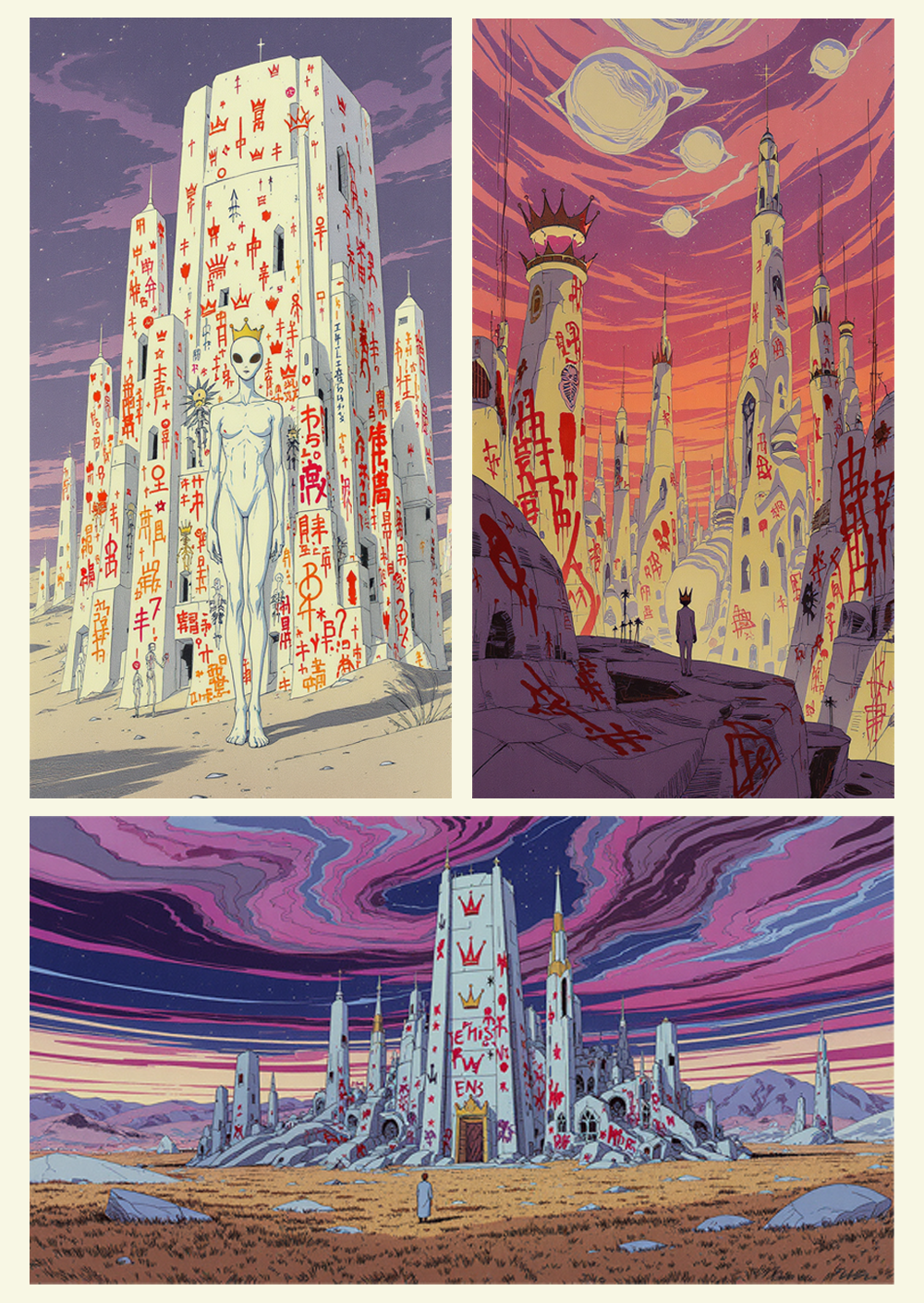
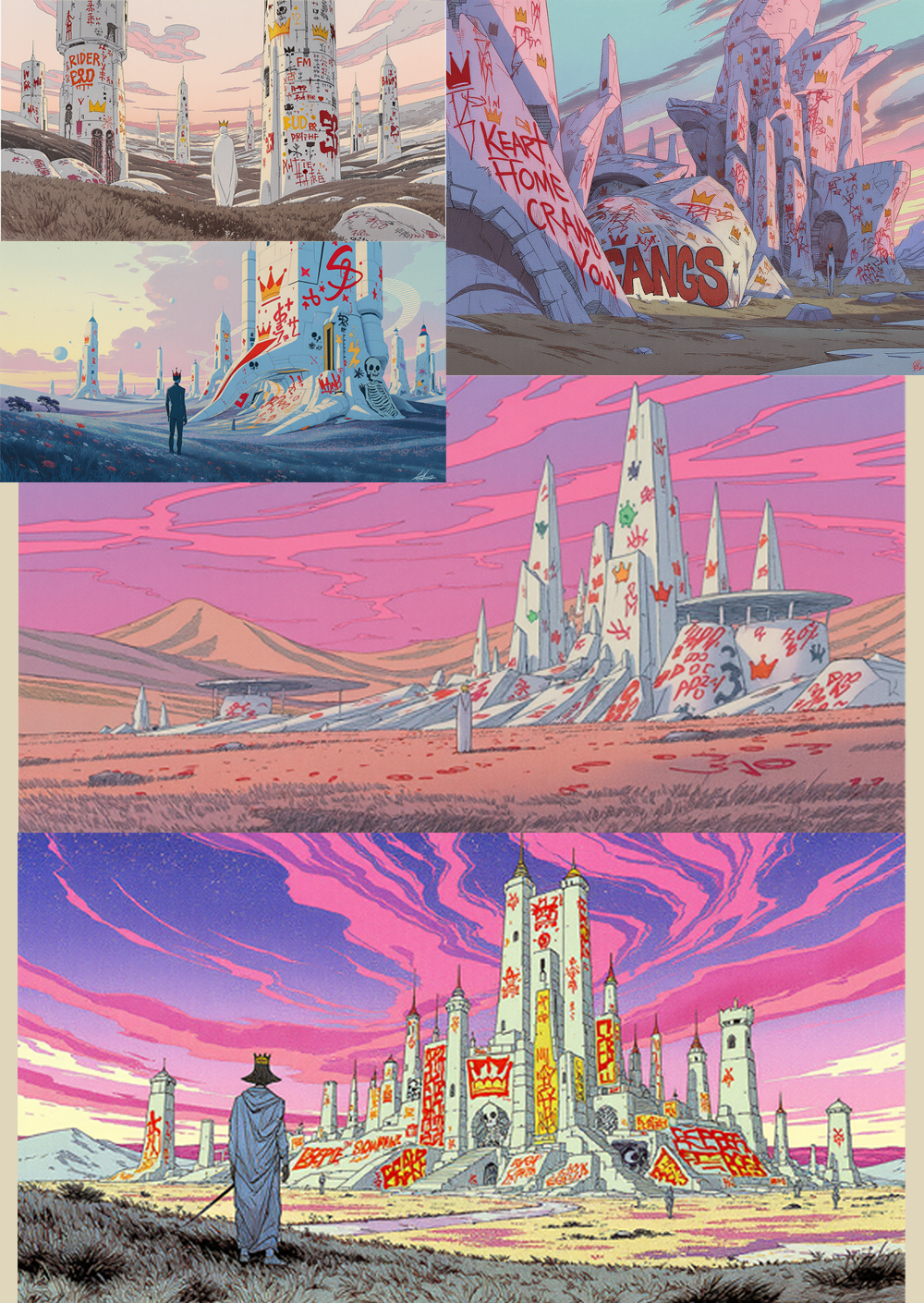
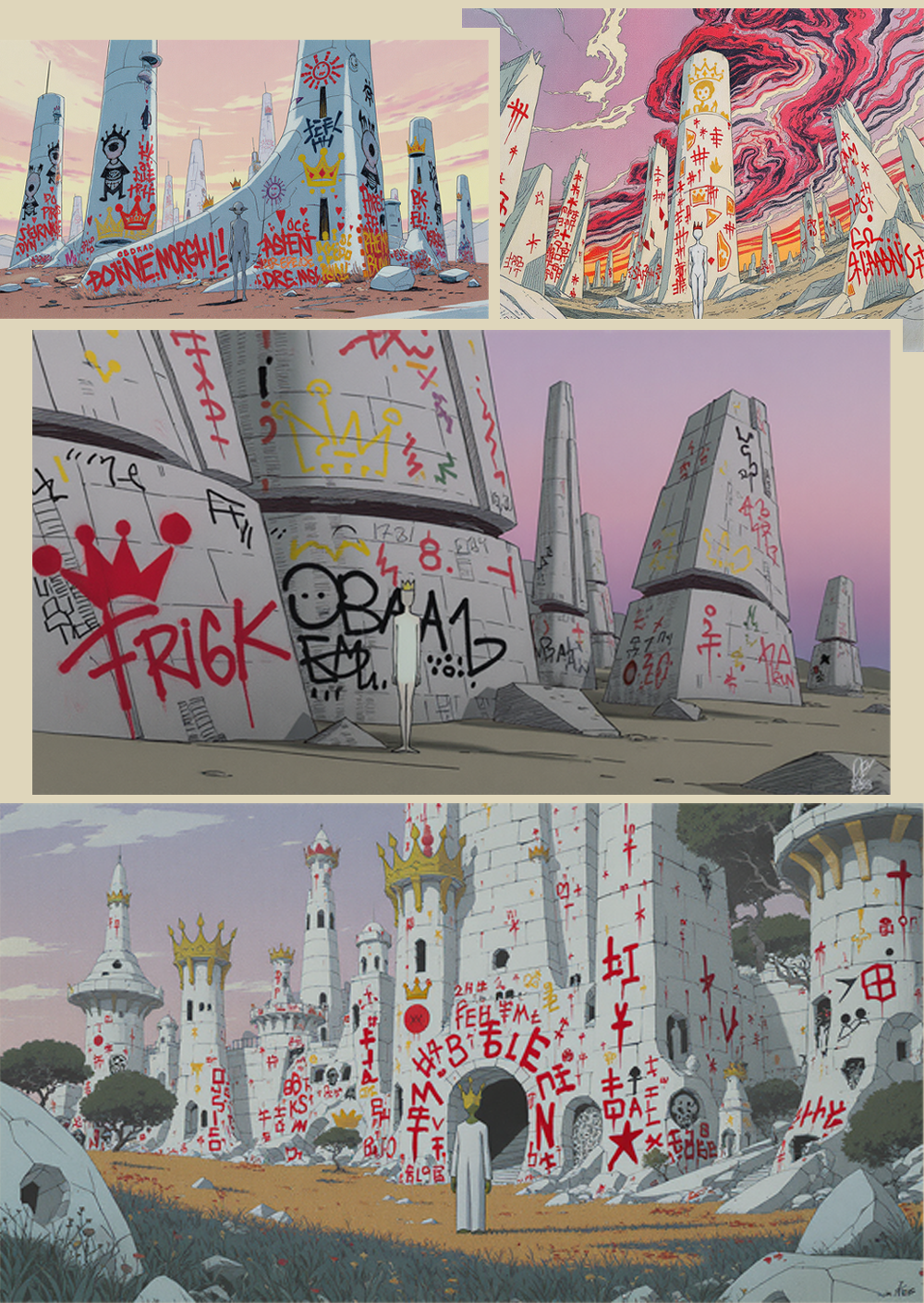
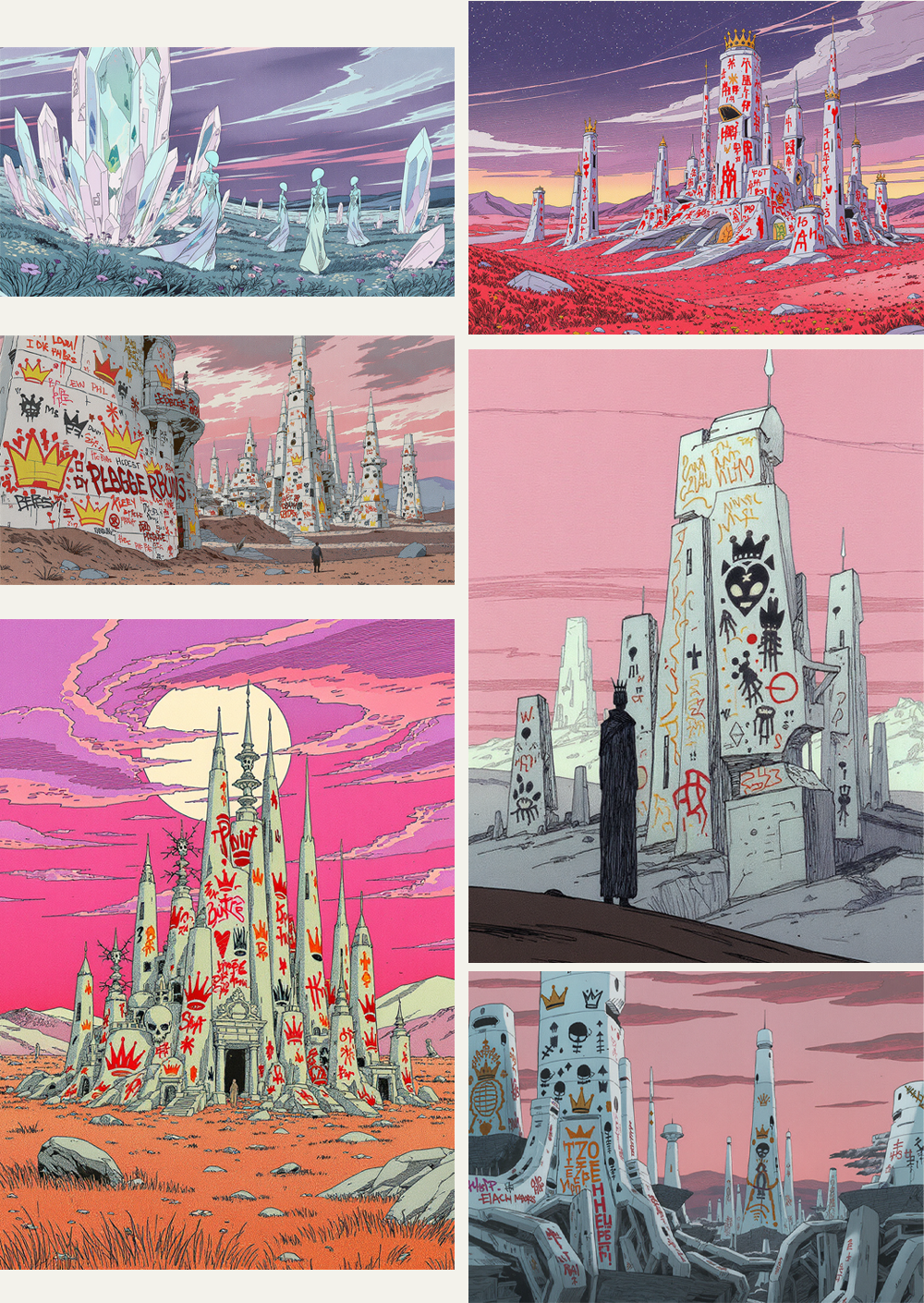
Crownscript Cities is a series of AI-assisted environment plates that treat architecture as a writable surface, and tagging as a form of public ritual. Across these pages, tall white monoliths and cathedral-towers are covered in repeating crown marks, glyphs, and warnings, transforming the built world into a living manuscript. Small witnesses (a lone figure, a crowned pilgrim, an “alien” body) establish scale and ethics: the city is not neutral; it speaks, instructs, excludes, and blesses. The work asks what happens when language becomes landscape, when collective identity is inscribed onto infrastructure, so that place itself functions like a social operating system.
DXARTS relevance: This series treats architecture as a media system—testing how repeated symbols (crowns/glyphs), environment design, and camera-path logic produce belief, authority, and belonging as spatial experiences.
-
![]()
Method: AI-assisted worldbuilding + environment design + motif-system control
Iterative prompt cycles focused on consistent urban grammar (monolith towers, cathedral clusters, horizon scale cues).
Authorial selection for readable composition (approach path → threshold → wide establishing view).
Motif discipline: crowns + red glyph layer repeated like a rule-set across scenes.
Finishing pass for coherence: palette control (violet dusk / pink sunset / sand daylight), contrast tuning, and “plate” clarity.
-
![]()
Coherence anchor (motifs)
Crown mark: authority, authorship, vernacular sovereignty
Red glyph layer: public script; warnings/blessings; “law written on walls”
White towers: purity/monumentality as a canvas for ideology
Pilgrim / lone witness: scale + vulnerability; ethics of belonging
Cathedral clustering: belief made infrastructural
Sky as mood engine: the heavens as propaganda / revelation / omen
Crystals (in one page): alternate “sacred material” vs. sacred text
-
![]()
Crystal Sanctuary vs. Crown Ruins
A contrast page: a crystalline gathering on one side, and the crown-tag urban field on the other. It introduces a second sacred grammar, mineral silence versus written authority.
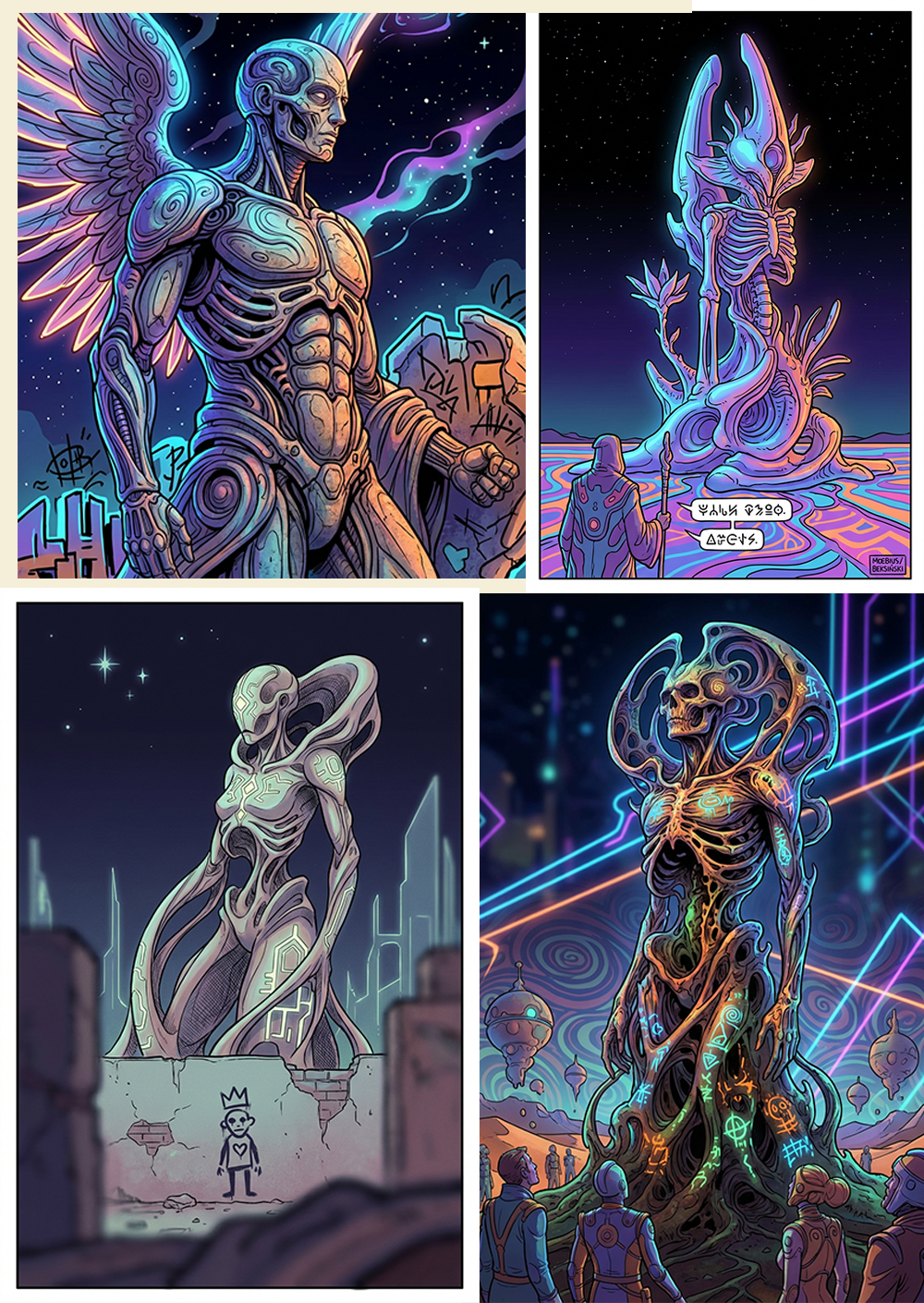
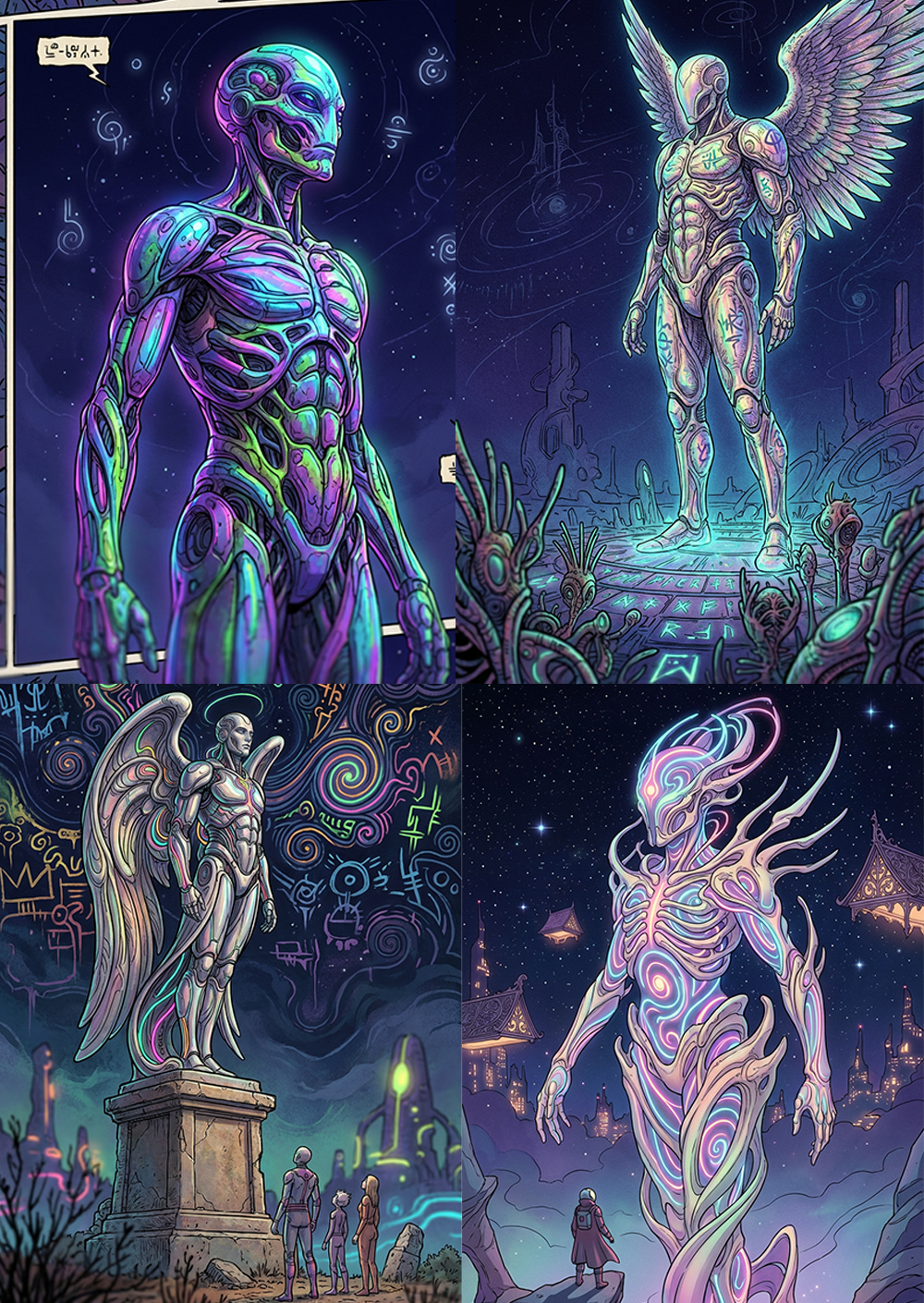
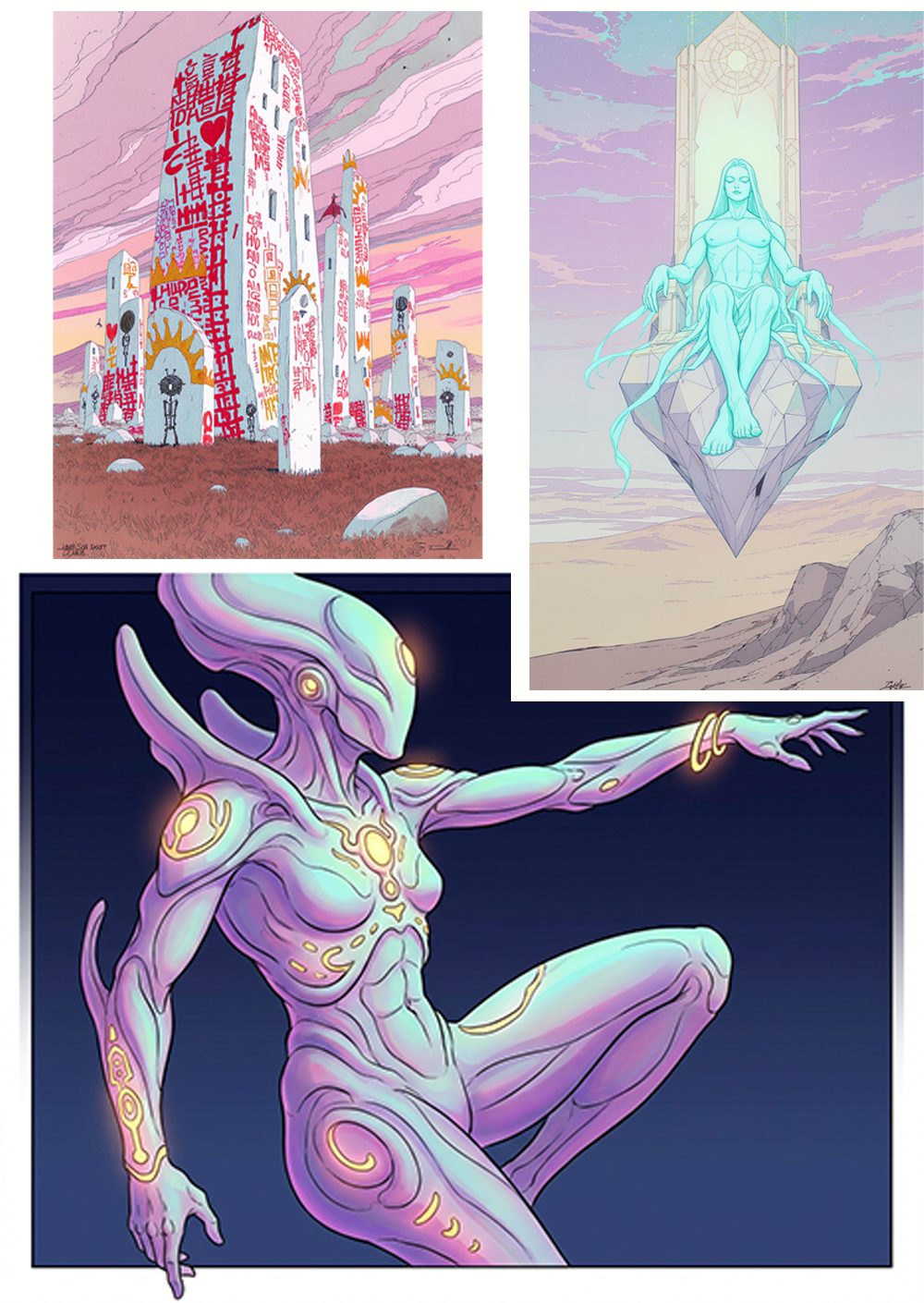
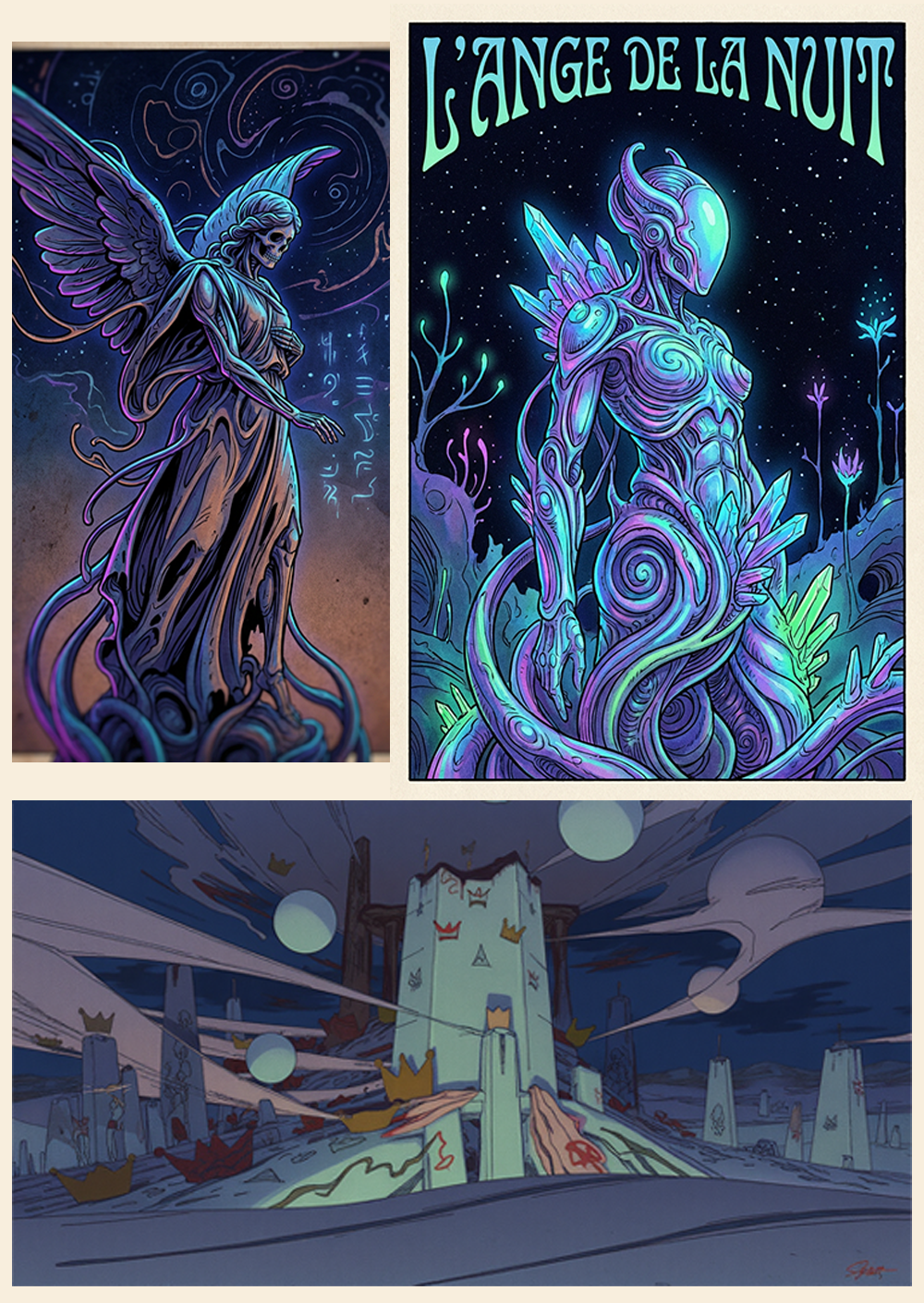
Angels of the Neon Night: Synthetic Guardians
-
![]()
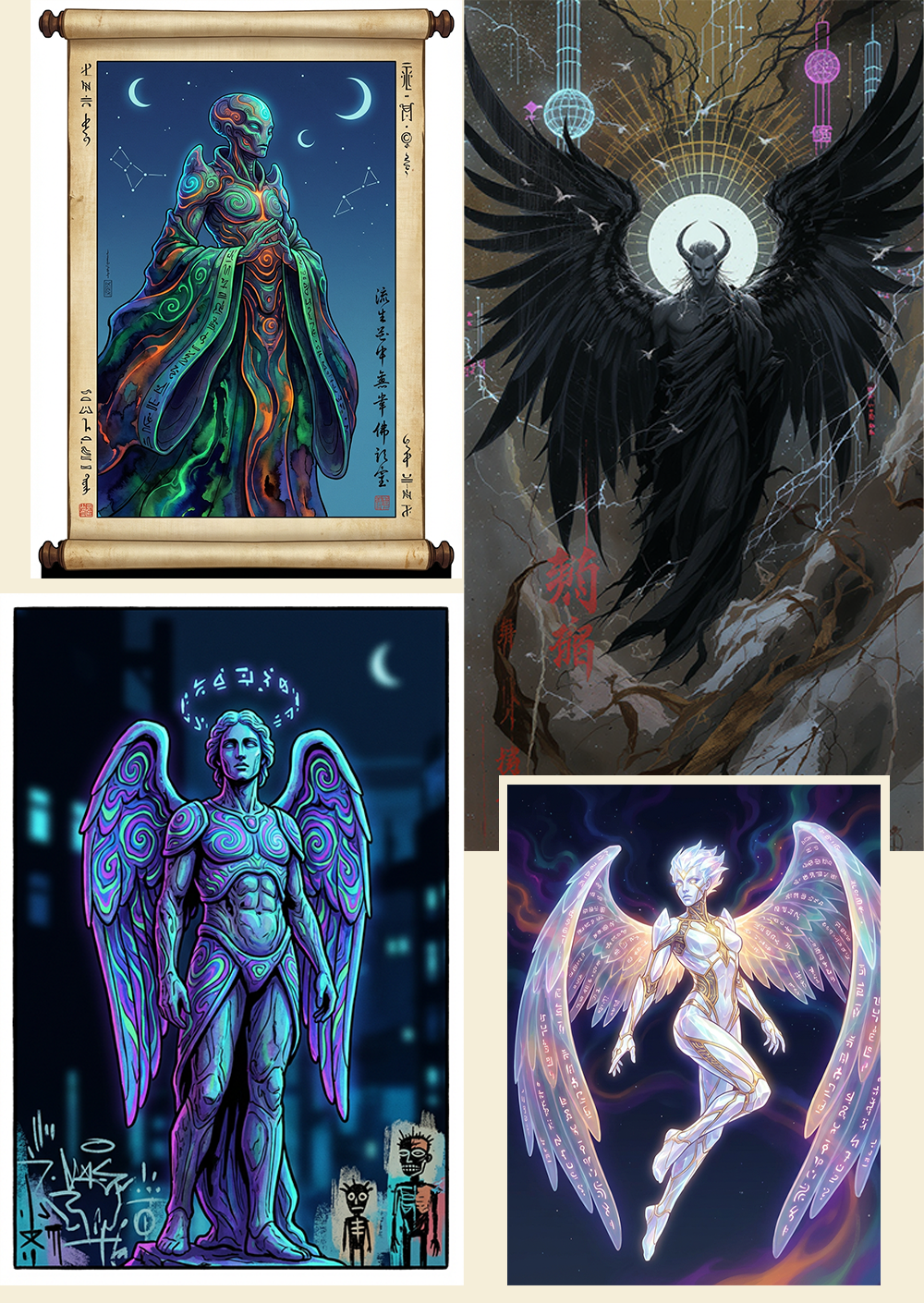
Angels of the Neon Night recodes the angel as a contemporary interface: part guardian, part broadcast, part weaponized beauty. Wings become circuitry; halos become light-engines; bodies become luminous diagrams. These are not devotional angels, they are mythic prototypes for the age of surveillance and spectacle: beings that promise protection while also revealing how protection can become control.
-
![]()
Method: AI-assisted character/icon design + poster logic + motif rules
Prompt-cycles for wing architectures (feather/circuit/hard-light variants)
Poster composition: central figure + emblematic framing + symbolic text
Palette control: neon violet/teal + deep night backgrounds
Variant curation: “guardian types” rather than individual characters
-
![]()
Motifs
Wings: amplification (protection or dominance)
Halo: attention device / UI crown
Night city: modern cathedral / control-horizon
Myth text / scroll framing: authority through presentation
-
![]()
The Scroll Seraph (Archive Format)
A page staged like a discovered artifact: the angel presented as a documented “type.” The framing implies institutional legitimacy, myth delivered as a credential.
-
![]()
L’Ange de la Nuit (Poster + Ruin Horizon)
A direct poster logic (“the night angel”) set against a ruin-city echo. The question embedded in the page is structural: is this protection, propaganda, or both?
Saints of the Signal: A Post-Digital Icon Cycle
-
![]()
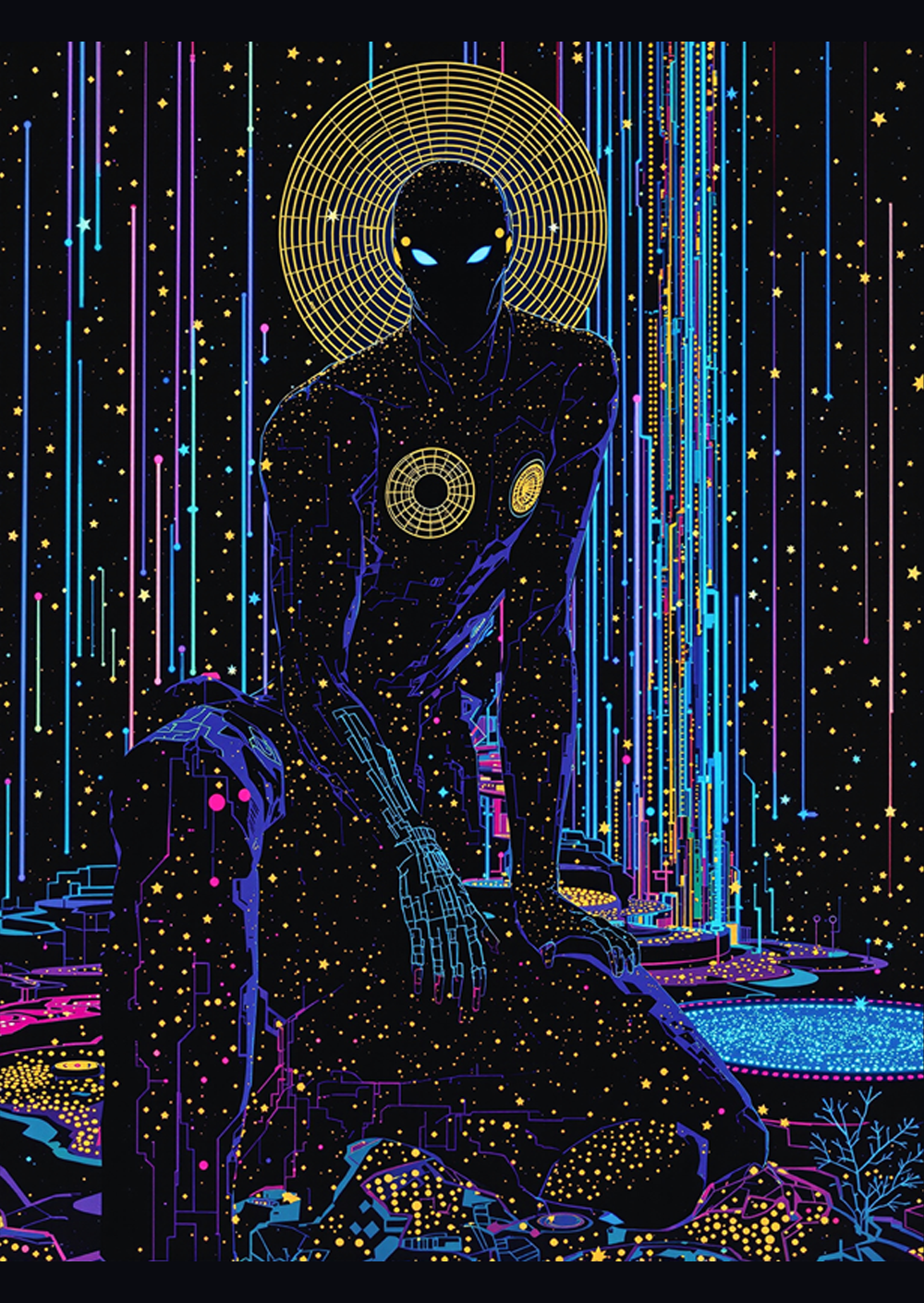
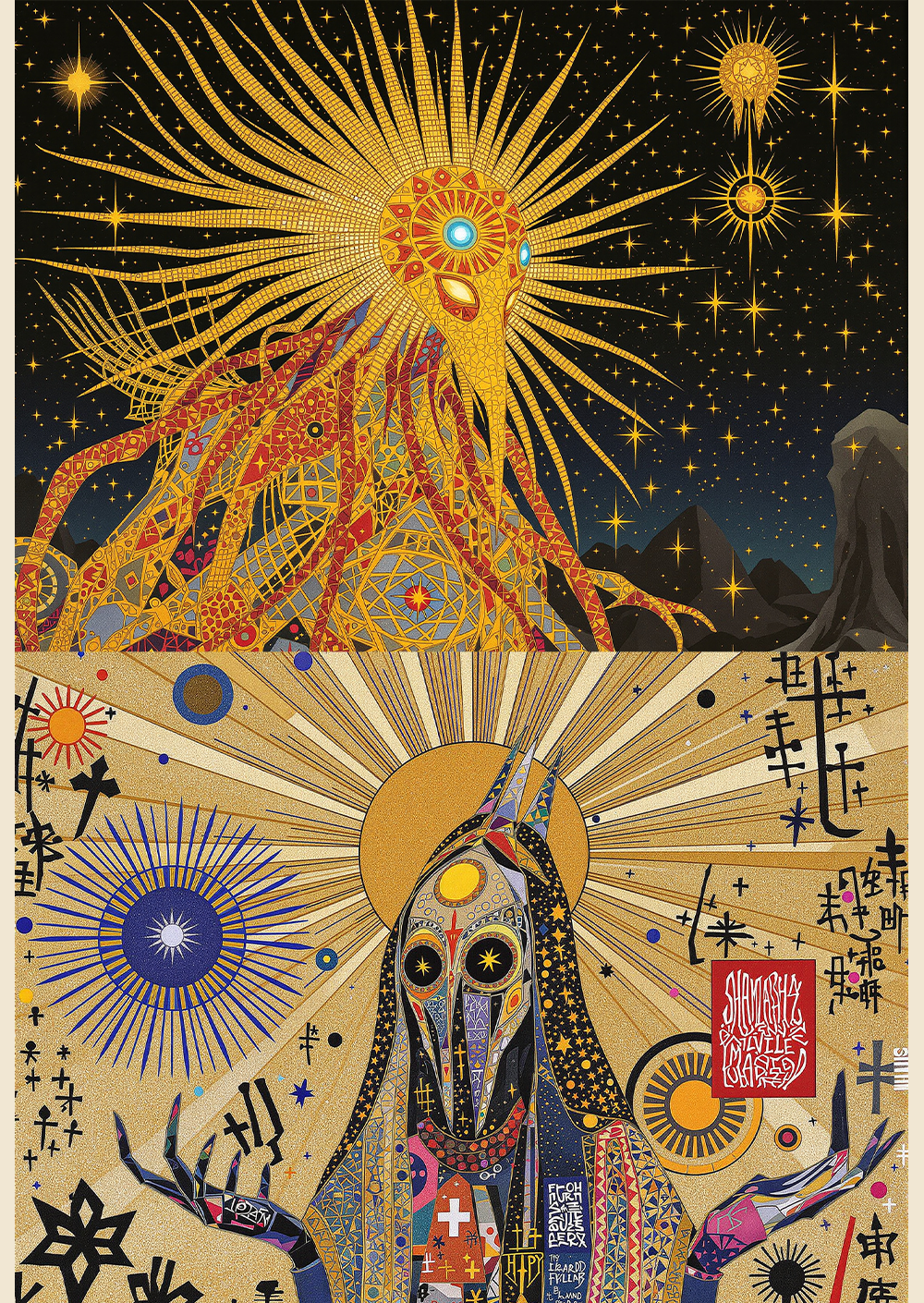
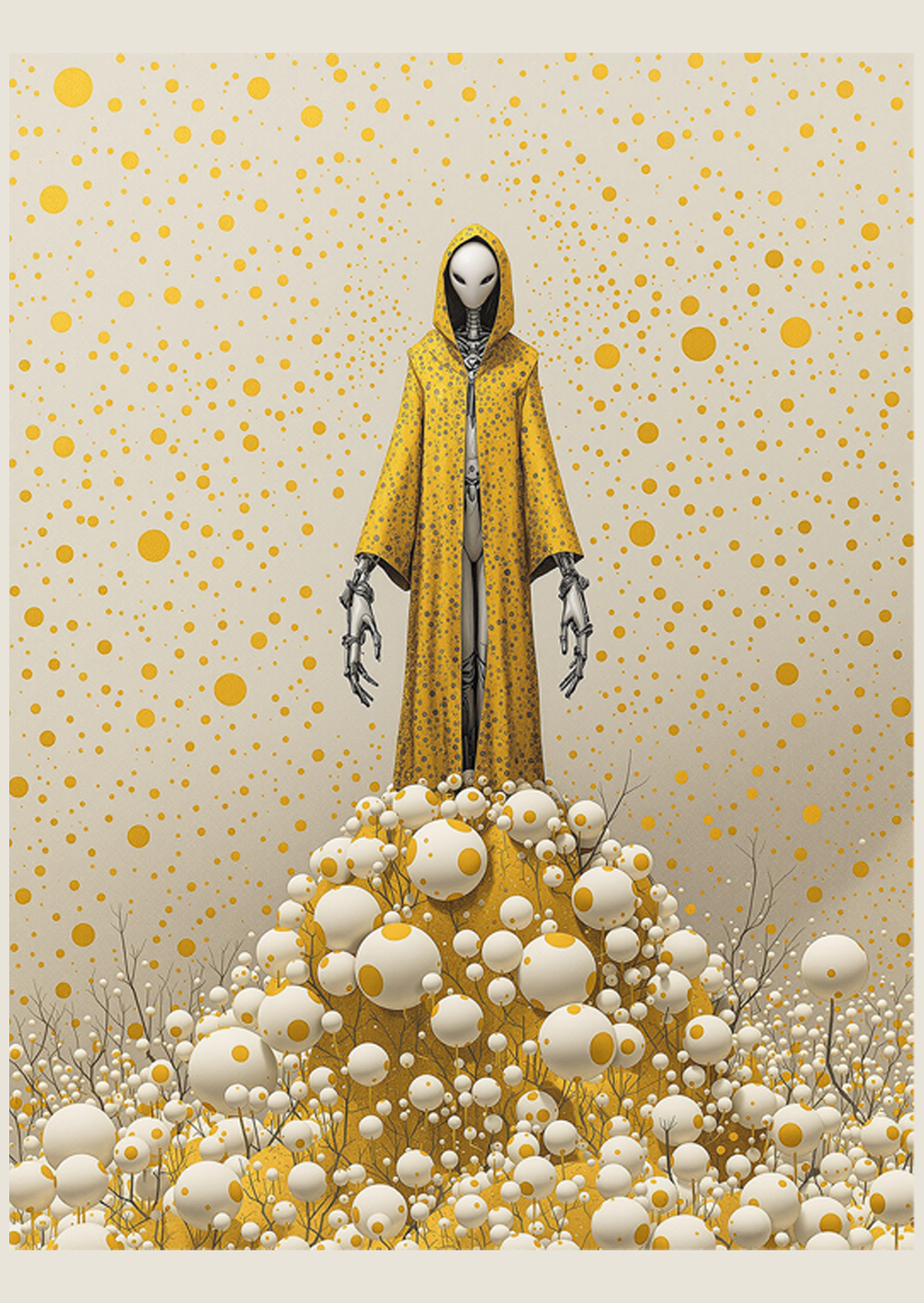
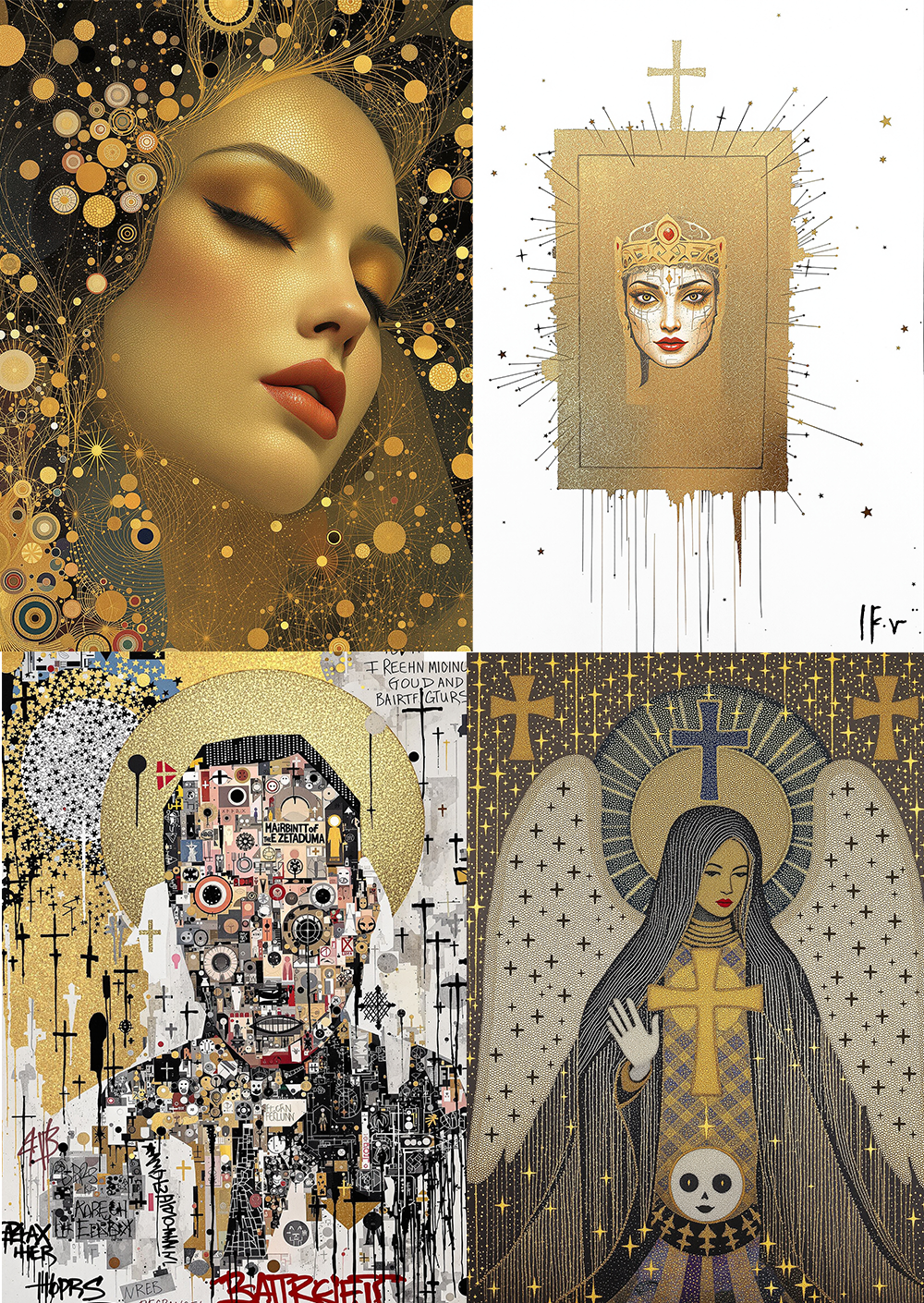
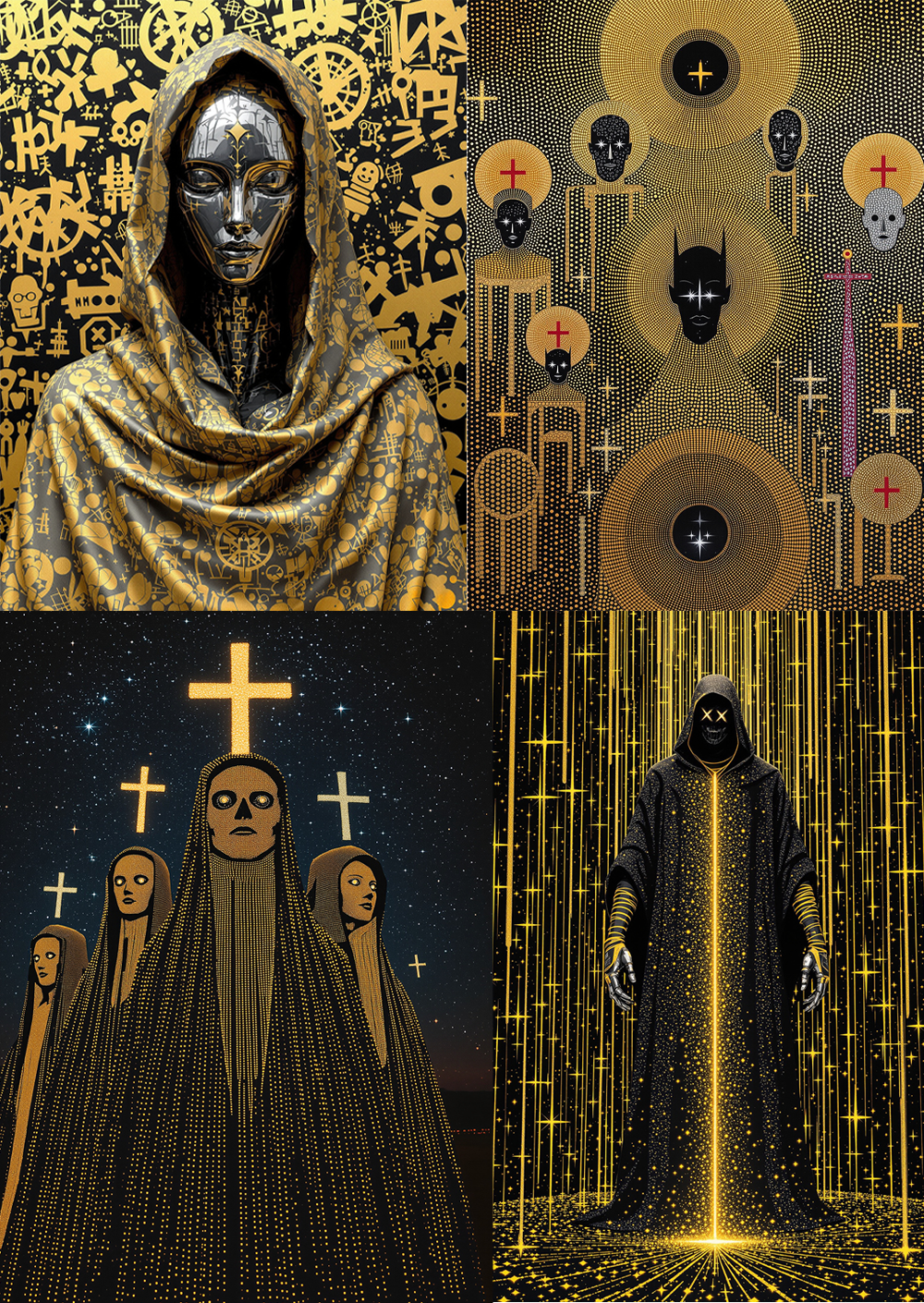
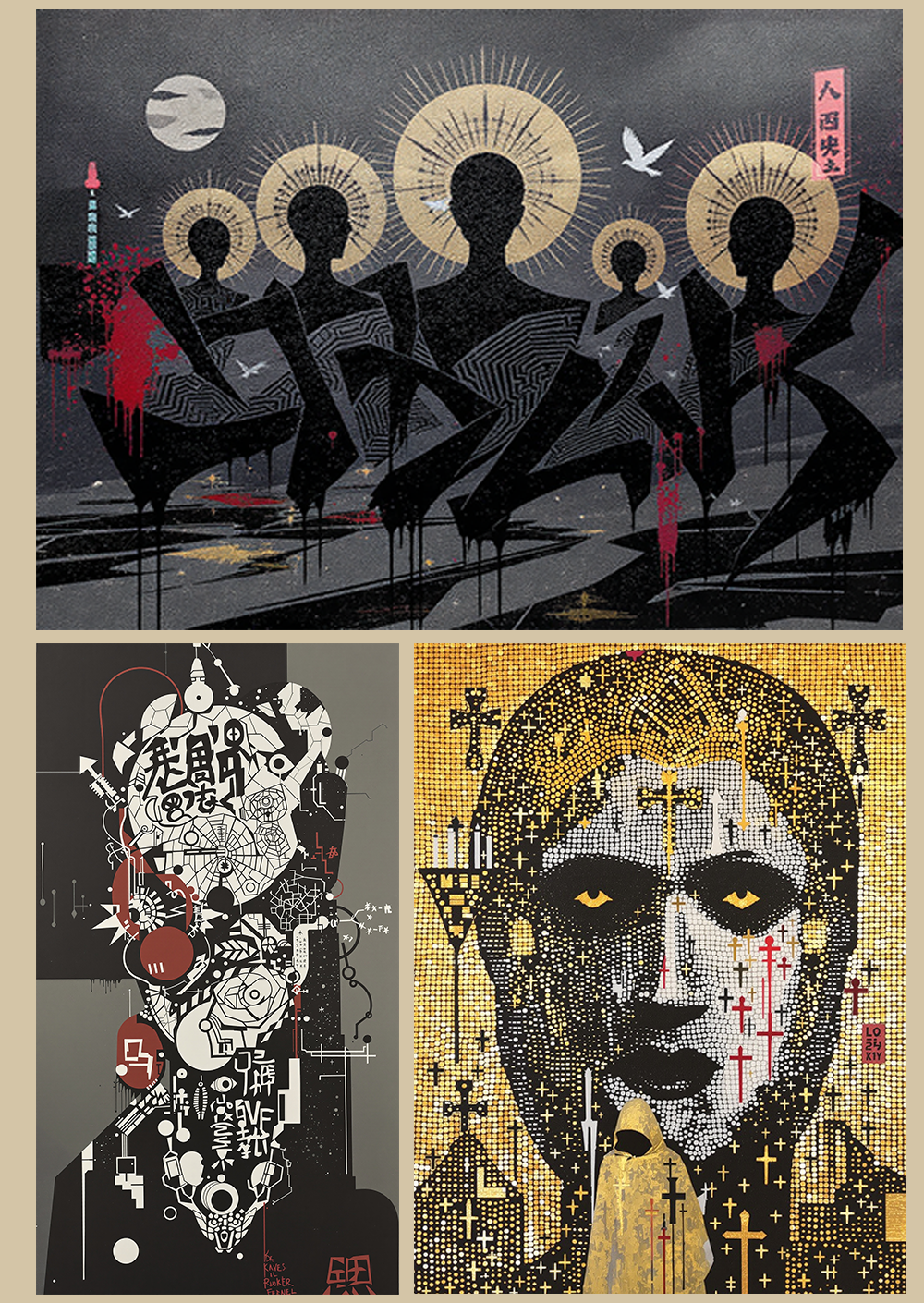
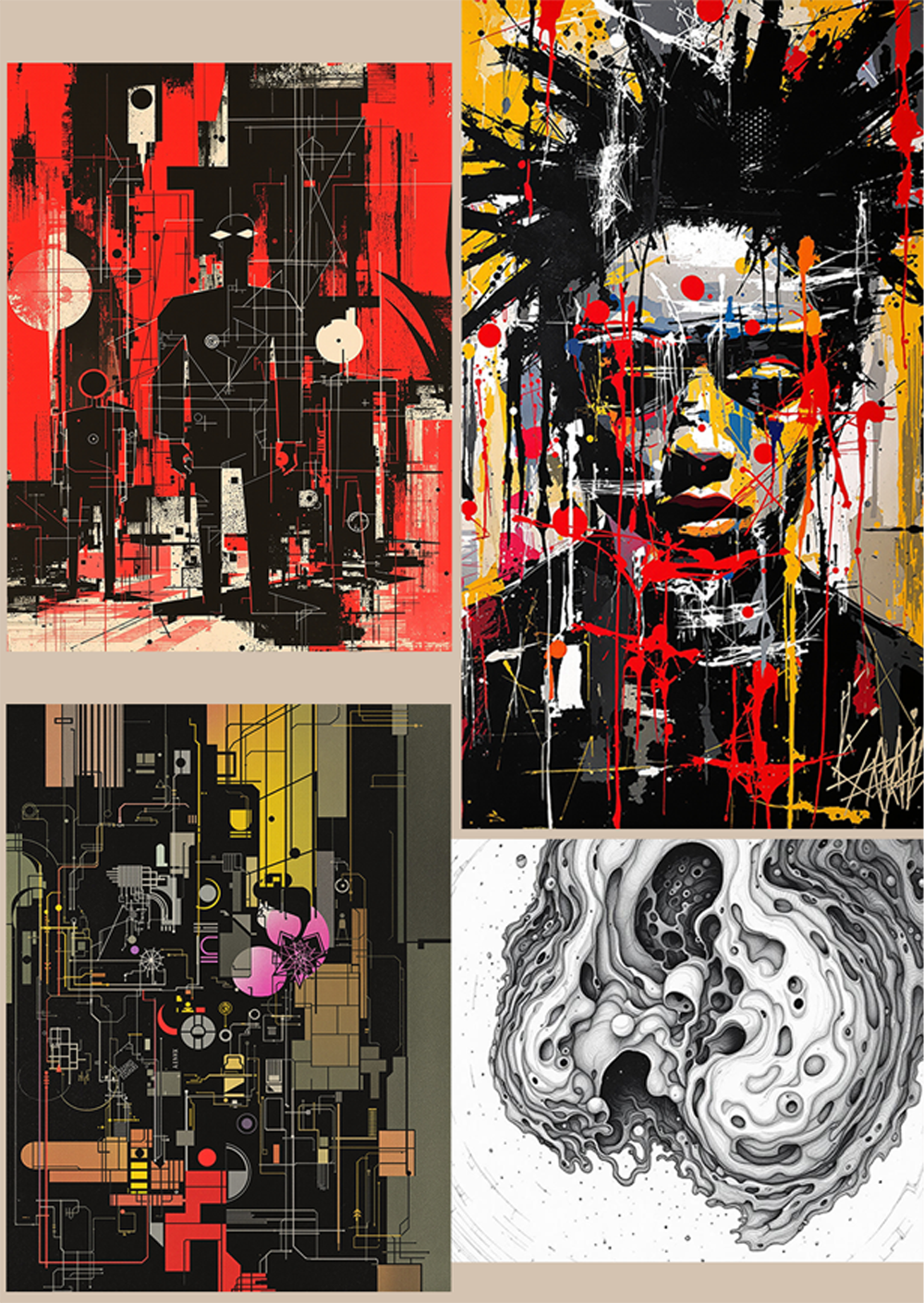
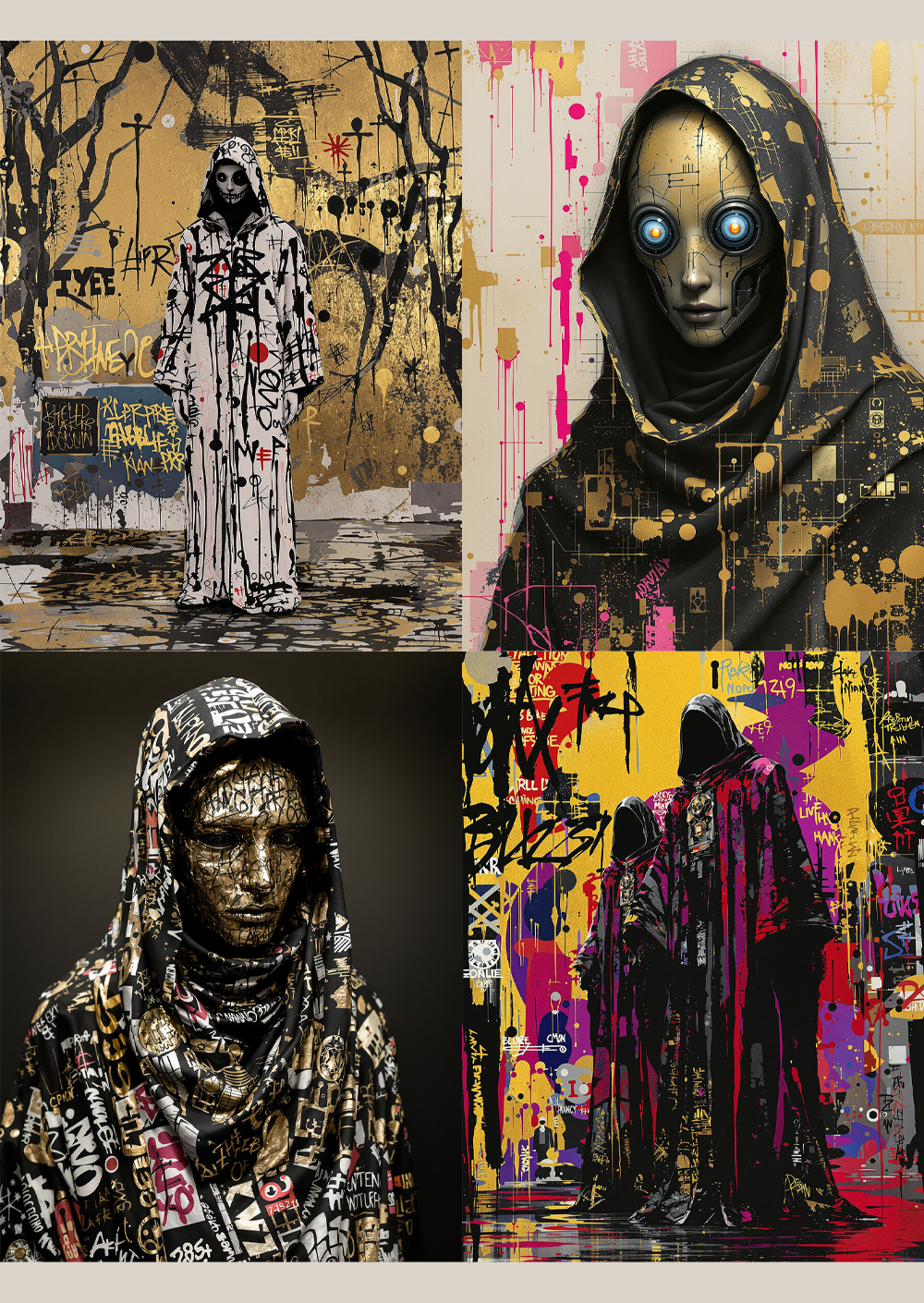
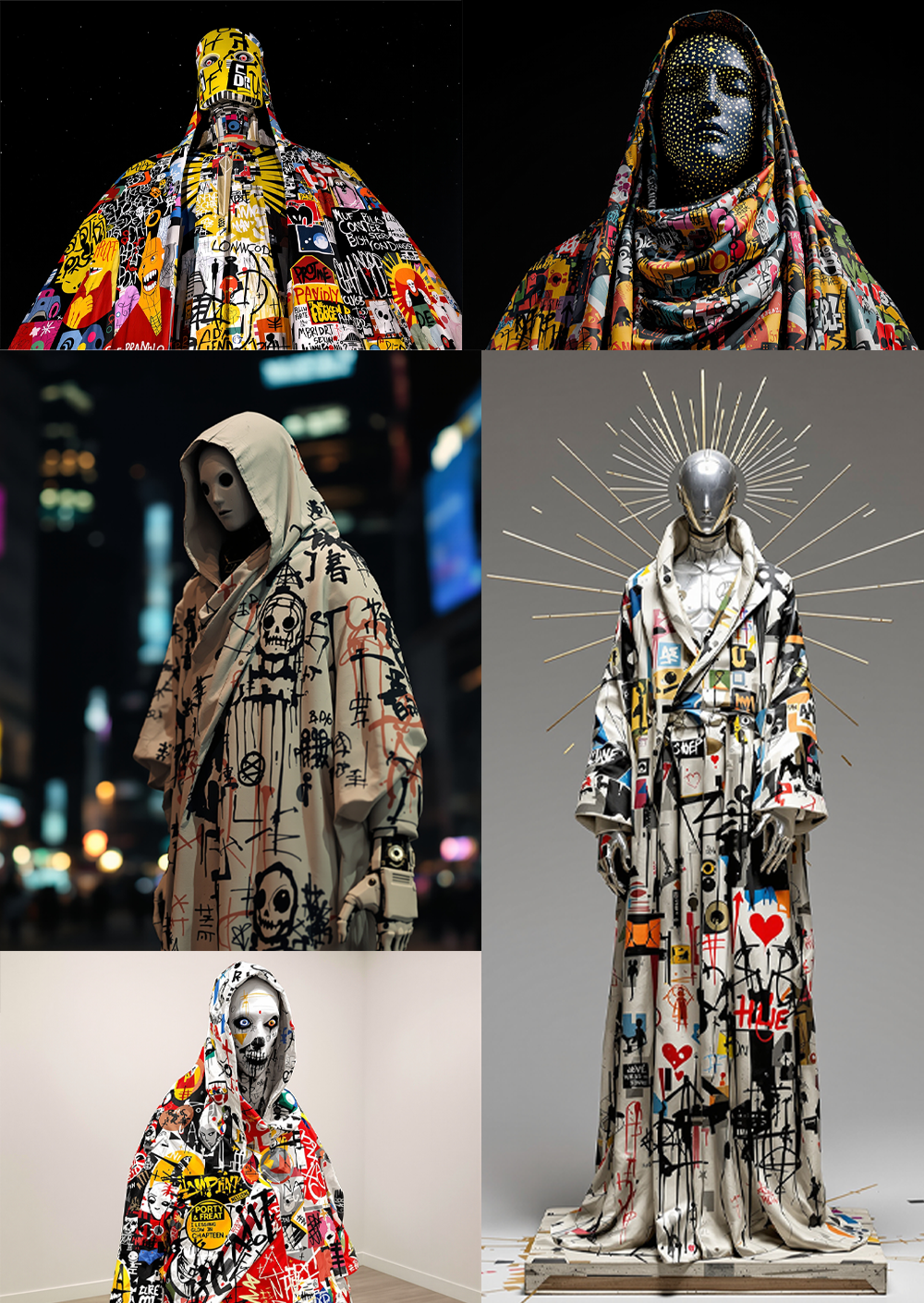
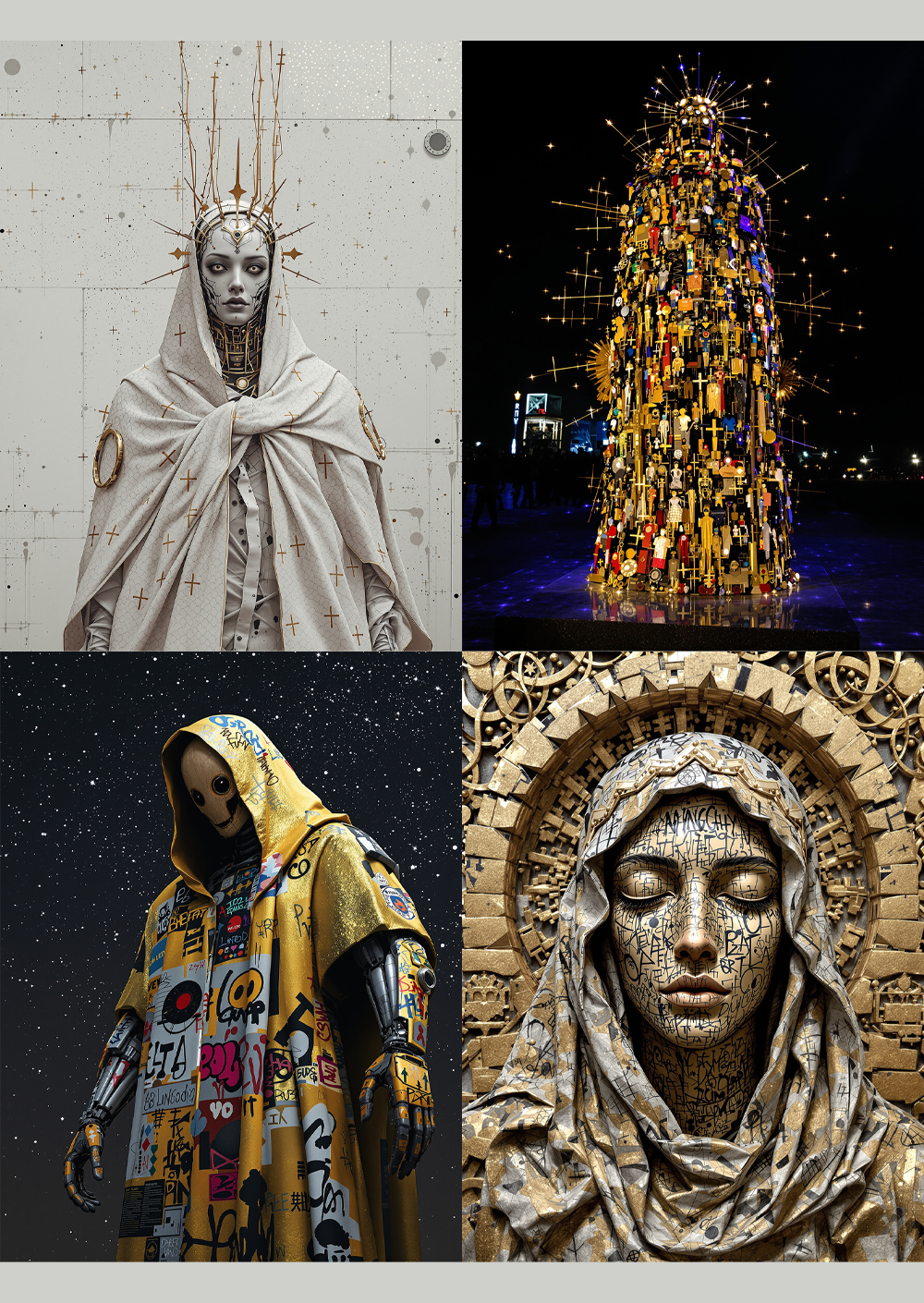
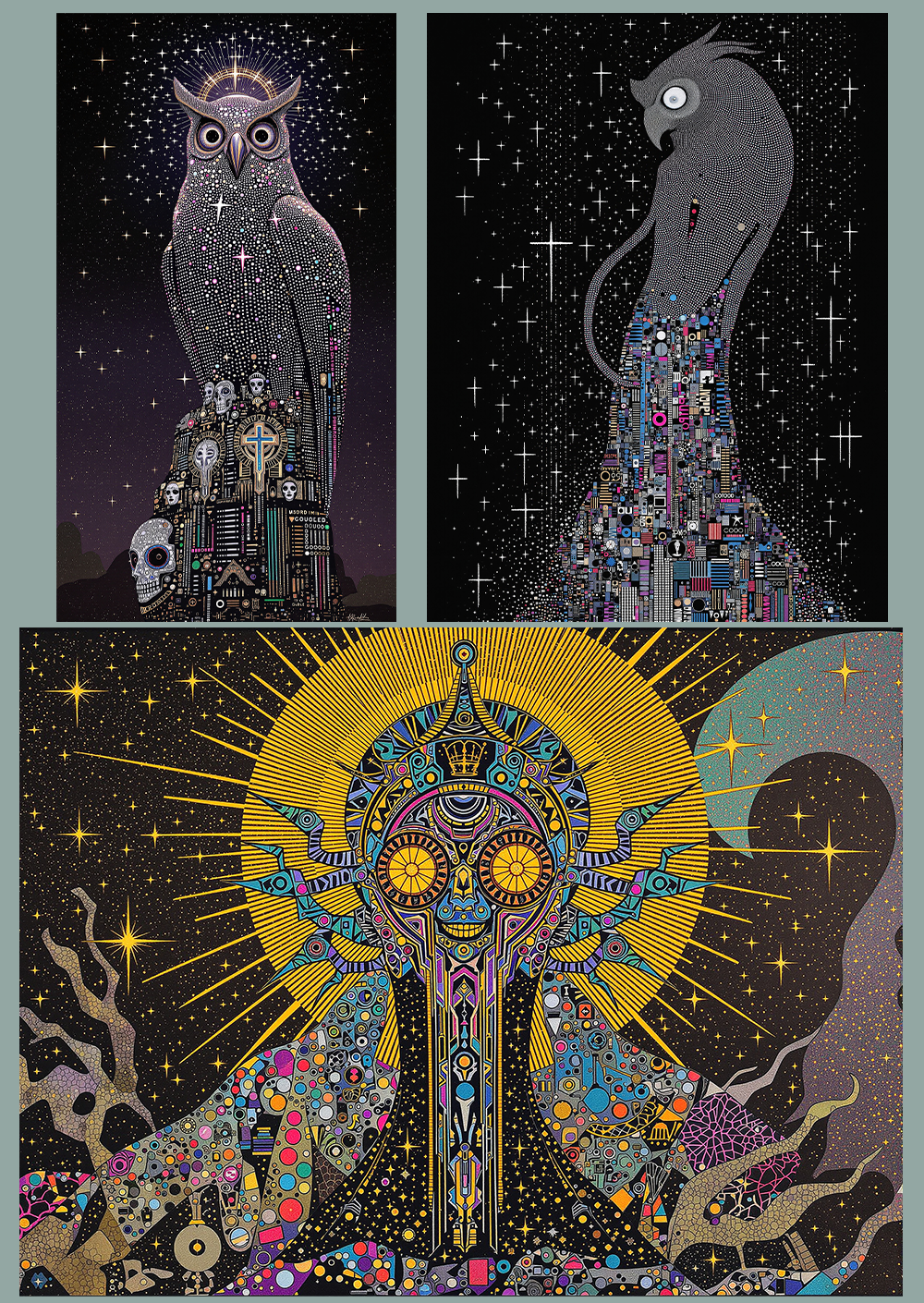
Saints of the Signal remixes religious visual grammar, halos, gold radiance, procession, icon frames, into a contemporary vocabulary of networks, masks, and synthetic bodies. These figures are not “religion” in the devotional sense; they are interfaces for belief: witnesses to how authority and comfort are manufactured through light, repetition, and spectacle. Across gold-fields, graffiti-robes, data-rain, and halo-diagrams, the series asks what we will call holy when images are generated at scale, and what kinds of power return disguised as beauty.
-
![]()
Method: AI-assisted iconography + compositing + “ritual design”
Icon research: halos, gold fields, frontal presentation, procession
Generative iteration: saint variants, masks, robes, symbol-fields
Authorial selection: affect, stillness, distance, symbolic density
System consistency: halo-as-UI, gold-as-authority, veil-as-filter
-
![]()
Motifs
Halo / aureole: attention device (UI for reverence)
Gold field: authority, certainty, spectacle
Veil / hood: filtering, anonymity, protection
Graffiti / collage skin: belief as public signage; identity as surface
Stars / data rain: faith as network pattern
-
![]()
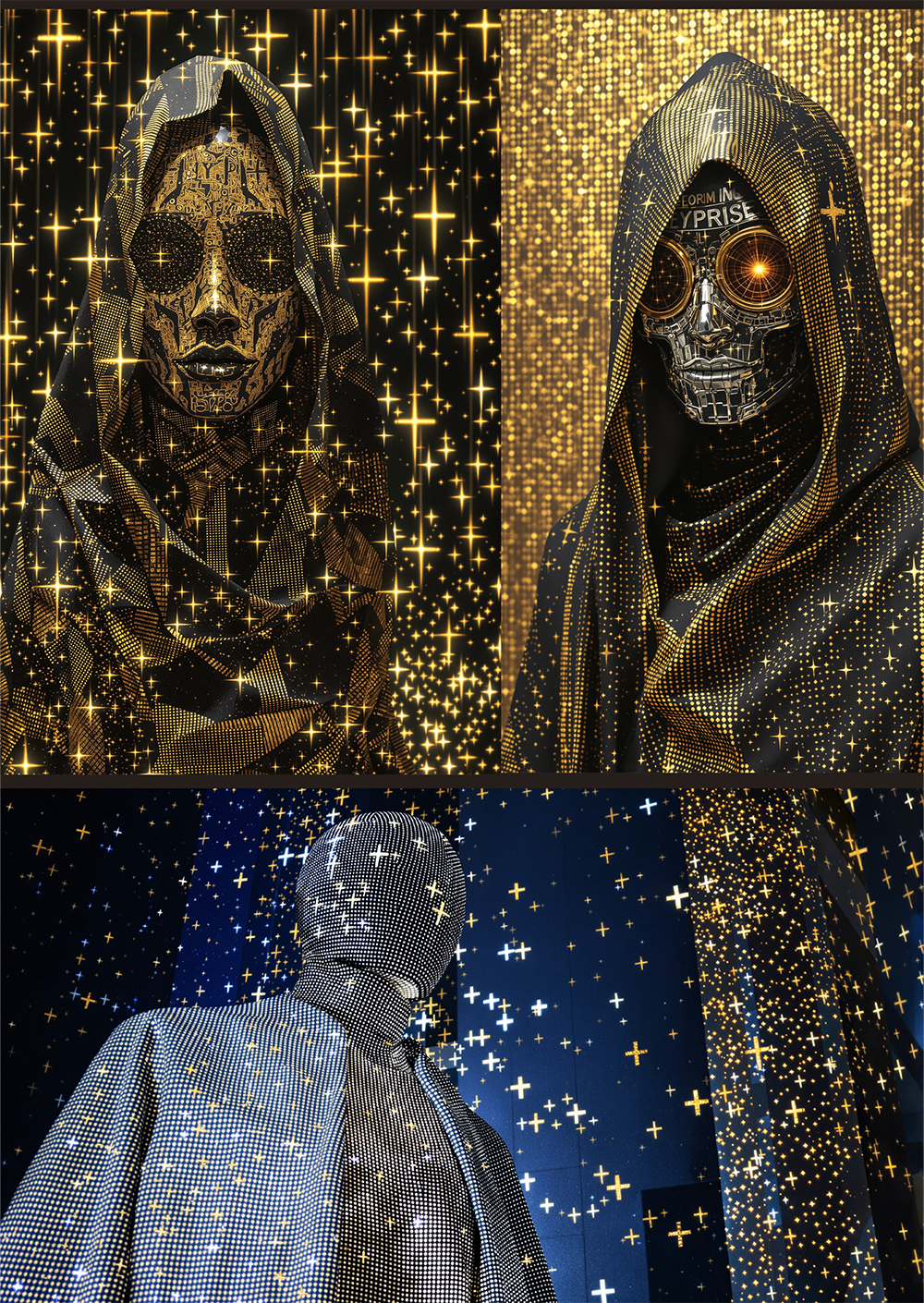
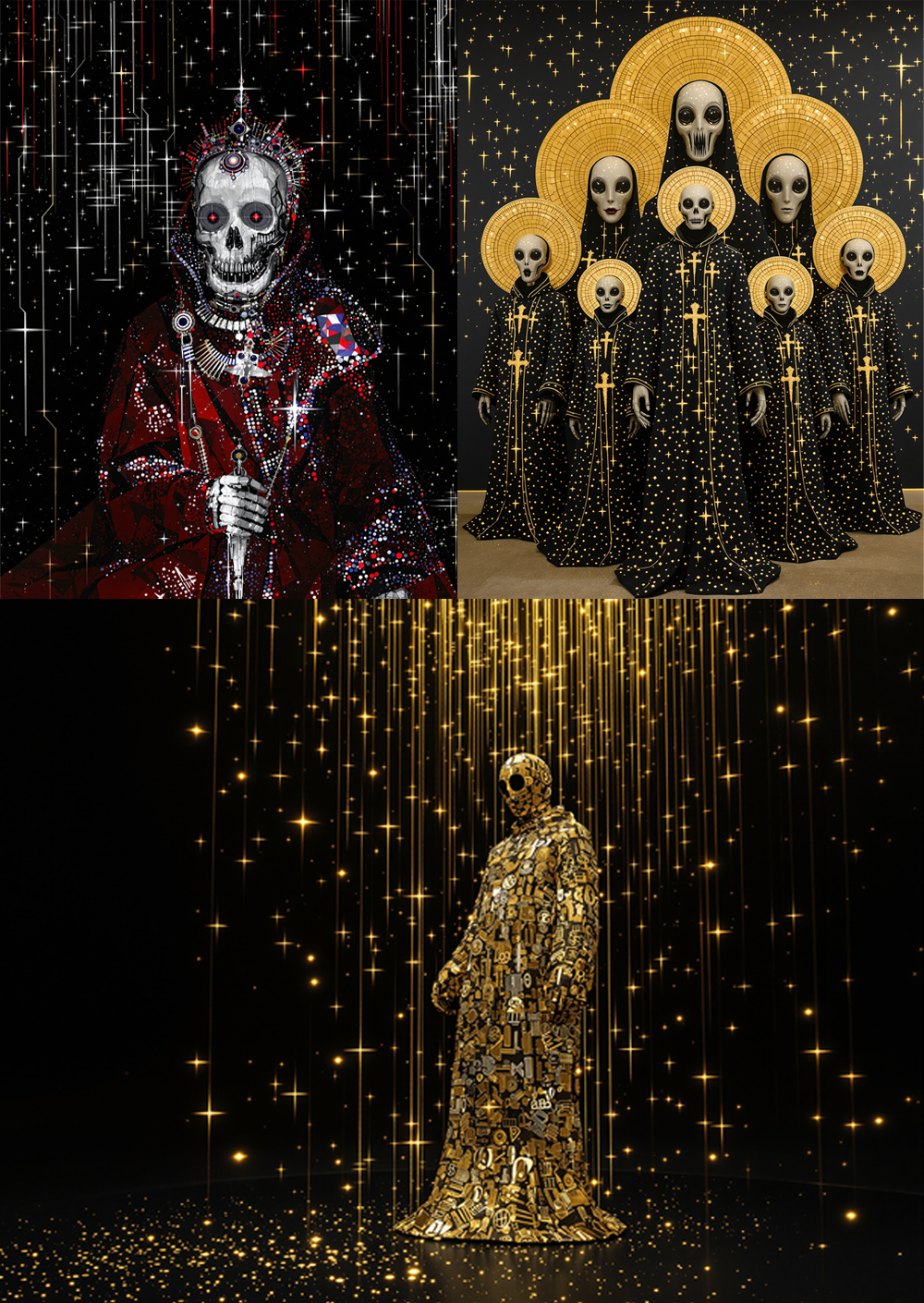
Procession Under Goldfall
A three-part page of skeletal clergy, haloed congregation, and gold-rain apparition. Death, spectacle, and ritual are braided into one device: the page itself becomes a ceremony. -
![]()
The Face as Relic (Gold Portrait Field)
Portraiture becomes shrine-logic: intimacy presented through ornament and framing. The page asks what “aura” means when it can be manufactured with perfect control. -
![]()
The Diagrammed Saint (Systems of Belief)
Icons, grids, and hooded witnesses appear as schematics. The sacred becomes a blueprint, belief rendered as design language and repeatable template. -
![]()
Graffiti Choir (Haloed Letterforms)
Angular bodies, halos, and tags compress the human into signage. The page reads like a warning: identity dissolving into brand-mark ritual. -
![]()
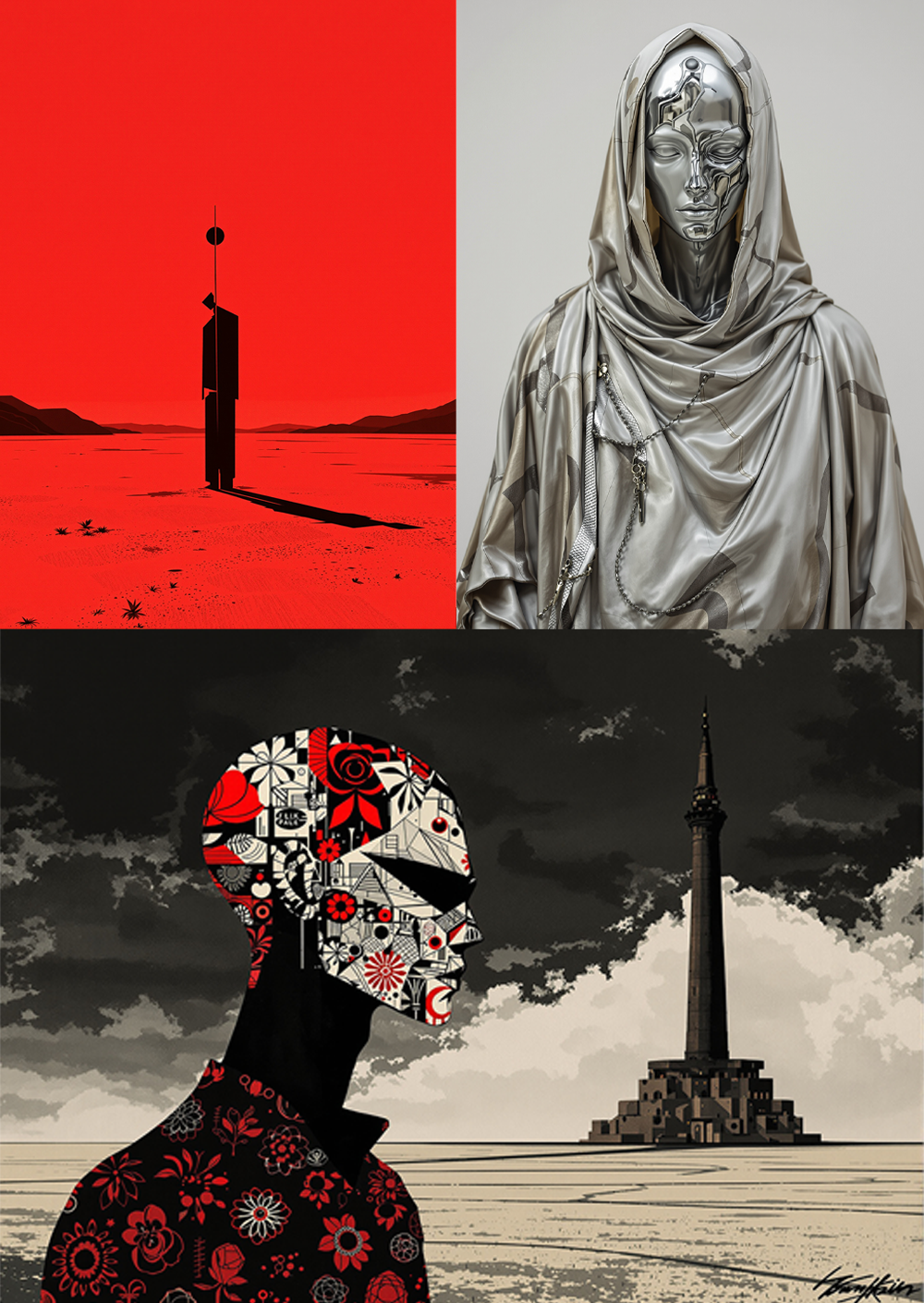
Broadcast Ruins (Red / Black / Noise)
A harsher palette where icons feel like damaged transmissions. The work shifts from “gold seduction” to “signal trauma”, what the system looks like when it fails. -
![]()
Veil Protocols (Hooded Variants)
Multiple veiled figures operate like a taxonomy of concealment. Protection and erasure sit on the same line: the veil as safety and as disappearance. -
![]()
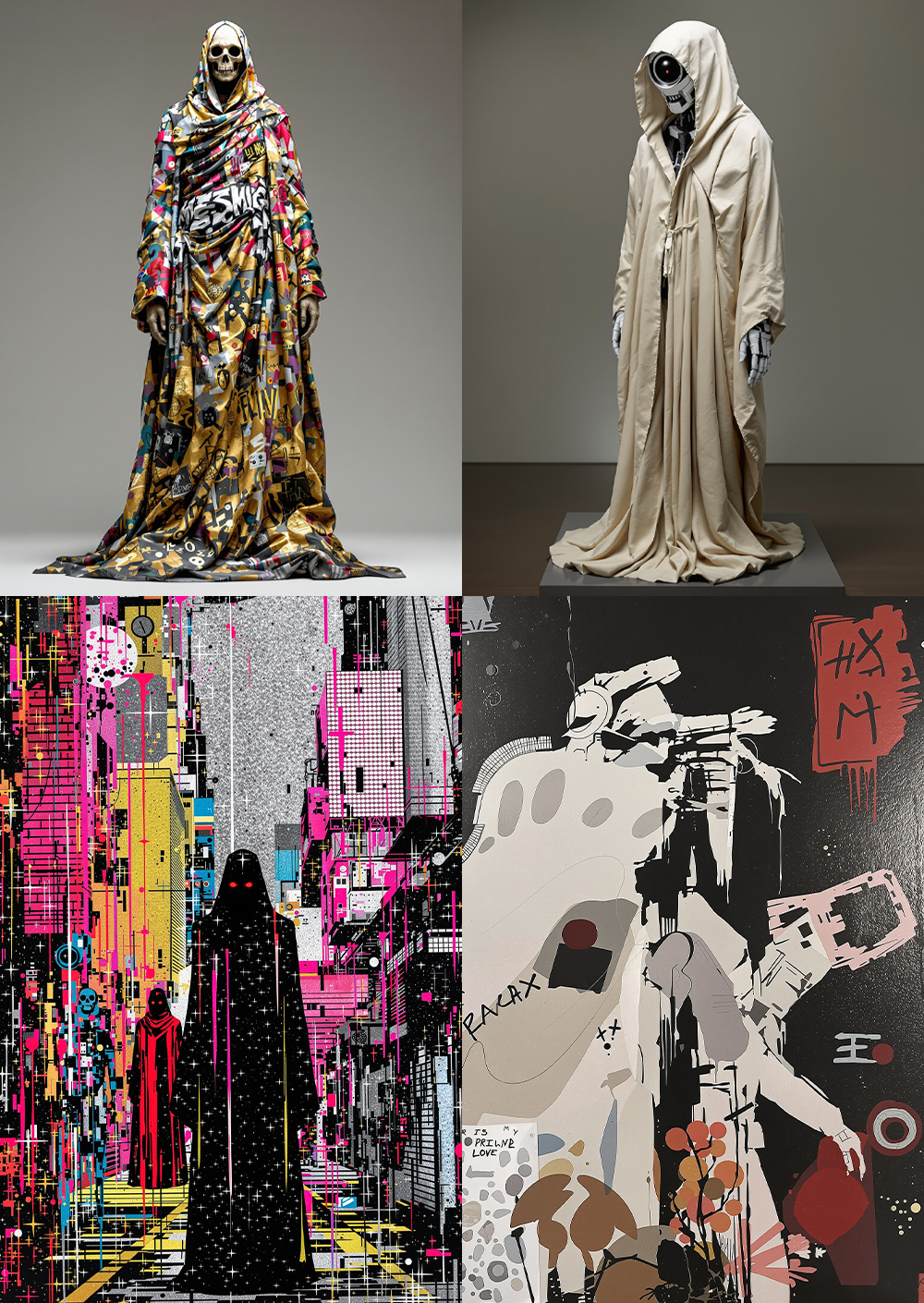
Robes of Data (Halo, Fabric, Authority)
Cloaks become carrier-surfaces for symbol-economies: tags, crowns, icons, and diagrams. The page frames costume as ideology, authority worn, not earned. -
![]()
-
![]()
-
![]()
-
![]()
Pilgrims of the Unfamiliar Sky
-
![]()
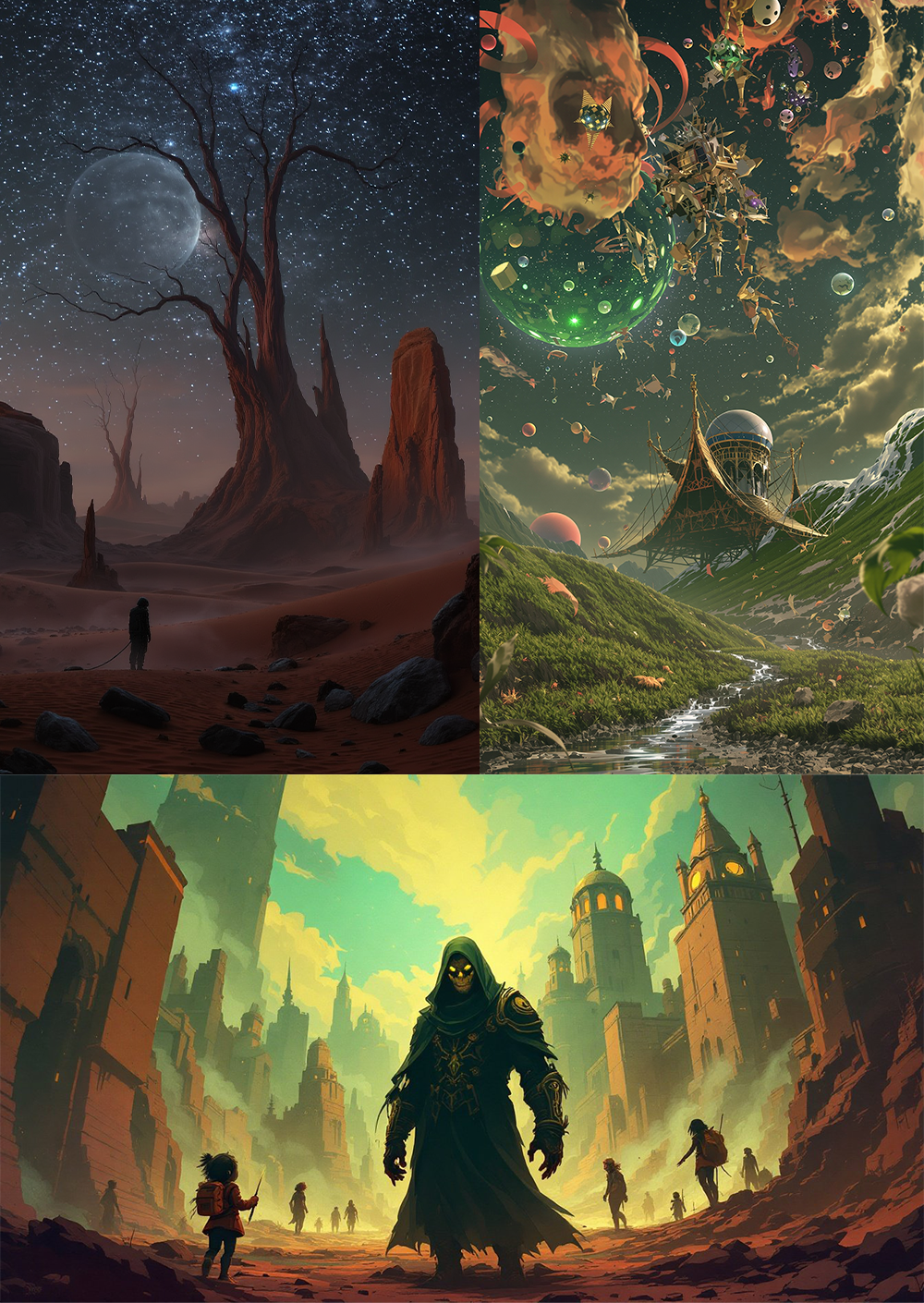
Afterworld Cartography / Night Geography (Planetfall)
A lone figure moves through three registers of the sublime: a silent desert under an over-large moon, a valley where the sky behaves like a physics experiment, and a ruined city framed as a threshold event. The “story” is less narrative than calibration—testing what scale, silence, and impossible atmospheres do to the body when the world stops agreeing with itself. These images treat landscape as a cognitive instrument: the environment isn’t backdrop; it’s the thing doing the speaking.
Motifs: solitary witness • vastness as pressure • post-catastrophe architecture • sky as system/portal
-
![]()
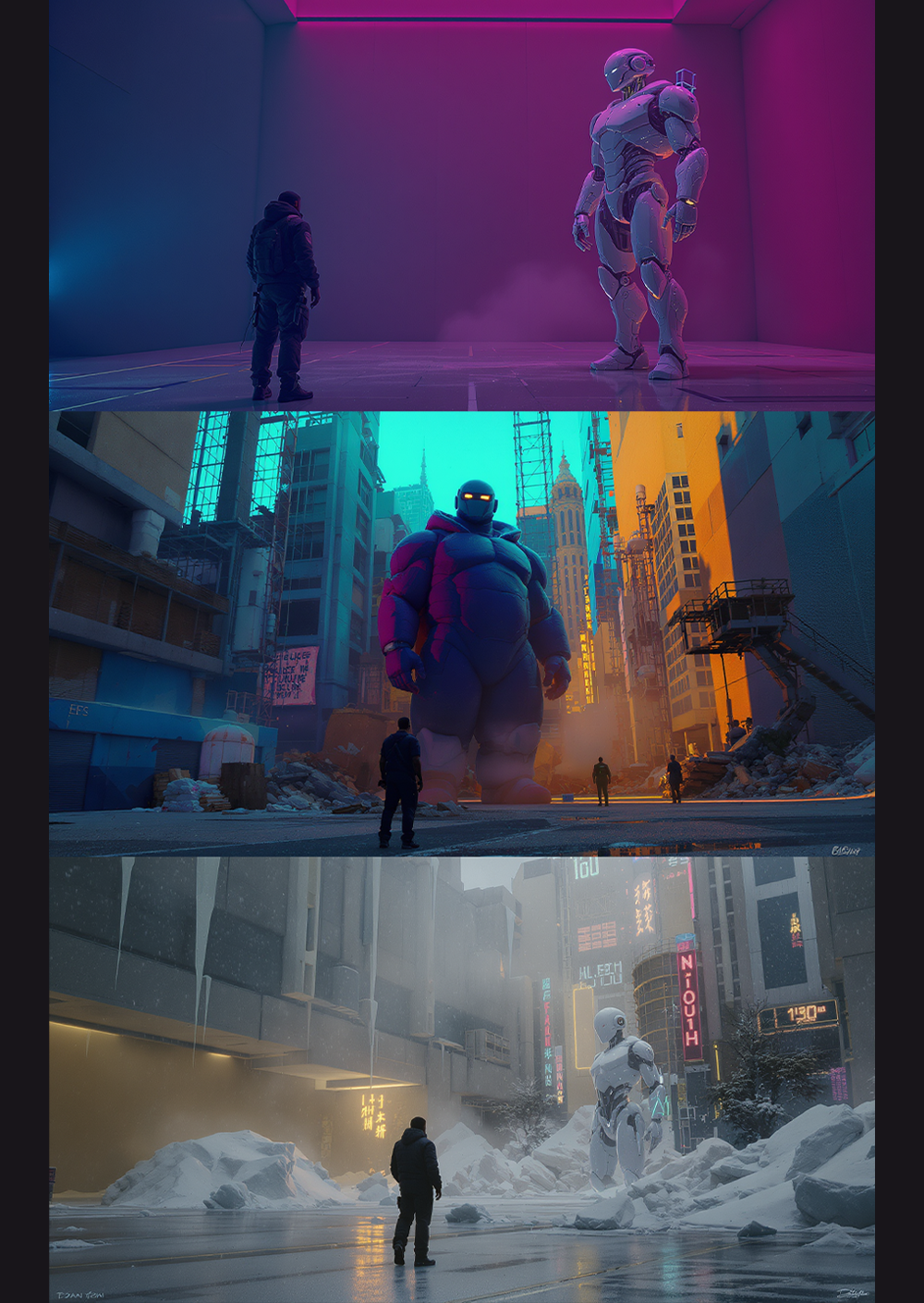
Scale Tests: Human–Robot Encounter / Containment Rooms
This page stages contact as a design problem: how do you meet something built at a different scale—emotionally, architecturally, ethically? Across sterile light-box space, a damaged city, and a frozen street, the “giant” reads as both protector and threat, while the human remains a measuring device for vulnerability. The work leans into controlled color and compositional distance to make the encounter feel procedural—like a test chamber for trust.
Motifs: mismatch of scale • soft power / hard body • urban aftermath • climate as stress test
-
![]()
Guardian City / Child Witness / Spirit Infrastructure
Here, wonder becomes protection. A robed figure and child face a sunlit citadel; a lone swordsman stands beneath a flowering tree in an emptied street; a green spirit-serpent curls through old architecture like an electrical current made visible. The page holds a coherent emotional arc—care, readiness, and the sudden arrival of the mythic—treating the city as a living ritual space where memory and guardian-presence can re-enter the frame.
Motifs: parent/child horizon • blossom as temporary sanctuary • spectral guardian • urban temple logic
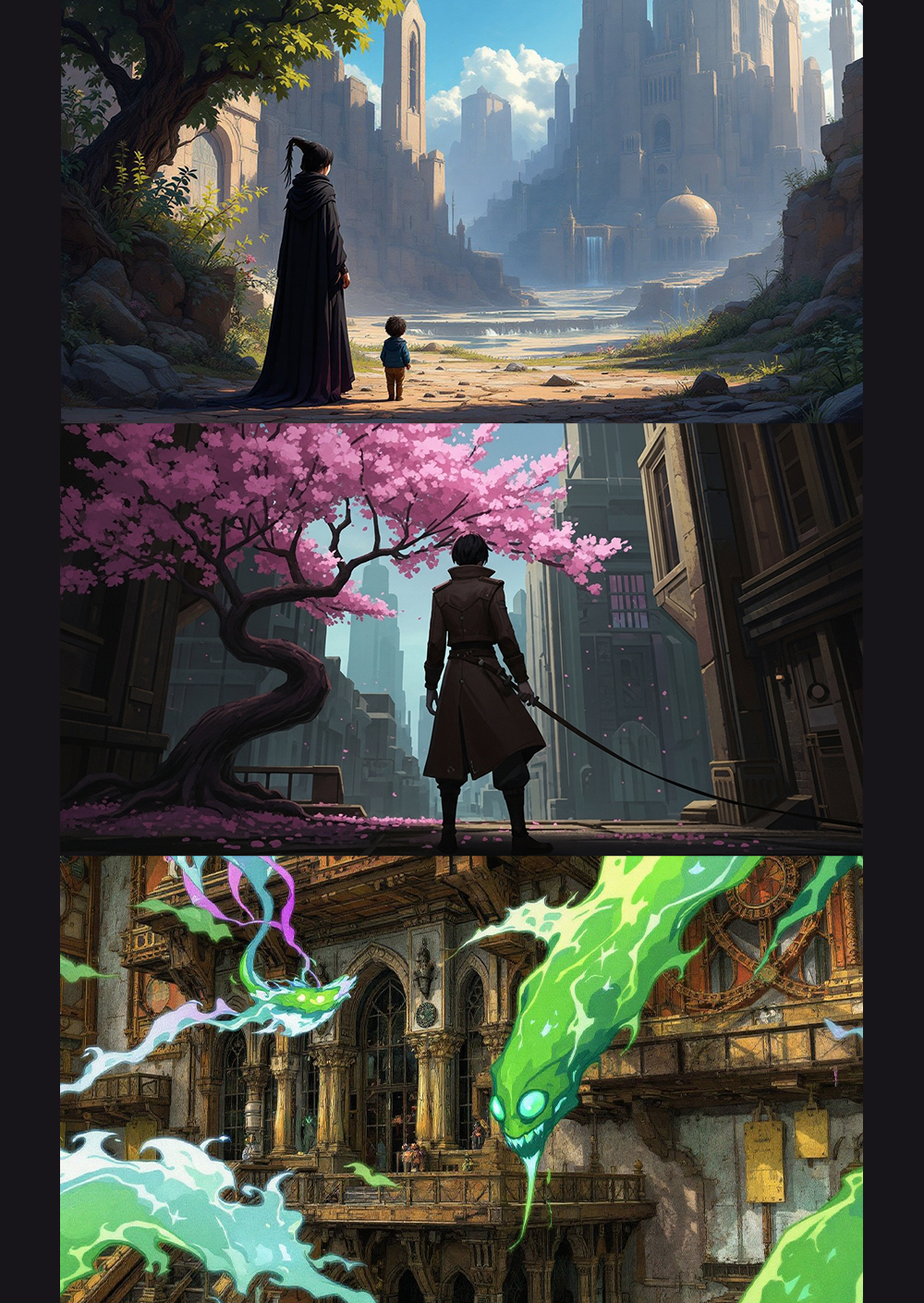
Light as Fabric: Perforated Continuum
-
![]()
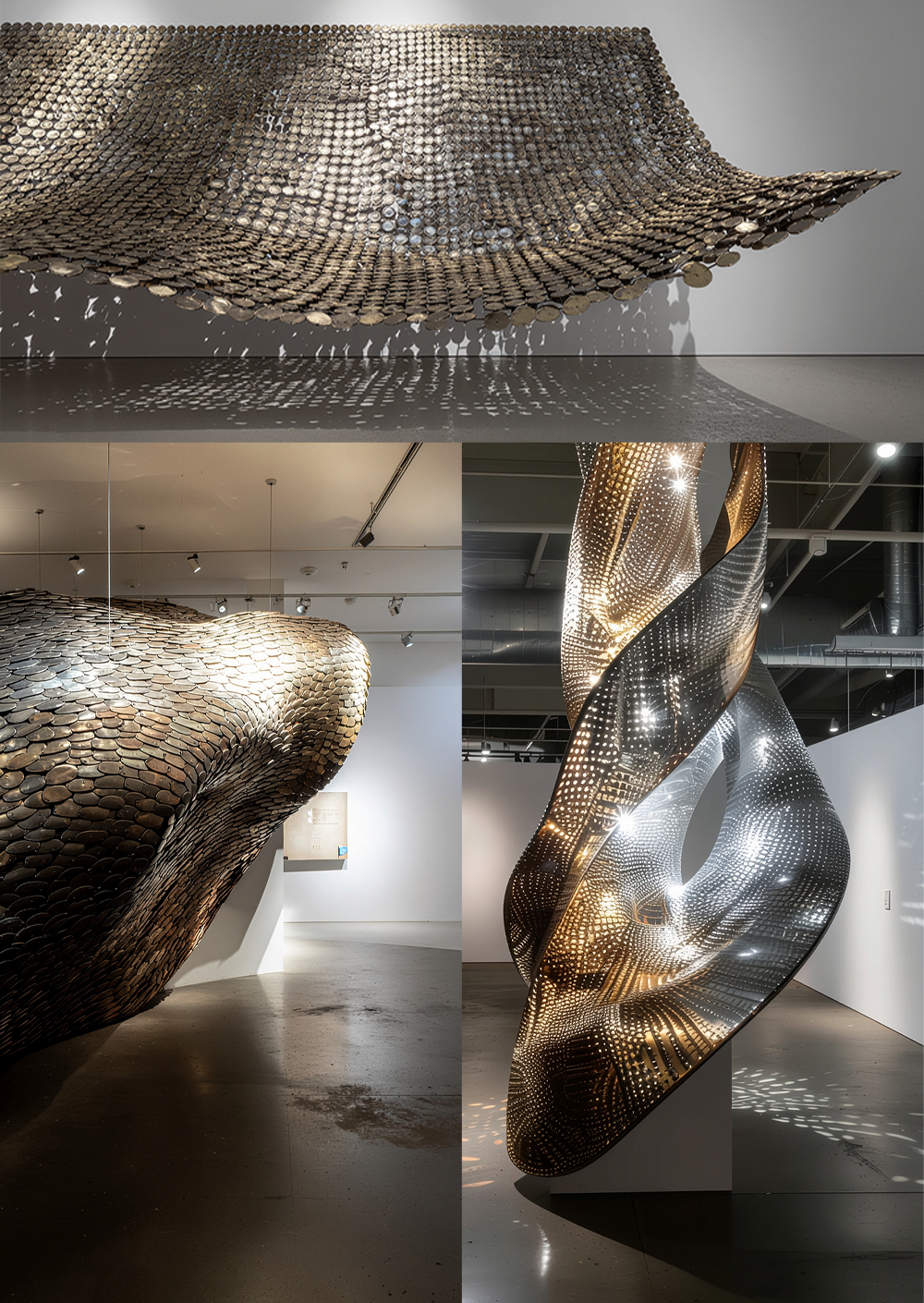
Light as Fabric is a series of AI-assisted sculptural installation studies where metal is treated as a soft, responsive membrane, folded, draped, and waved into forms that behave like cloth while remaining structurally impossible-looking (until you remember engineering). Perforation becomes a syntax: a field of pores that turns illumination into pattern and shadow into information. The work sits between architecture and body, between the gallery “white cube” and the living, breathing surface, asking what happens when material becomes a screen, and when a surface becomes a sensor for attention, time, and awe.
DXARTS relevance: This series treats material as media, testing how generative imaging, optical pattern systems (perforation), and installation staging can turn sculpture into a perceptual interface for light, attention, and embodied scale.
-
![]()
Method: AI-assisted sculptural visualization + material logic + installation staging
Form research: studying drape physics, tensile surfaces, folded sheet behavior, and large-scale installation precedents.
Generative iteration: producing multiple “surface families” (ribbons, veils, helices, wall-reliefs) and testing silhouette readability at architectural scale.
Material translation: treating perforation/tiling as a structural and optical system (porosity gradients, specular bounce, cast-shadow choreography).
Authorial selection: curating variants by how they hold light (glow, scatter, shadow density, and viewing-angle shifts).
Environment staging: white-cube mockups, reflective floors, and close-ups to verify spatial impact and tactile plausibility.
-
![]()
Coherence anchor (motifs: what repeats + why)
Perforation field: code made visible; light translated into readable texture.
Wave / ribbon: “breath” as structure—movement frozen into form.
Veil / drape: softness in a hard medium; opacity as a variable.
Gold ↔ silver sheen: alchemy + authority; warmth vs coolness as emotional register.
Shadow lattices: the work’s “second body” (the sculpture continues on the walls/floor).
White cube: neutrality as a test chamber—making perception measurable.
-
![]()
Here the membrane becomes architectural: a hovering sheet, a close study of scale-like tiling, and a twisting vertical form that reads as both column and textile. The emphasis is transformation, how a single material logic can become multiple bodies (canopy, curtain, spine) depending on tension, fold, and light angle.
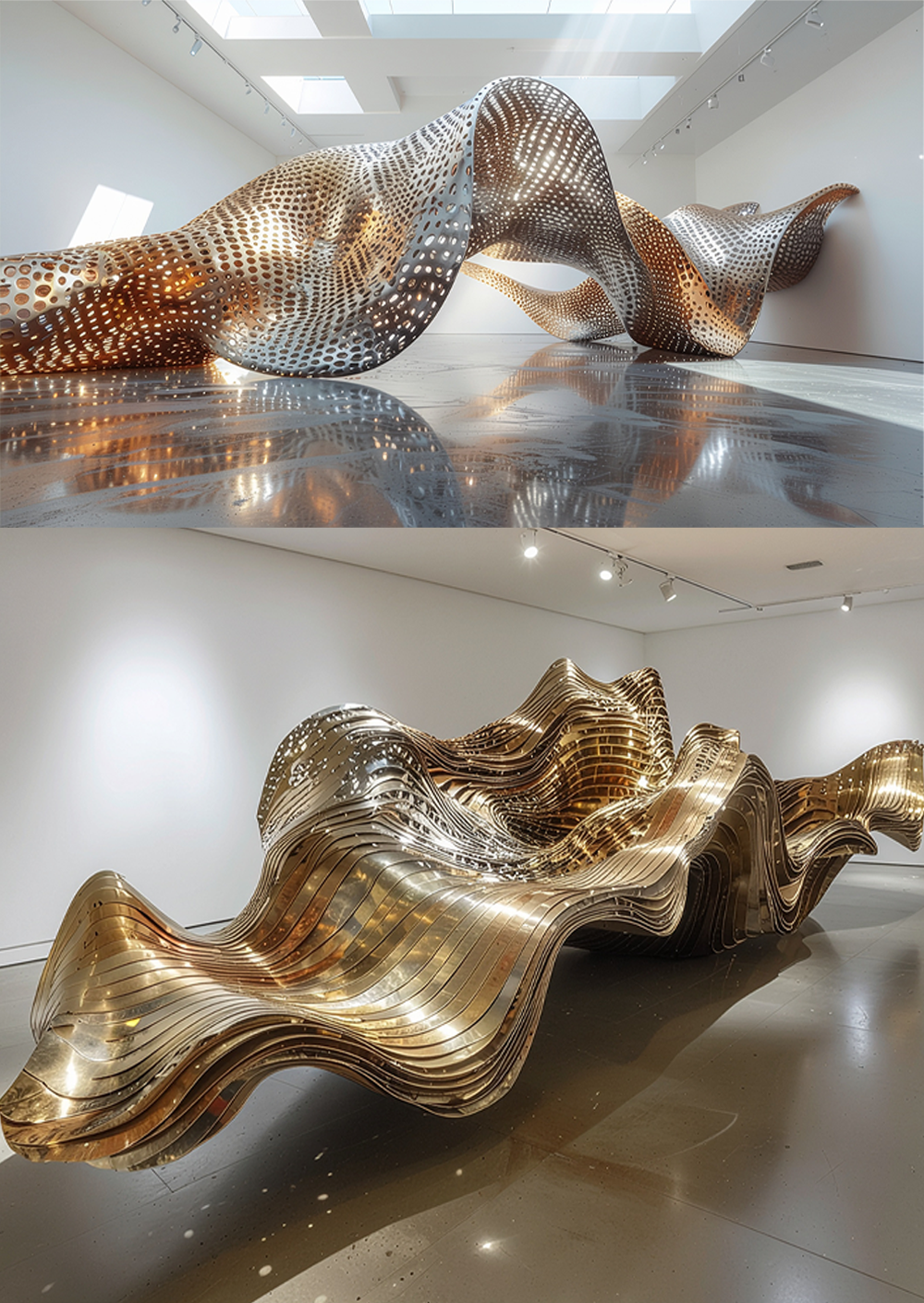
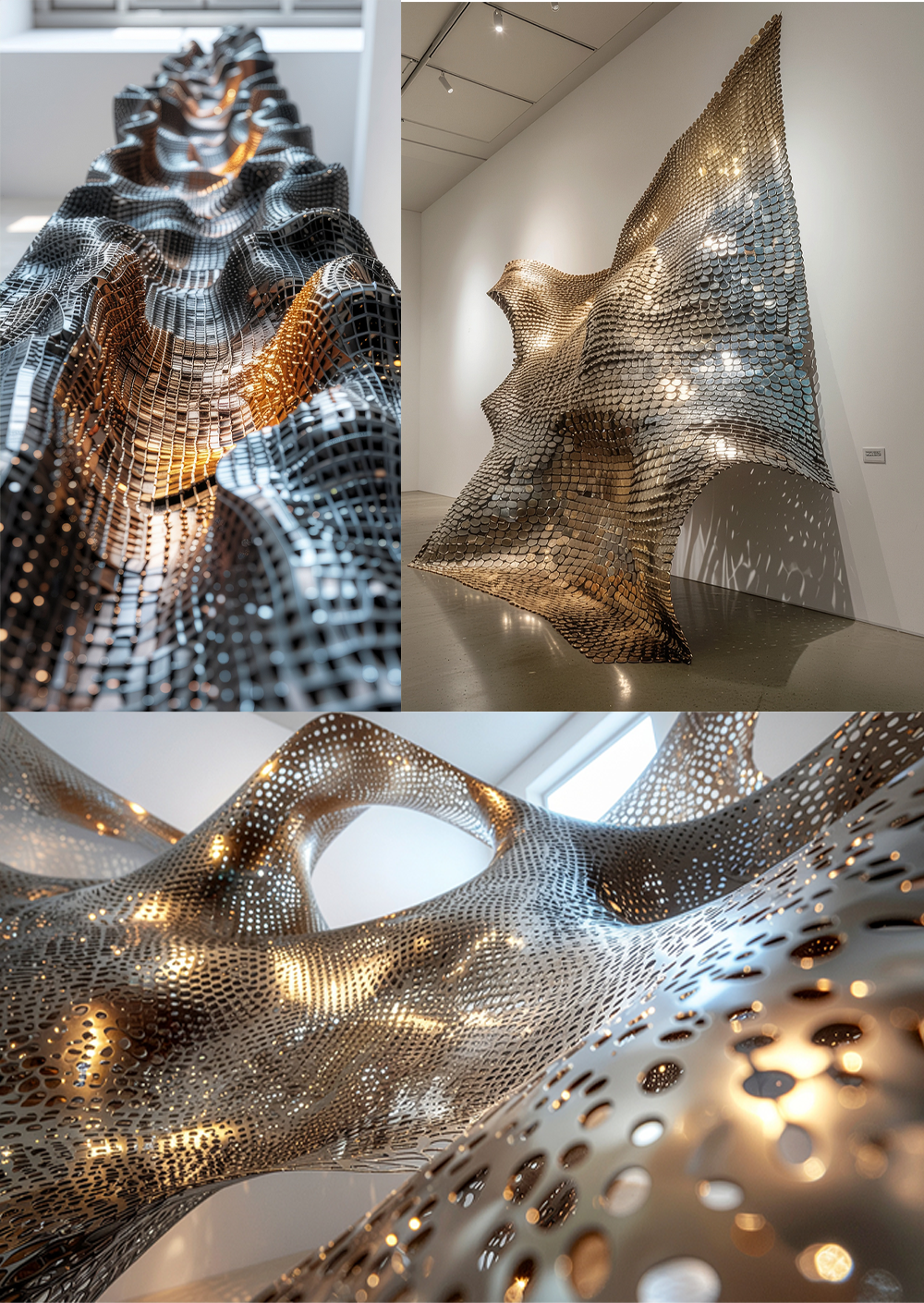
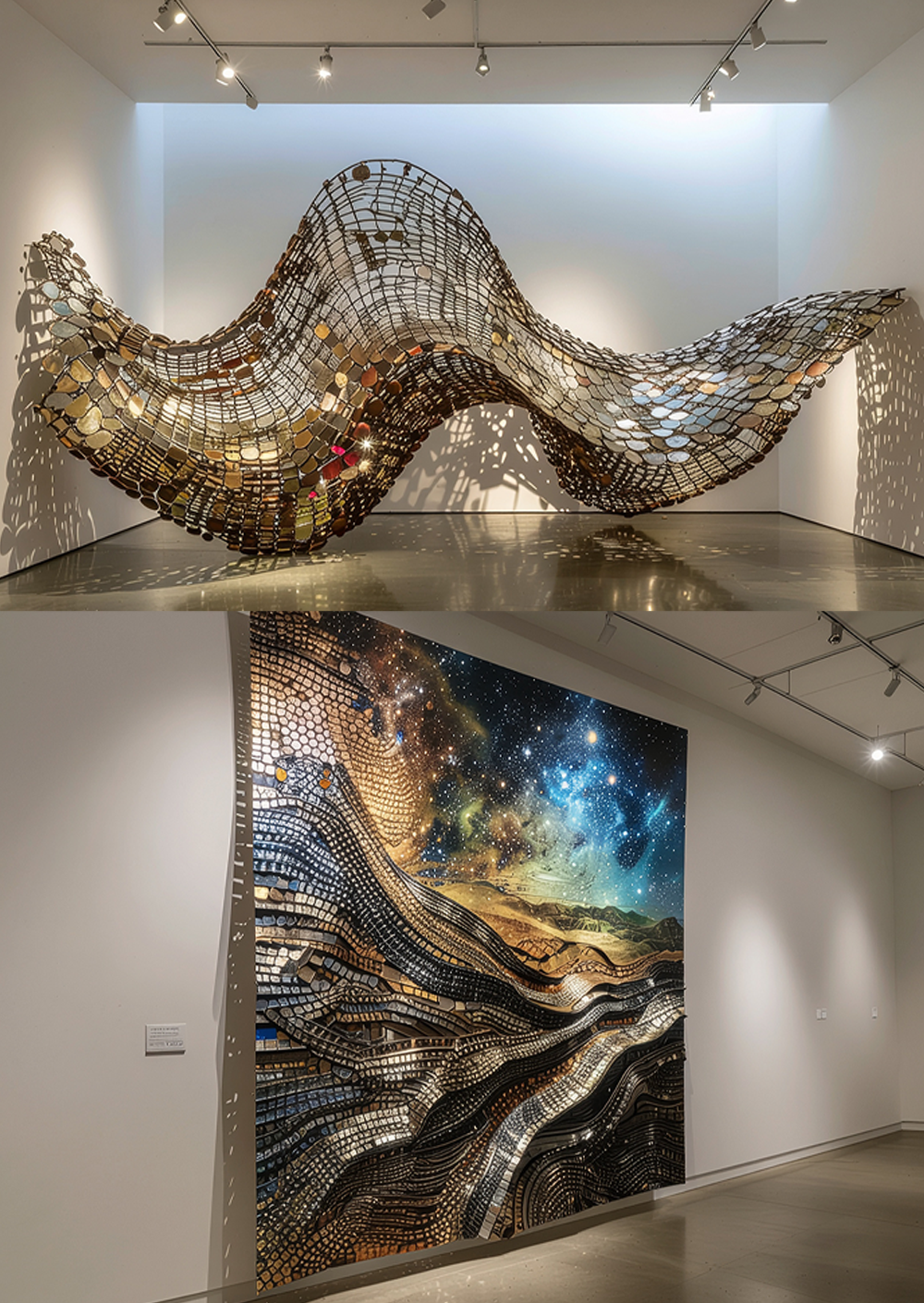
Africa as Living Cosmology
-
![]()
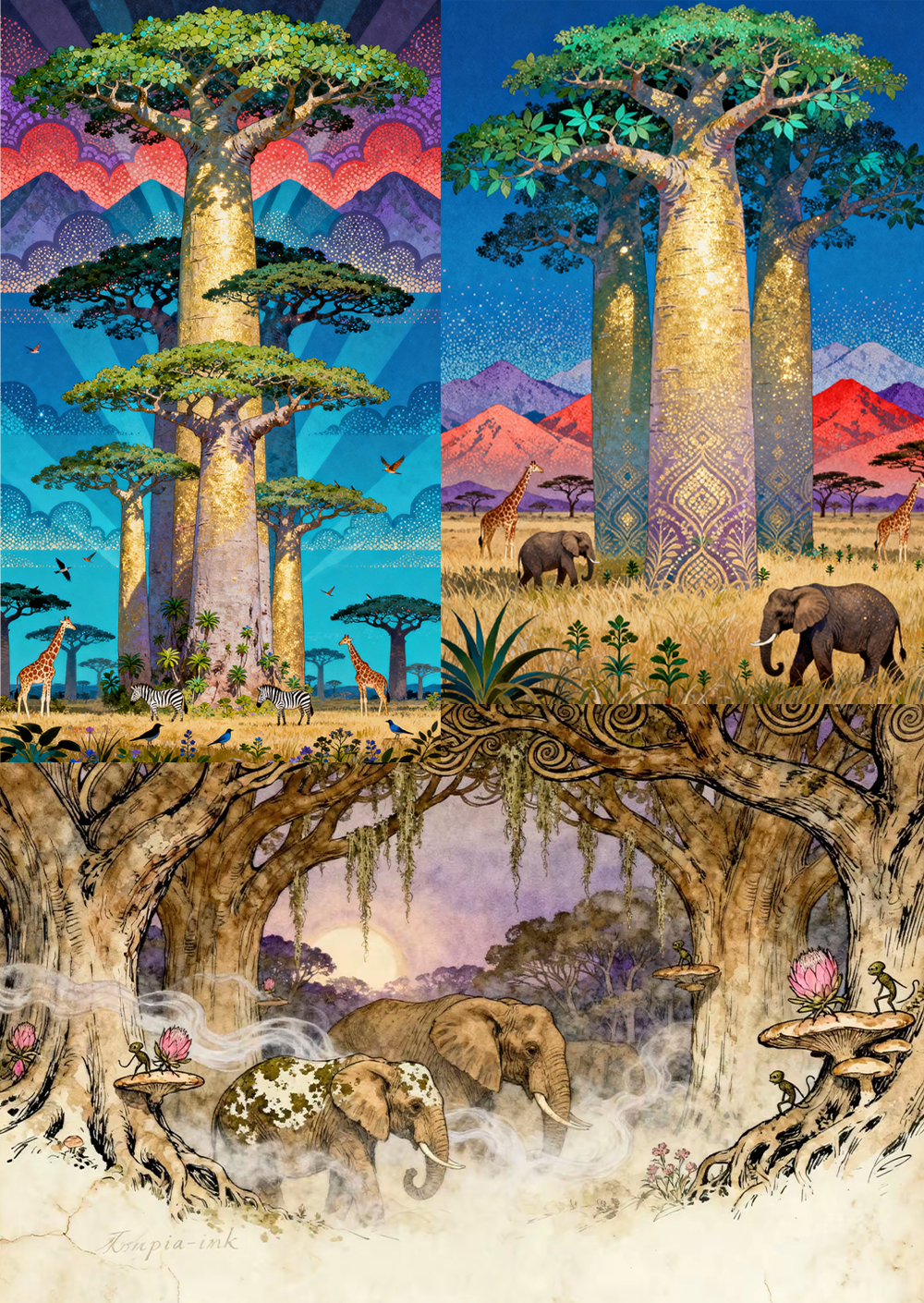
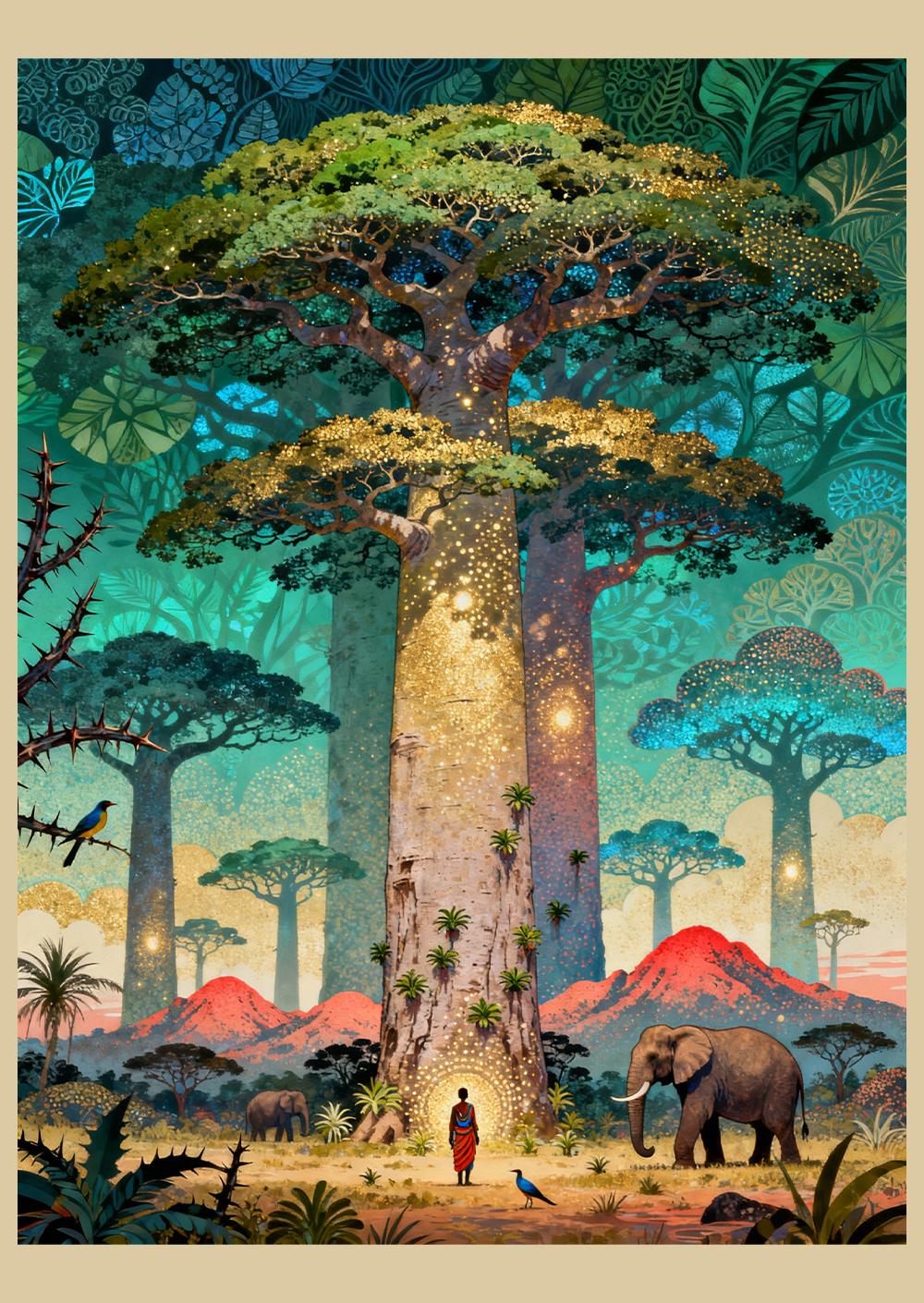
This series imagines Africa not as backdrop or territory, but as a living cosmology: a space where ecology, ancestry, animal life, myth, and memory remain entangled. Baobabs become cathedrals, elephants move like memory-keepers, proteas open as sacred emblems, and landscape holds both tenderness and scale. Across these pages, the work shifts between reverence, childlike wonder, and speculative mythmaking, building an image-system in which African terrain becomes a site of protection, imagination, and metaphysical continuity.
DXARTS relevance: This series treats landscape as an image-system for memory, refuge, and metaphysical world-building, using AI-assisted image generation to test how ecology, symbolism, and speculative fiction can produce emotionally legible public myth.
-
![]()
Repeating motifs
Baobab: architecture of memory; the tree as ancestor, shelter, and world-axis
Elephant: memory, procession, gentleness, and sovereign presence
Mist / glow: transition states between ecology and spirit
Protea / flowers: local emblem, fragility, and beauty held close
Mountain / wave / planet: Africa as cosmology, not only geography
Shelter forms: hollow tree, grove, water, and enclosure as images of care
-
![]()
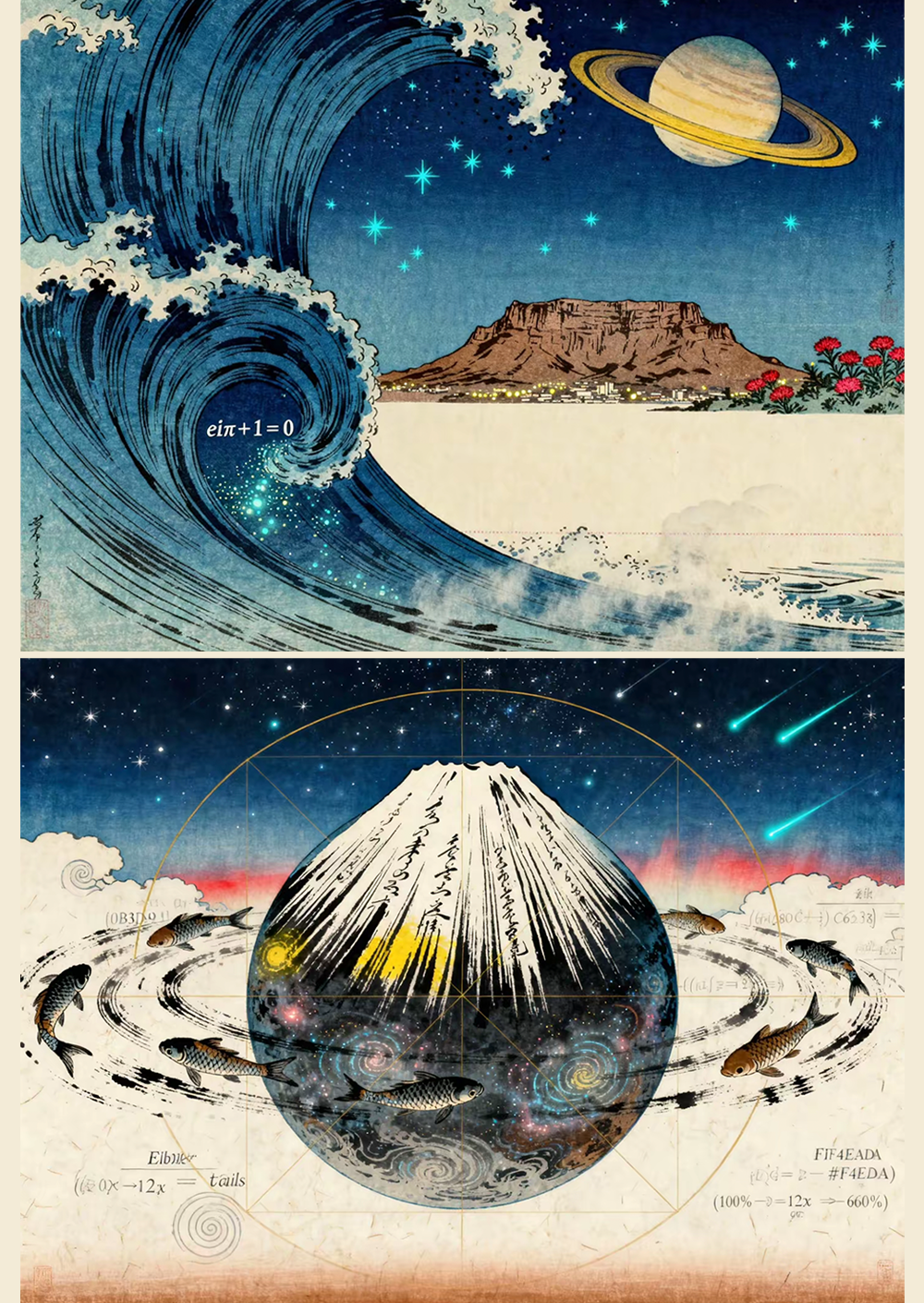
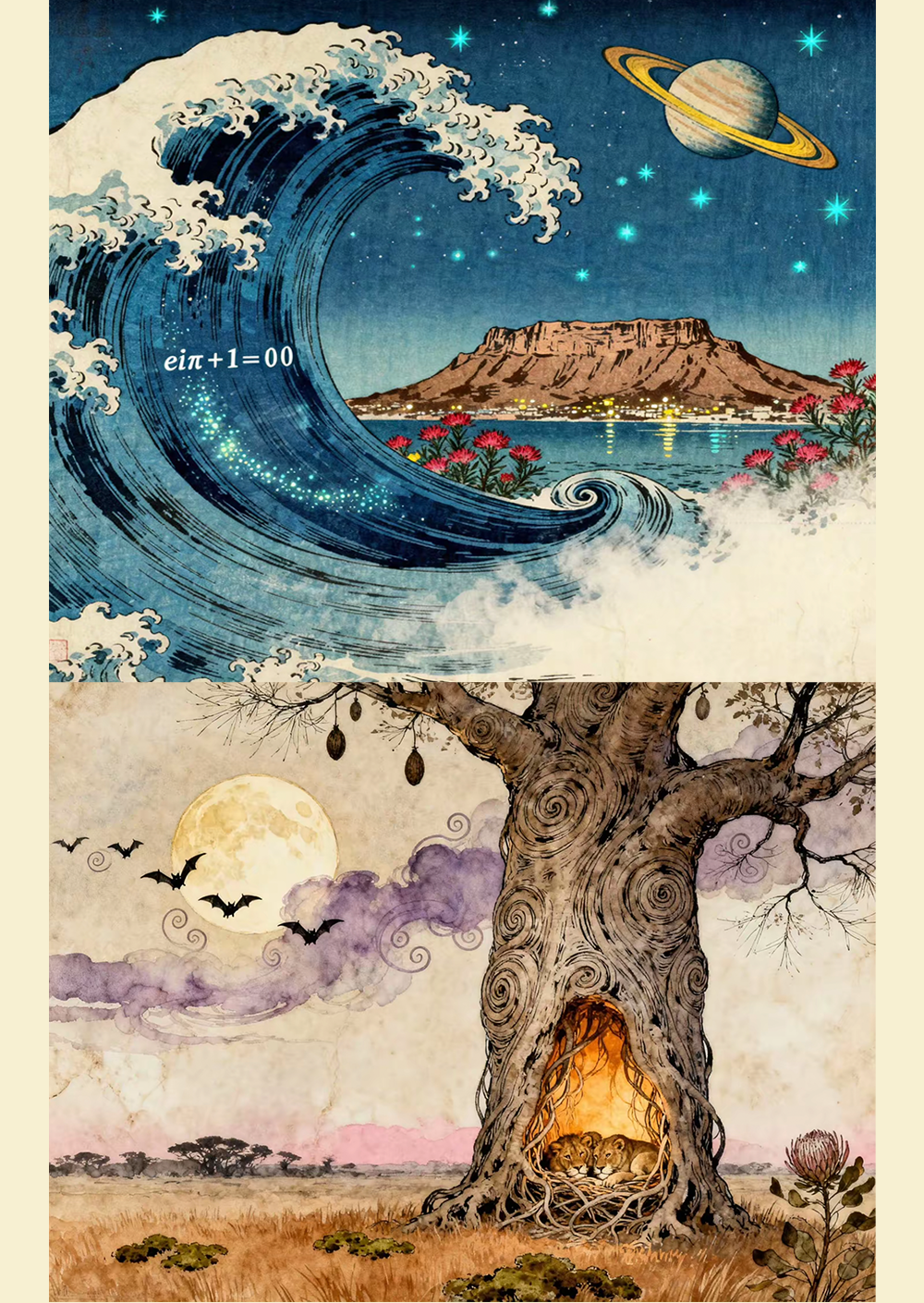
Cape Cosmology / Wave, Peak, Planet
This page shifts from savannah ecology into symbolic cartography. A stylized wave, ringed planet, and mountain-body fuse mathematics, Japanese print memory, and African landscape into a cosmographic image system. It suggests that the continent can be pictured not only biologically, but mathematically and metaphysically.
Motifs: wave as thought-form • mountain as diagram • stars and geometry • place as equation
-
![]()
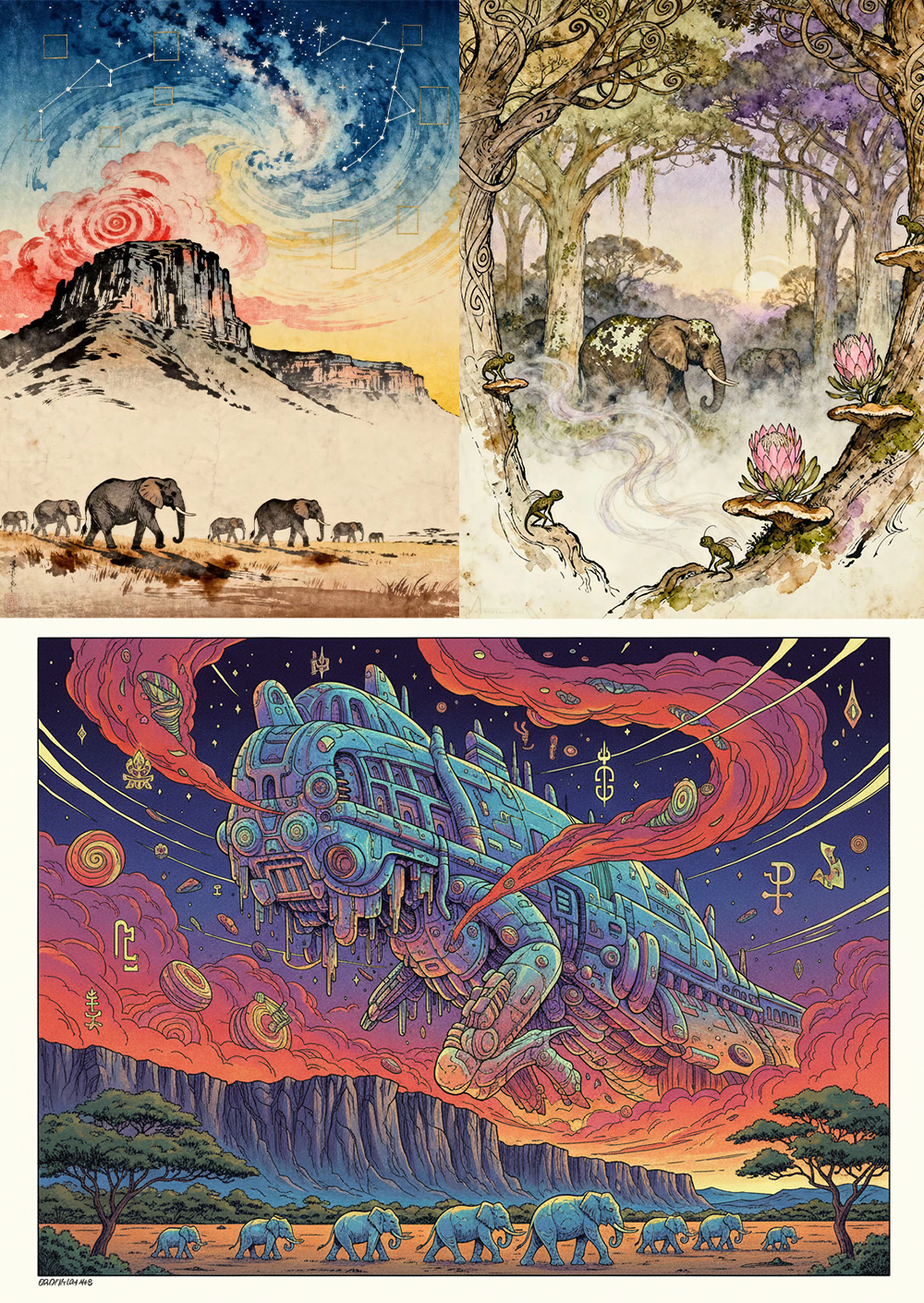
Elephant Transit / Sky Machine Over the Savanna
Elephants cross a familiar landscape while the sky becomes a site of speculative rupture: spirals, celestial symbols, and a hovering mechanical mass destabilize realism. The result is not simply “surreal,” but a tension between the ancient rhythm of migration and the arrival of another order of vision. This page asks what remains steady when the sky itself changes language.
Motifs: migration • atmospheric disturbance • machine-myth collision • ancient rhythm vs future intrusion
-
![]()
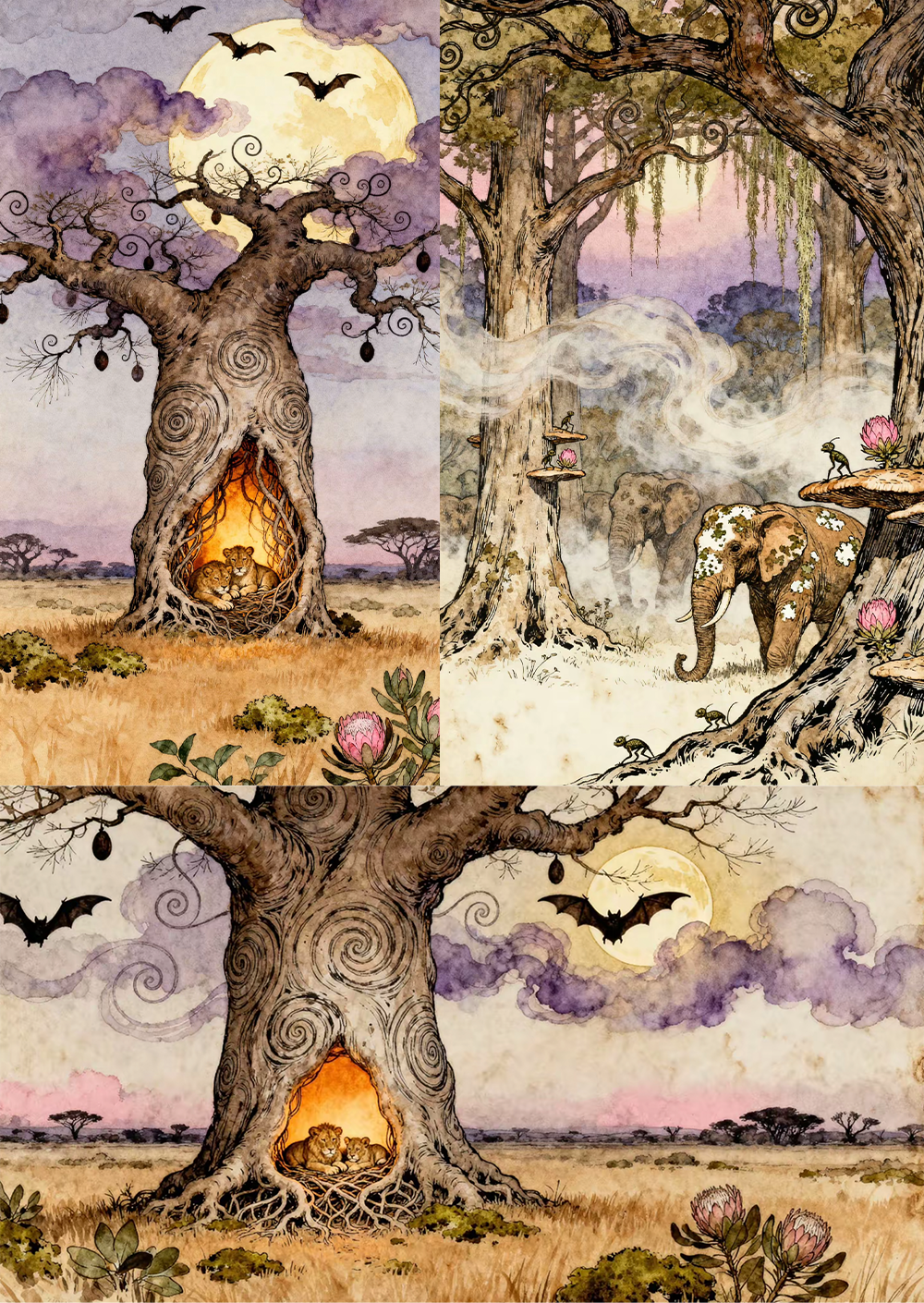
Lion’s Hearth / Shelter Under the Moon
This page is among the most emotionally legible in the set. Hollow trees become sanctuaries, lions appear in a protected interior glow, and misty elephant paths weave through the forest nearby. The imagery holds protection, vulnerability, and maternal enclosure without losing its mythic charge.
Motifs: refuge • den / hearth • moonlit protection • child-safety inside landscape
-
![]()
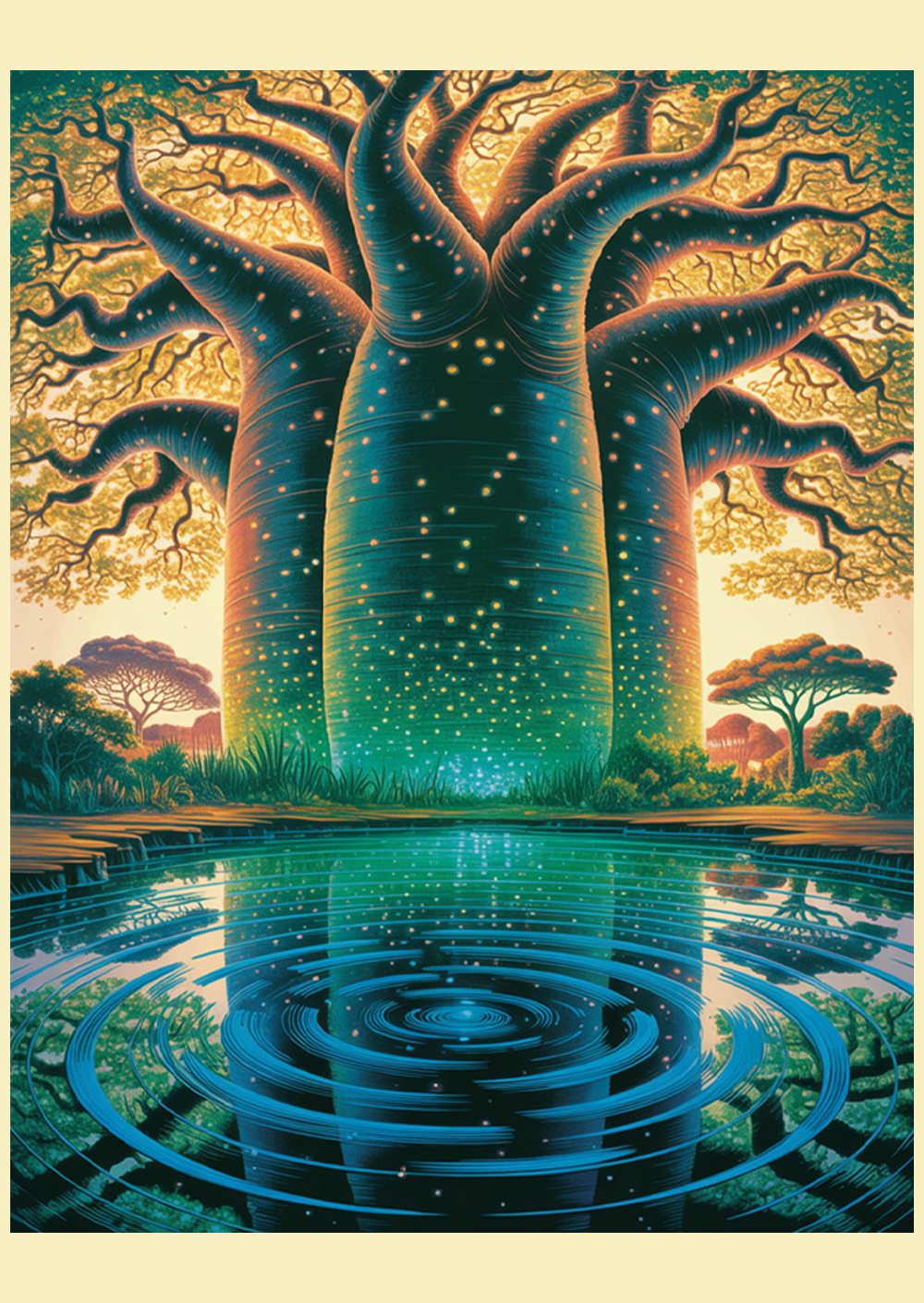
The Baobab Mirror
A monumental baobab stands over still water, its reflected form turning the image into a meditation on depth, memory, and recursion. The page is minimal compared with the others, but that restraint makes it powerful: the tree reads almost like a spiritual instrument, holding time above and below the surface.
Motifs: reflection • stillness • recursion • sacred symmetry
-
![]()
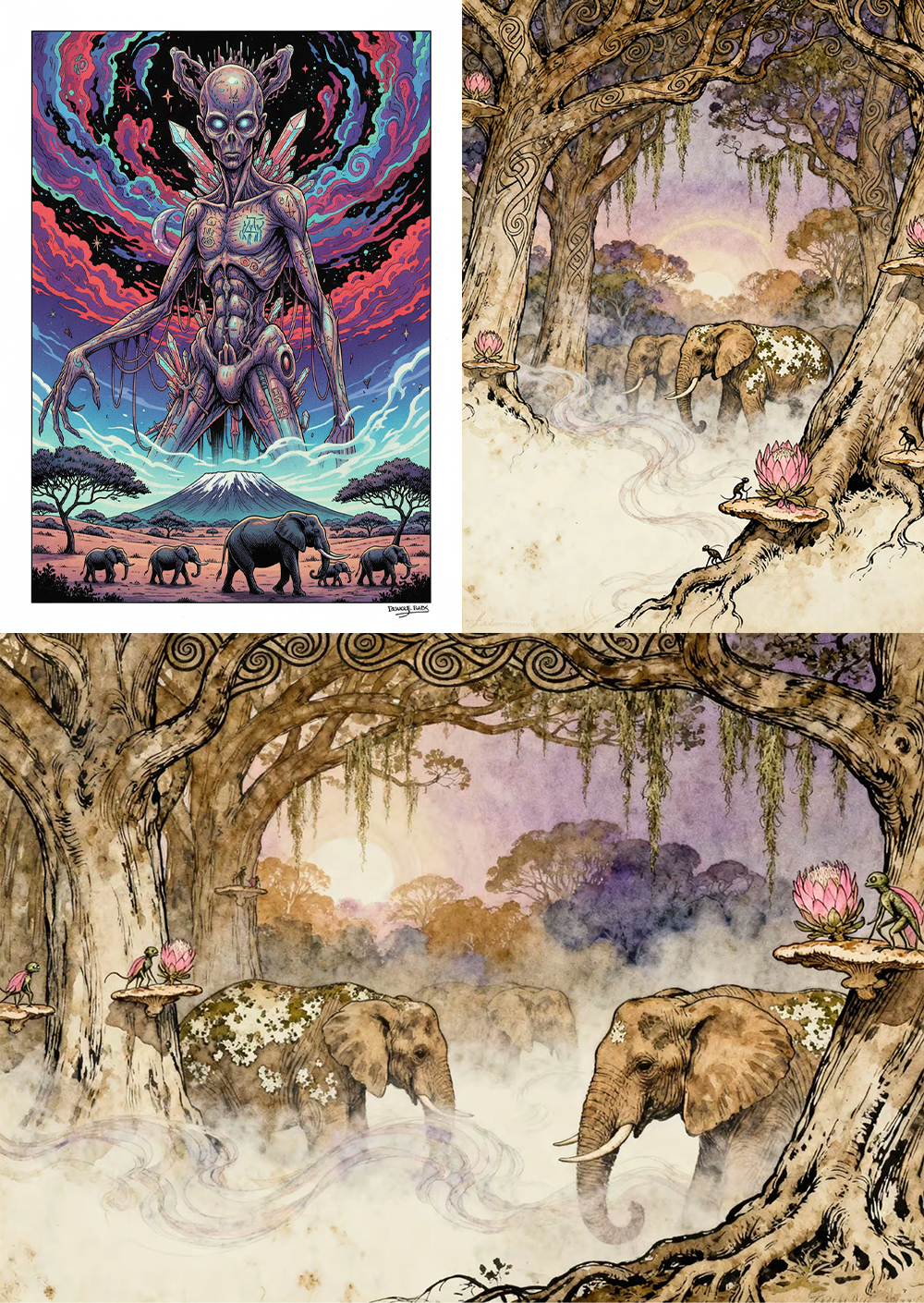
Mythic Intrusion
A towering speculative figure enters the ecology of elephants and forest mist, creating a productive dissonance between indigenous earth-memory and cosmic otherness. Rather than cancel one another out, the two visual systems intensify each other: the alien becomes legible as another kind of guardian, threat, or unanswered visitation.
Motifs: otherworldly figure • elephant field • contact zone • mythic dissonance
-
![]()
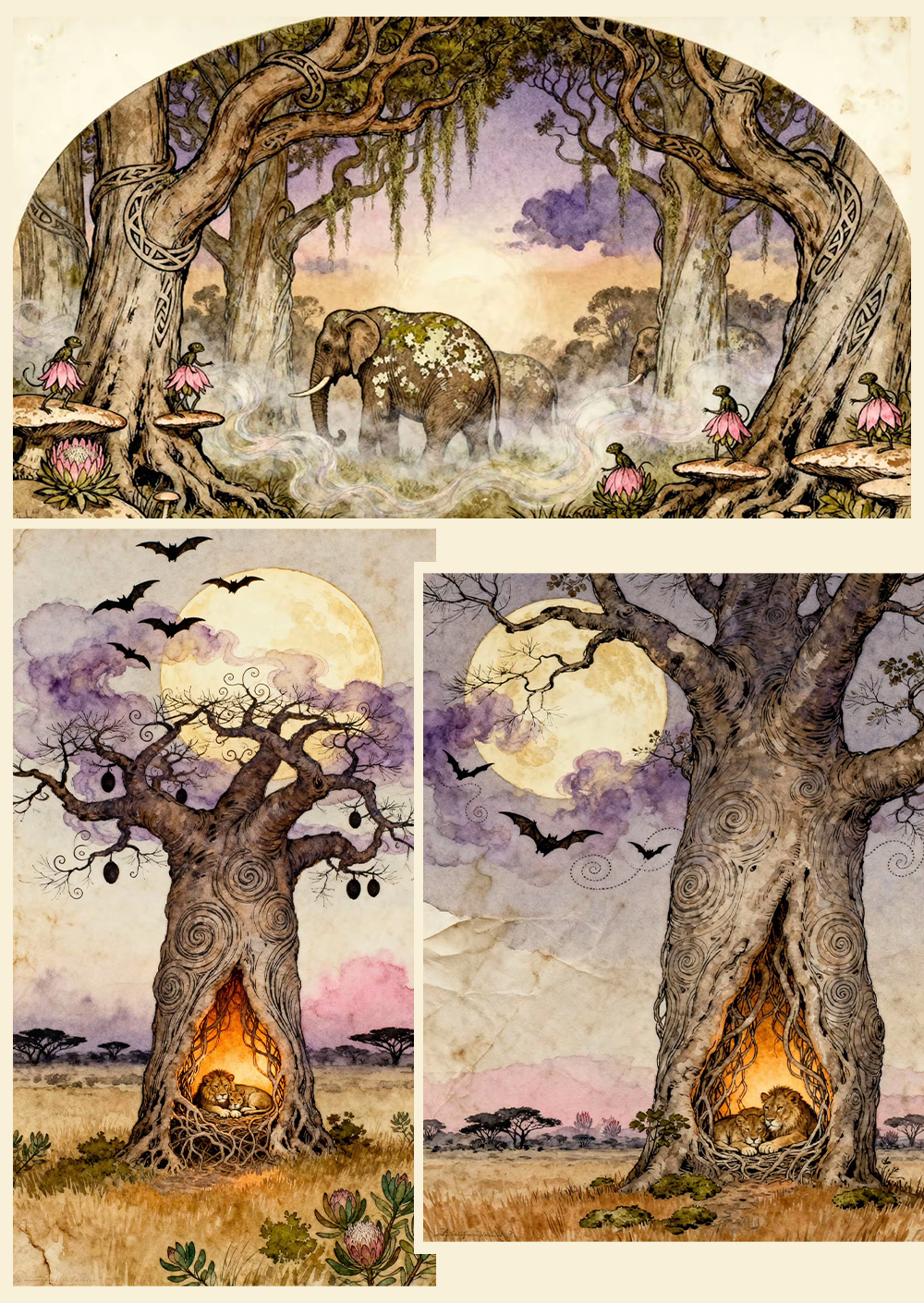
Elephant Chapel
This page deepens the series’ protective register. Elephants move through an arched grove that feels almost ecclesiastical, while flowering forms and curling branches soften the composition into a dream of safe passage. The work suggests a sacred architecture that predates buildings.
Motifs: arched forest • elephants as congregation • floral witness • ecology as chapel
-
![]()
Wave and Hearth
This pairing connects two origins: the oceanic and the terrestrial, the planetary and the intimate. A stylized cosmic wave speaks to immensity and motion, while the lion in the hollow tree returns us to nest, sleep, and embodied shelter. Together they stage a philosophy of Africa as both vast cosmology and immediate home.
Motifs: sea / shelter pairing • cosmic scale • intimate refuge • dual origin-space
-
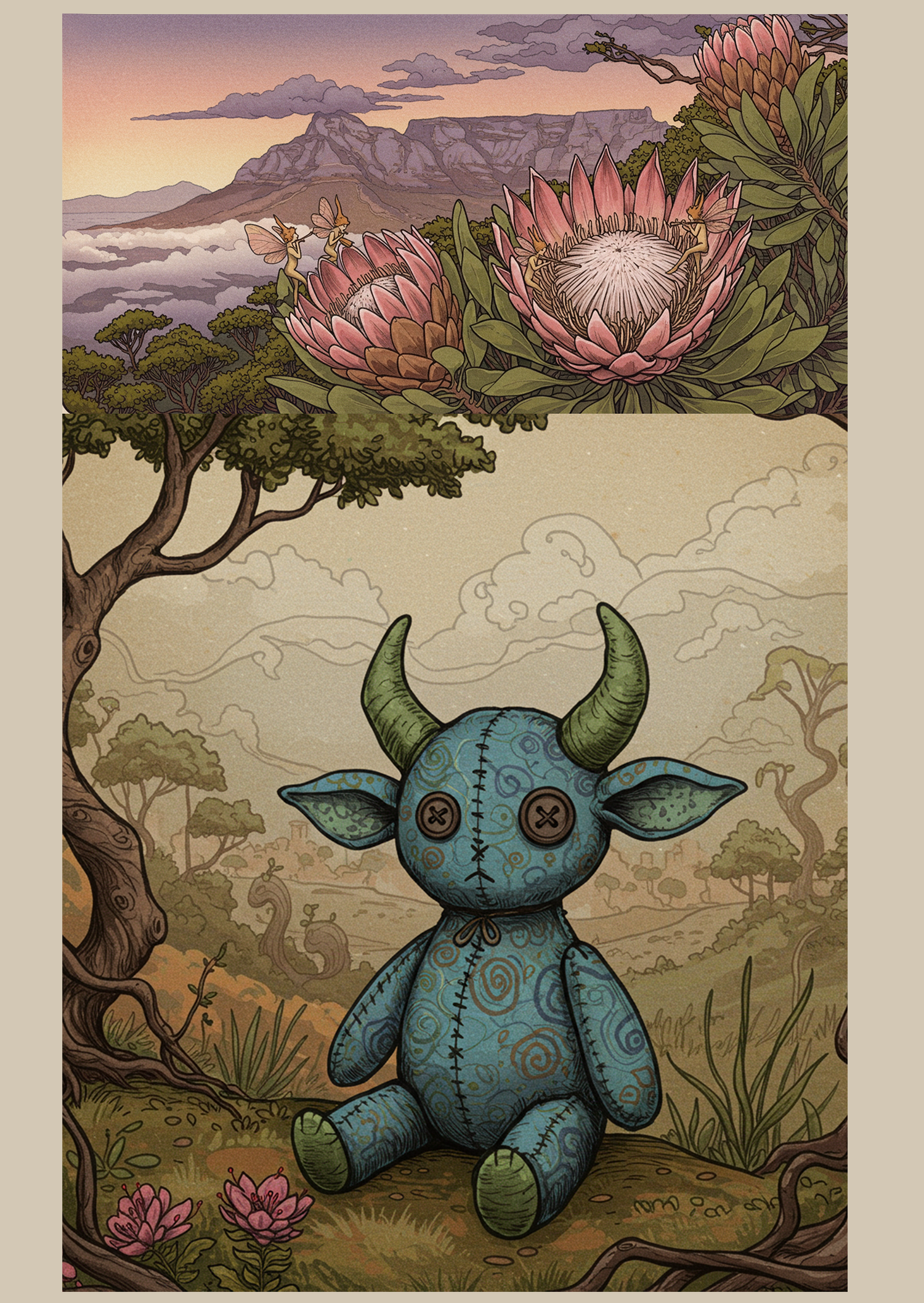
![]()
Protea and Familiar
This page turns toward softness, emblem, and child-facing intimacy. The protea opens as a botanical icon of place, while the horned stitched figure reads like a companion-object, talisman, or emotional surrogate. It broadens the series beyond monumentality into tenderness, showing that mythic world-building can also make room for play and care.
Motifs: protea as emblem • stitched guardian • tenderness • landscape as emotional home
-
![]()
-
![]()
-
![]()